Aim
This demonstration from ShowthePhysics Pols & Dekkers, 2024 introduces students to the ideas of measurement uncertainty.
Subjects
1A20 (Error and Accuracy)
Diagram
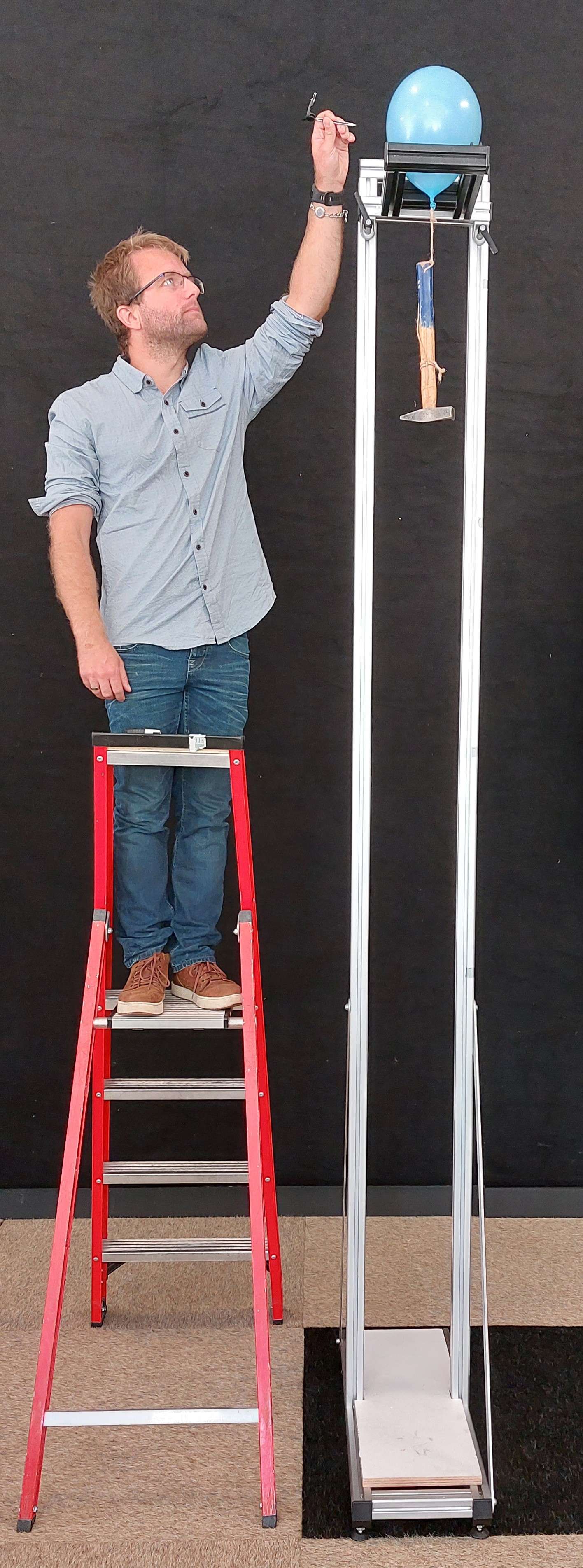
Figure 1:Freek determining the value , the acceleration due to gravity.
Equipment
Balloon
Long ruler
Phone with Phyphox app
Hammer
Rope
Ladder
Awl
Tall tripod
Presentation
Inflate the balloon and hang the hammer from it with a string. Hang the whole setup on the framework and ensure the wooden plank is directly beneath the hammer. Use the acoustic chronometer in the Phyphox app with a threshold value of 0.35 and a delay of ~0.3 s.
Start the demonstration by discussing what an accurate measurement entails and why an accurate value can be important. Explain the experiment: Using a single measurement and the equation, we will determine the gravitational acceleration as accurately as possible. Popping the balloon starts the acoustic chronometer, and the hammer’s BANG on the ground stops the timer.
Is it necessary for a good measurement to have the largest or smallest possible falling height? Are there any conditions on the extreme values you choose?
Where should you hold the phone? At the top, bottom, middle, or does it not matter? Why?
How accurately do we measure the time and height?
Have students brainstorm answers to the questions in pairs, write down the answers, and then invite students to share their answers (think, pair, share).
After measuring the falling height (with an estimate for the uncertainty) and determining the fall time, you can start a discussion about the uncertainty in the time measurement. Is it 1.0 s, 0.1 s, 0.01 s, or 0.001 s? Or is it something in between?
Normally, you determine the uncertainty in time by repeating the experiment, but what numbers do you expect to see when you repeat the measurement? Or said differently: Which decimal digit will likely vary?
By using the code provided below, you can calculate the final value of with its associated uncertainty.
Explanation
Every measurement can only be performed with a certain precision. Sometimes the precision is determined by the equipment, and sometimes by the measured property. In science, the answer is always given with the associated uncertainty, where the chance that a repeated measurement falls within the value with its associated uncertainty is equal to 68% (). When multiple quantities influence the uncertainty, as in the determination of the acceleration due to gravity, each measurement contributes to the uncertainty. The final value of the uncertainty in this equation is given by:
The uncertainty is always given with only one significant figure. The final answer is presented with the same decimal digit (e.g., ).
Remarks
This demonstration is shown in our Introductory Laboratory Course.
- Pols, F., & Dekkers, P. (2024). Show the Physics. TU Delft OPEN Publishing. 10.59490/tb.101