Fakir
Aim
To show an example of non-linear behavior
Subjects
3A95 (Non-Linear Systems)
Diagram
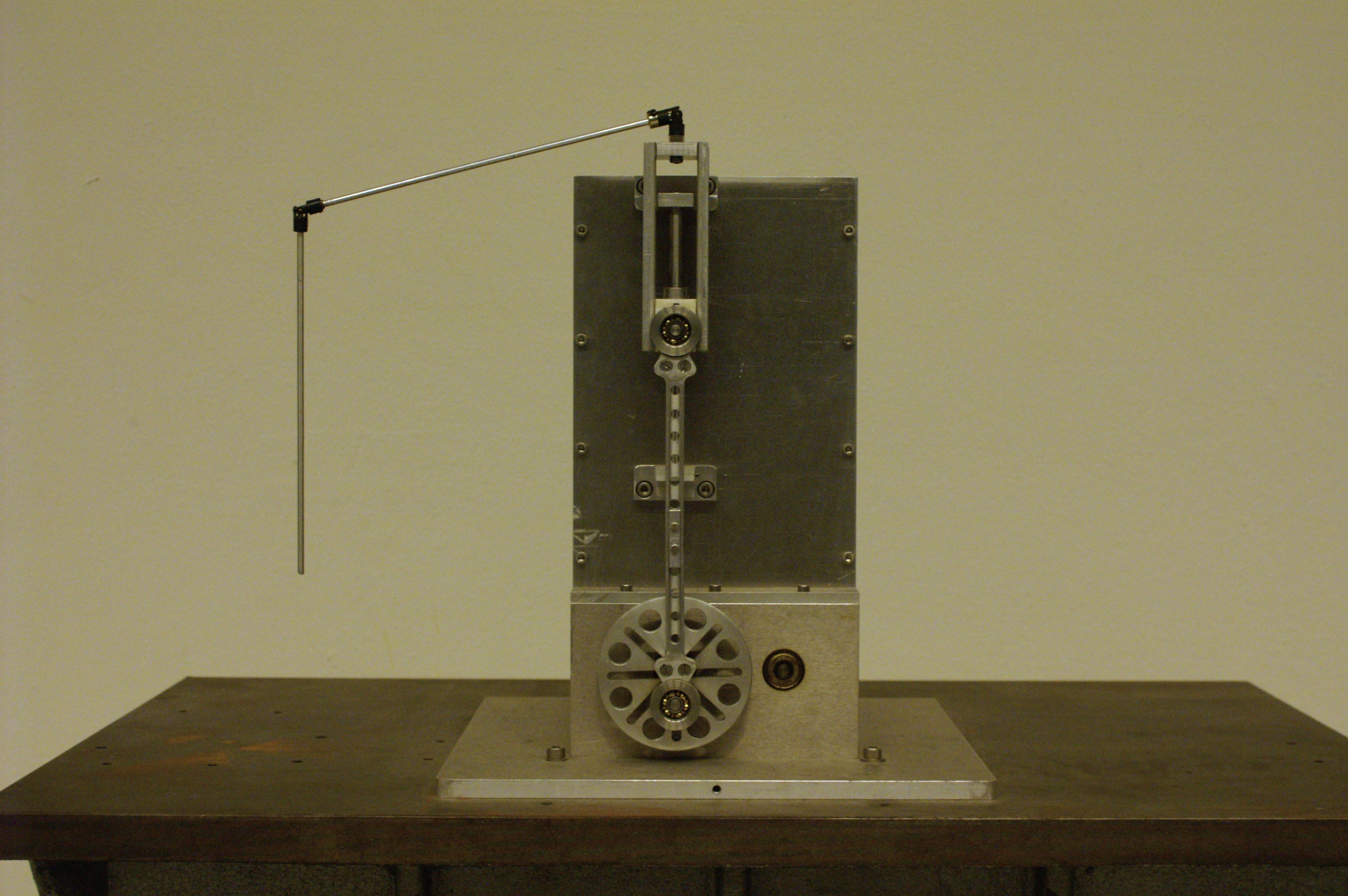
Equipment
Driven upside-down pendulum,
Adjustable dc powersupply (),
1 aluminium rod ),
2 aluminum rods ( ), linked with a cardan- joint,
(3 aluminum rods ( ), linked with two cardan joints).
Presentation
On top of the driver shaft the single aluminum rod is fixed in a cardan joint. The eccentric is adjusted to obtain a drive-amplitude of about . While loosely holding (by hand) the aluminum rod vertically upright above its pivot, the voltage of the powersupply is increased to speed up the electric motor. When the frequency of rotation is high enough ( ), the up and down dancing rod can be left by itself and suprisingly will not fall down!
You can push it off balance by almost and still the rod will not fall. Leaving it, it will dance back up to the vertical again much in the same way as an ordinary downward hanging pendulum moves.
The single aluminum rod is removed from the cardanjoint and replaced by the linked two Al-rods. To get this pendulum balanced upright a higher frequency is needed. When the needed frequency cannot be reached, it is also possible to adjust the eccentric to a higher drive amplitude.
This double upside-down pendulum can be made as stable as the single one.
The same procedure is followed when using the triple pendulum.
Etc.
Explanation
A basic understanding arises when it is realised that the fast moving pivot drags the linkage downwards faster than it would fall normally by gravity alone. When the inverted pendulum is a small angle away from its vertical position, then a torque acts on the pendulum and the pendulum accelerates away from the vertical. Newton’s second law describes the movement: , being the moment of inertia. When the pivot moves with (negative when going upwards), then the pivot’s acceleration is: sinut. Newton’s second law becomes: . When , then the torque is of the restoring type. When is large enough then this is the case during a large part of the downward movement of the pivot. So a restoring torque is possible.
This reduced analysis holds only for very small values of and even then it can be seen that during the largest part of the movement of the pivot, the torque has a positive sign and so the pendulum will fall down. A real understanding can only be obtained when nonlinearity is taken in account (see literature).
Remarks
We don’t demonstrate the triple pendulum very often, because it sometimes happens that the cardan joints cannot withstand the forces that occur when high values are used.
Sources
Acheson, D.J. and Mullin, T., Nature, Vol.366, pag. 215
Butikov, E.I., American Journal of Physics 69(7), july 2001, pag. 755-768
Ehrlich, R., Why Toast Lands Jelly-Side Down: Zen and the Art of Physics Demonstrations, pag. 134
Stephenson, A., Memoirs and proceedings of Manch. Lit. and Phil. Soc., part 52(8), pag. 1-10