Aim
To show a traveling wave and the inverse relationship between frequency and wavelength.
Subjects
3B10 (Transverse Pulses and Waves)
Diagram
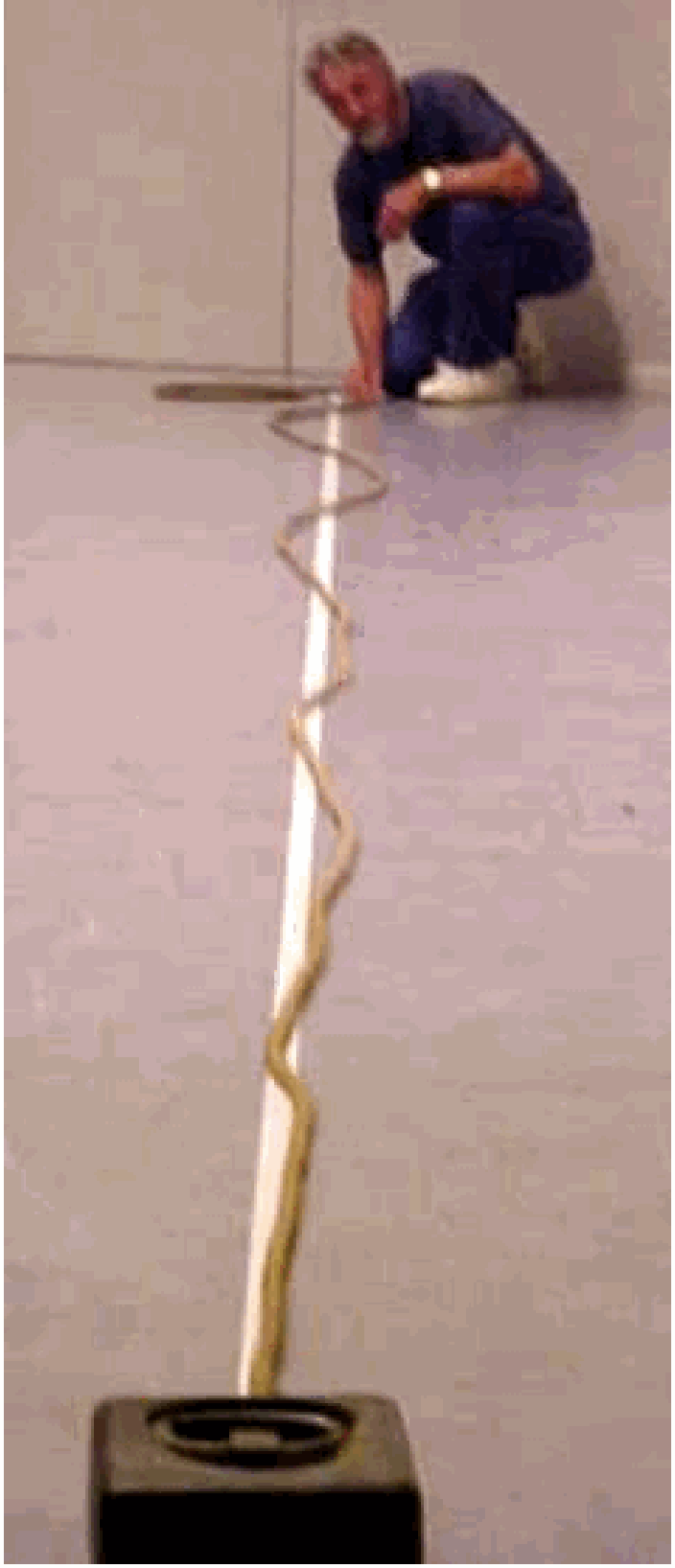
Equipment
Heavy rubber hose ().
Heavy weight ().
Tape.
Camera.
Projector.
Presentation
Lay the hose in a straight line on the floor at the front of the lecture room, marking its position with tape. Secure one end of the hose using the heavy weight.
Next, generate a sine wave by shaking the free end of the hose vigorously in a horizontal direction. Adjust the tension and amplitude so that the wave amplitude is damped to zero by the time it reaches the fixed end of the hose. This eliminates the need to consider reflections.
The traveling wave can then be clearly observed, illustrating why it is called a “traveling wave.” By shaking the end of the hose at different frequencies, you can demonstrate the inverse relationship between frequency and wavelength.
Remarks
To get a “nice” wave make sure that you drive the rubber hose at the same amount of amplitude at both sides of the taped line. Practicing before demonstrating is necessary.
To get a good view of the traveling wave, a camera is placed at the fixed end, so that a picture can be projected by the Projector as shown in the Diagram.
Sources
Ehrlich, Robert, Turning the World Inside Out and 174 Other Simple Physics Demonstrations, pag. 126
Friedrich, Artur, Handbuch der experimentellen Schulphysik, part 1, Schwindungen, Wellen, Schall, Ultraschall, pag. 74
Mansfield, M and O’Sullivan, C., Understanding physics, pag. 307-310