Aim
To show how the voltage of a charged capacitor changes when changing the dielectric.
Subjects
5C20 (Dielectric) 5C30 (Energy stored in a capacitor)
Diagram
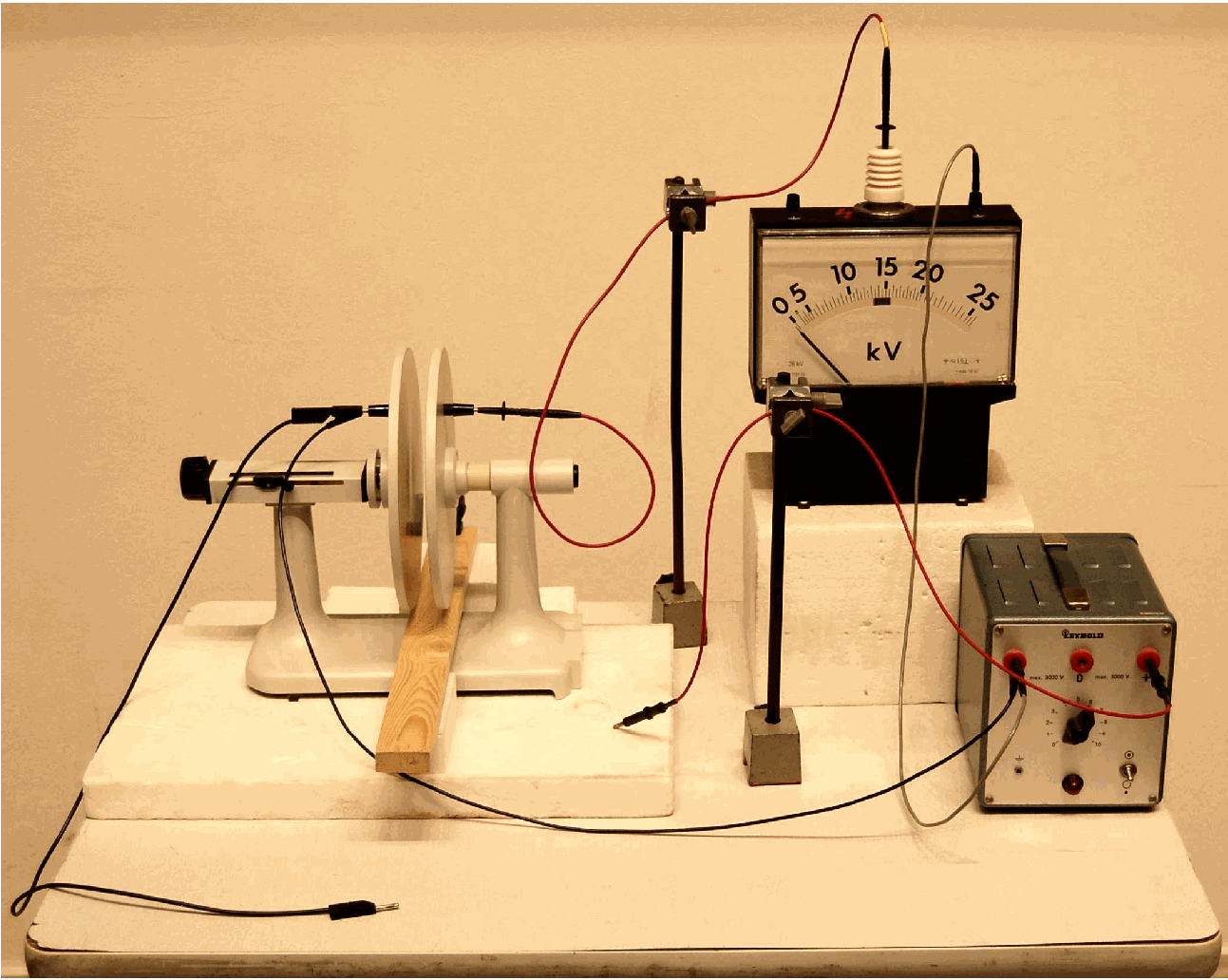
Equipment
Parallel plate capacitor.
Piece of isolating foam between the plate capacitor and table.
Electrostatic voltmeter, .
Glass plate, thickness .
Perspex container, , filled with demineralized water.
Wooden bar as a guiding construction (very well visible in Figure 3).
Power supply, (see Safety). For the demonstration it is better to use a power supply, set at
Use connection leads with Teflon isolation.
Electric heater (to prevent that moisture spoils the demonstration).
Safety
The power supply has passive current limitation, ensuring that no dangerous contact voltage can occur*. Nevertheless be careful, because when you accidentally touch the high, you probably make a spastic movement, and you may hurt yourself (or somebody else).
In accordance with IEC 61010-1 (Safety requirements for electrical equipment):
a part is not deemed to be live (i.e. carrying a dangerous contact voltage) when, at voltages greater than extra-low voltage (> DC), the current through an induction-free resistance of is not greater than for DC, additionally, the charge for voltages up to is less than , and the stored energy does not exceed for voltages over .
Presentation
The setup of the demonstration is explained to the students. The plates are set at such a separation that just a little bit larger than the thickness of the glass-plate. The power supply is set at .
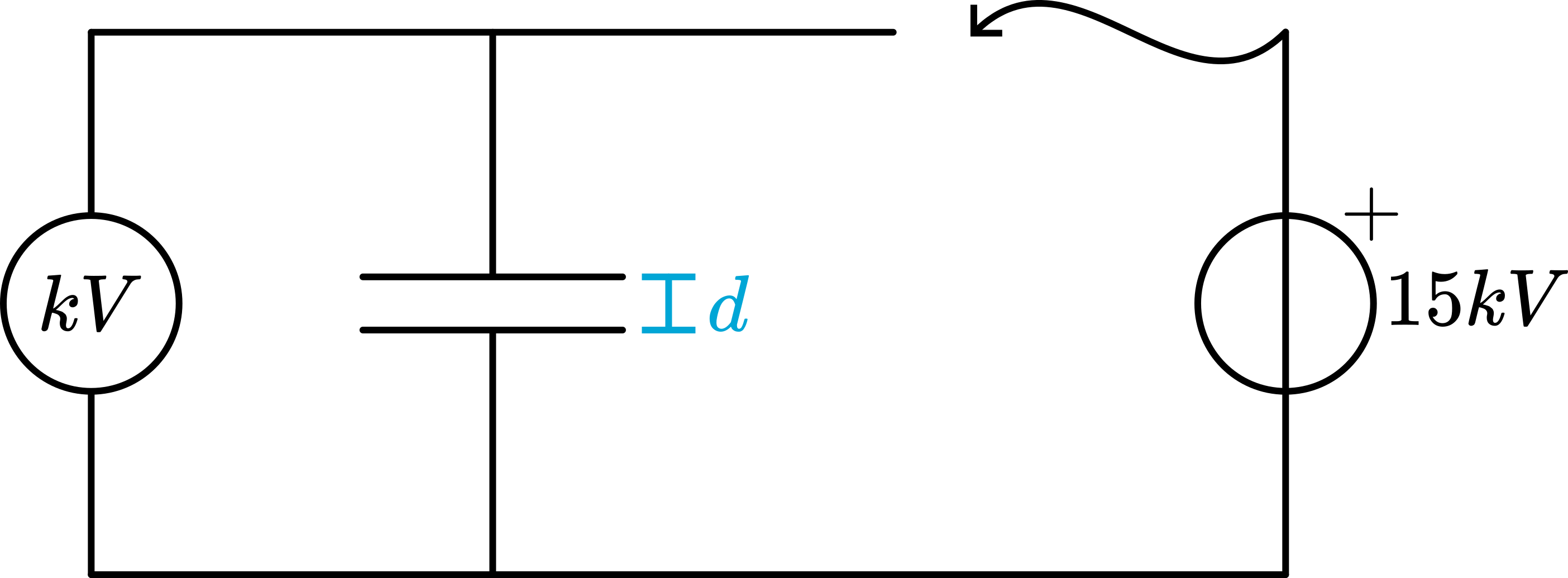
The capacitor is charged by shortly touching the capacitor with the free lead of the power supply (see Figure 2). After this charging of the capacitor, the voltmeter reads .
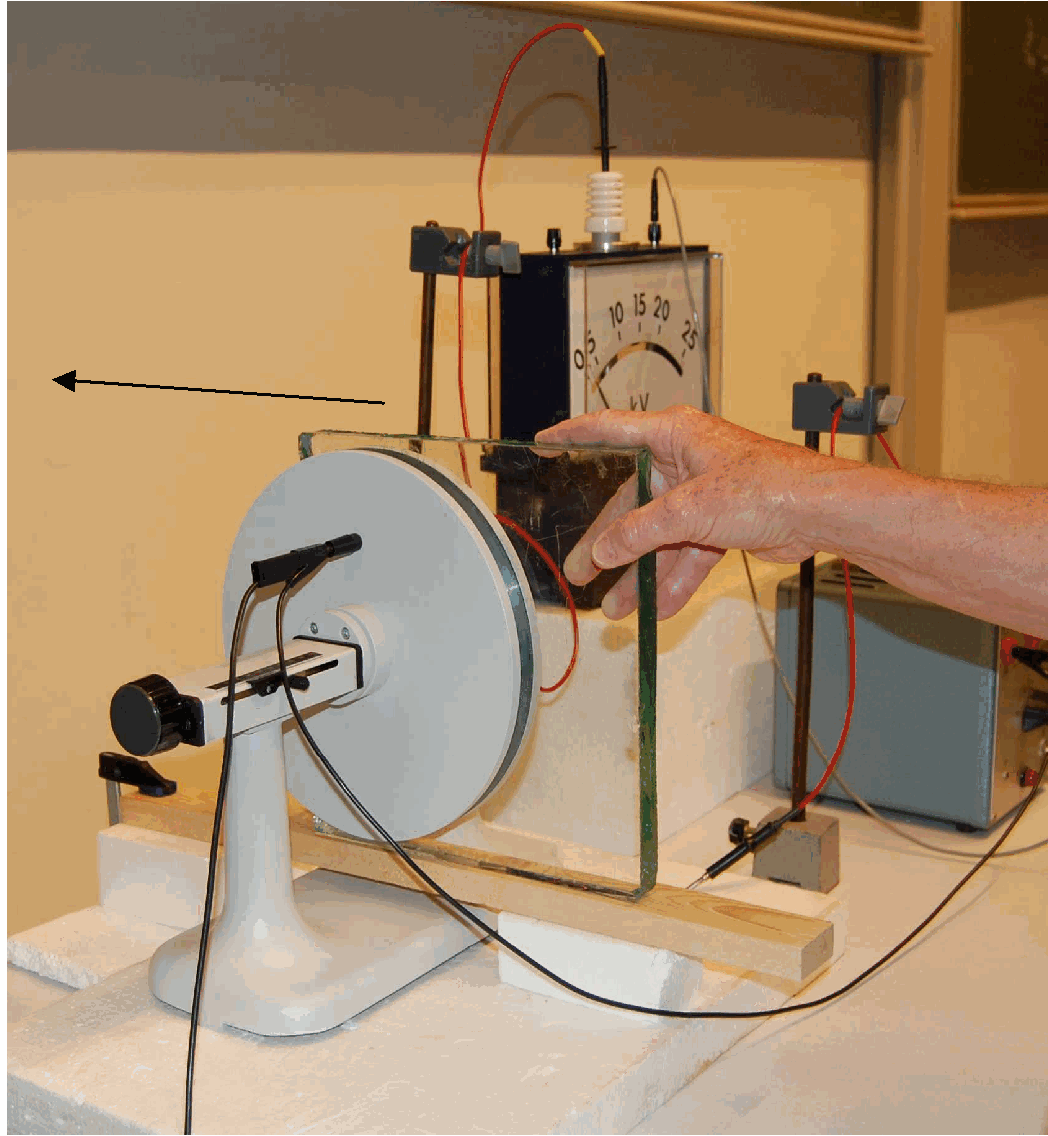
The students are asked what will happen to the voltage of a charged capacitor when the glass plate is shifted between the plates (see Figure 3). After their answers shift the glass between the capacitor plates. They will see that the voltage lowers. Shift carefully all the time, with the glass plate sliding along the grounded plate of the capacitor, so the glass plate does not touch the high voltage positive plate!
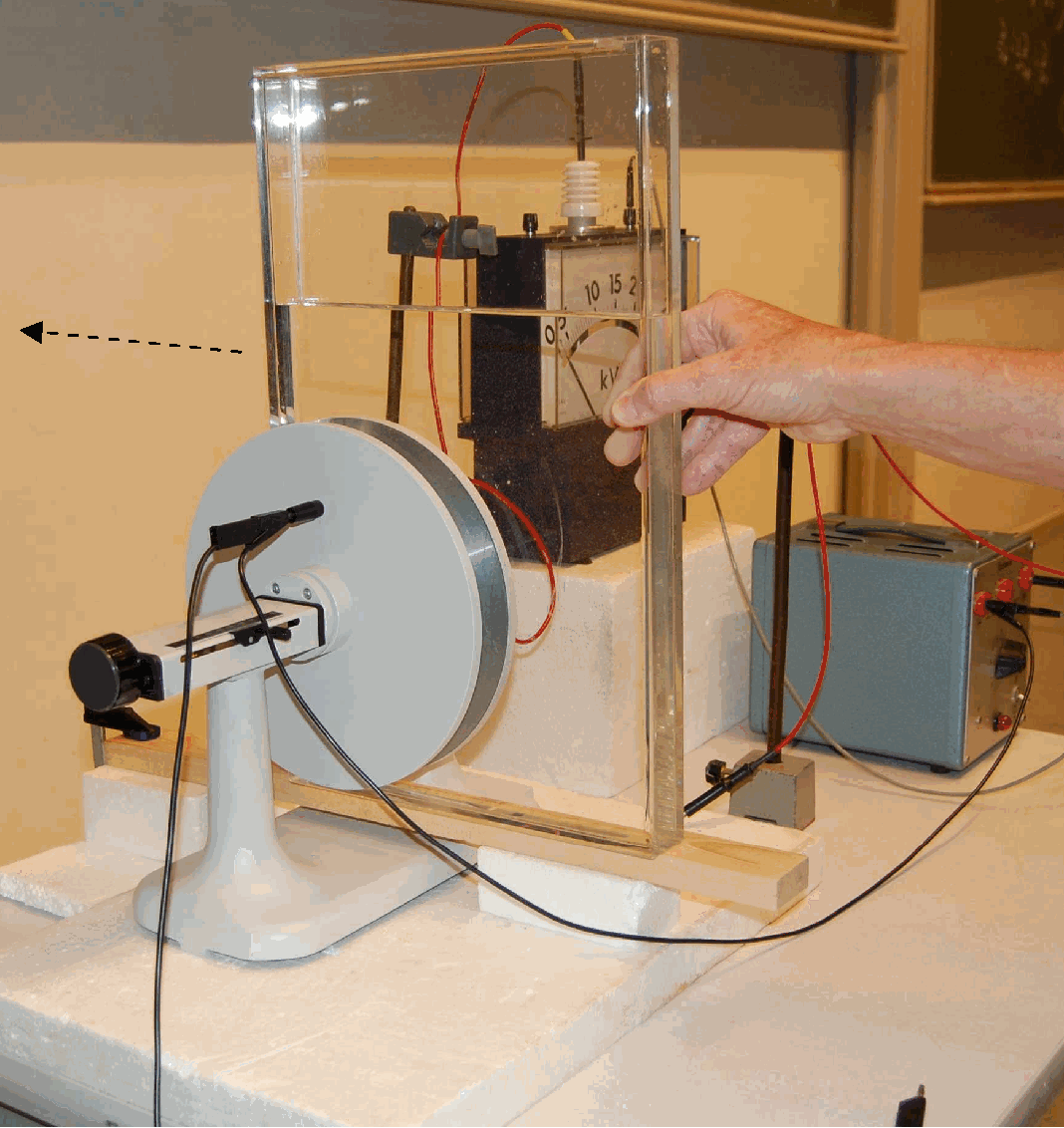
Removing the glass plate will increase the voltage again to its original value of . The same experiment is performed with the container filled with water (see Figure 4).
Explanation
Explanation 1:
The demonstration shows that the voltage lowers when a dielectric is shifted between the capacitor plates. Voltage is the energy per unit charge, so we can say that the potential energy of the capacitor lowers. Where is this energy gone? It was needed to polarize the dielectric! The “lost” energy is now in the polarized dipoles of the dielectric.
In the same way the energy stored in the capacitor becomes higher when the dielectric is removed. Also the demonstrator has to pull now because there is an attracting force between the induced charge on the dielectric and the plates. So he adds energy to the capacitor.
Explanation 2:
When the dielectric is between the plates, increases ( ) because becomes higher, and since is constant this will cause to decrease .
(This explanation is just mathematics and no physics.)
Especially when water is the dielectric the voltage should lower dramatically, since of water is around 80 !
Remarks
In the explanation of the demonstration it is supposed that the charge on the capacitor is constant. This is true only if the capacitance of the electrostatic voltmeter is small compared to that of the parallel plate capacitor. Capacitor (2) Different dielectrics
Sources
Mansfield, M and O’Sullivan, C., Understanding physics, pag. 455-458.
Giancoli, D.G., Physics for scientists and engineers with modern physics, pag. 621-625.