Aim
To show an apparent violation of the second law of thermodynamics
Subjects
4F10 (Entropy)
Diagram
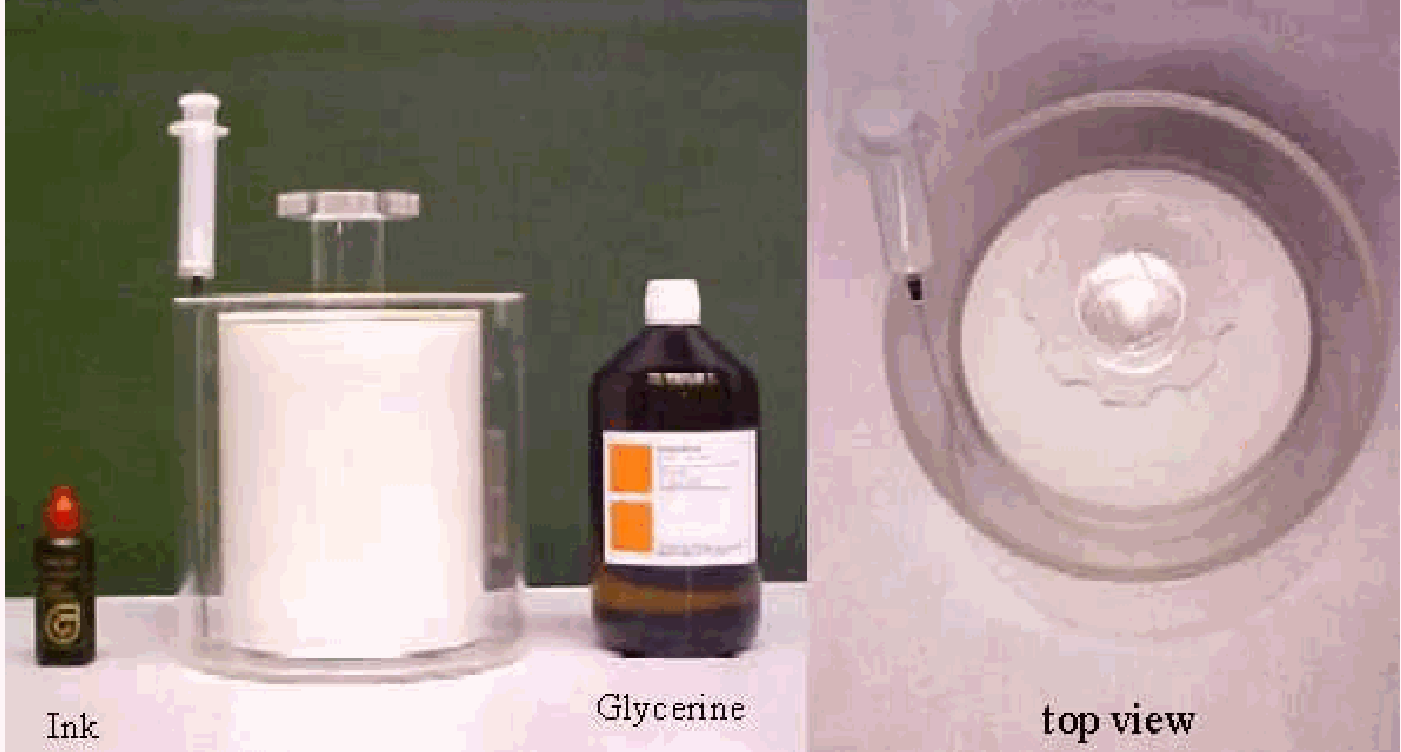
Equipment
Petri dish.
Transparent oil (e.g. sunflower oil).
Transparent cylinder, containing a second, white cylinder inside that can turn around the common axis.
Glycerine.
Syringe with long needle.
Red ink.
Presentation
As an introduction a Petri dish is placed on the overhead projector. The dish contains a layer of (transparent) oil. By means of the syringe a large drop of dark ink is spouted into the oil (see Figure 2 a). Using a flat spatula one rotation is made in the fluid. The drop of dark ink breaks into smaller drops (Figure 2 B).
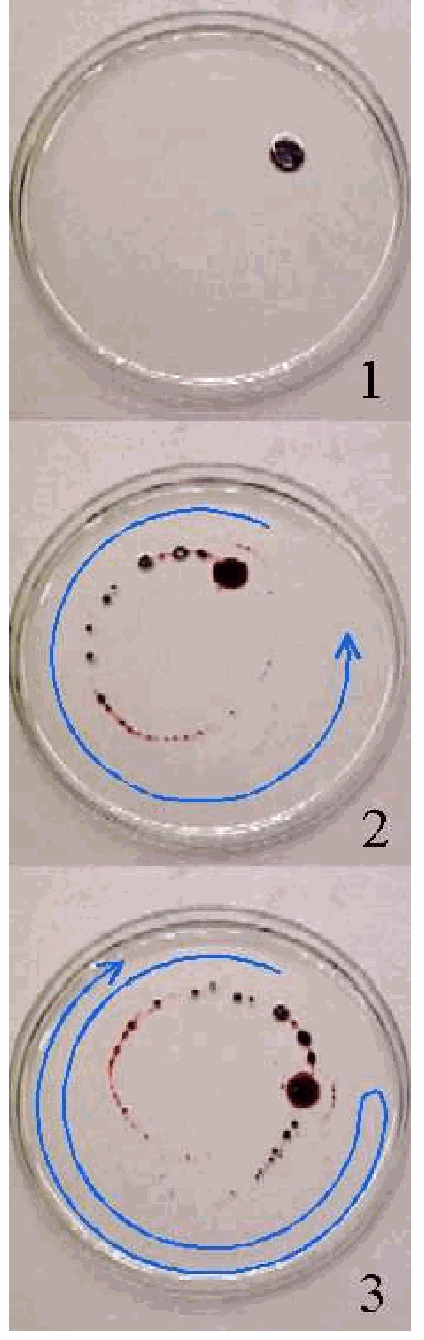
Now it is suggested to the students to turn the spatula in the liquid into the opposite direction, in order to repair the original drop of ink. This action is performed, but the result is that still more destruction is done to the inkdrops (Figure 2 C).
Next the experiment with the plastic cylinder (see Diagram) is done:
The space between the two concentric cylinders is filled with glycerine. A column of ink is inserted into the glycerine using a syringe with a long needle. The inner cylinder is rotated one turn. It now appears that the ink is mixed with the glycerine. However, when a reverse turn is made, the column of ink reforms!
The experiment can be repeated with even making more turns: the column reforms when the same number of reverse turns is made.
Explanation
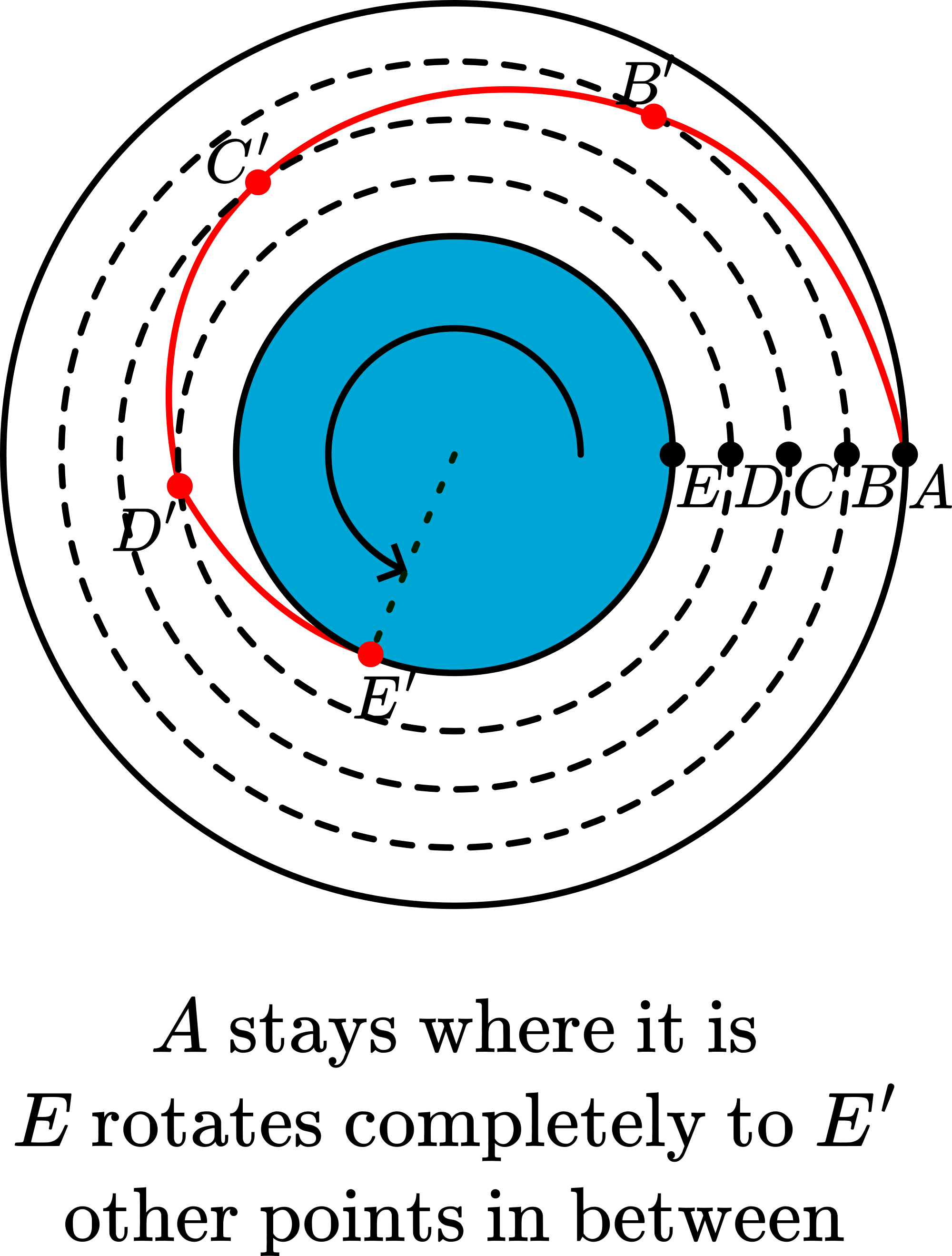
Although it looks like it, the law of entropy is not violated. The spreading out of the ink does not represent any increase in entropy or disorder. An enlarged top view of the space between the two cylinders (see Figure 3) shows that molecules on the inner edge of the liquid rotate through angles different from those in the middle or outer edge. There is only a laminar displacement; no mixing occurs. The original vertical line is restored when the rotation is reversed.
Remarks
When the glycerine is too fluid it is advised to refrigerate the system before using it.
The inner cylinder is constructed heavy enough to prevent it will float in the glycerine.
Sources
Ehrlich, Robert, Turning the World Inside Out and 174 Other Simple Physics Demonstrations, pag. 124-125
Freier, George D. and Anderson, Frances J., A demonstration handbook for physics, pag. H31
Mansfield, M and O’Sullivan, C., Understanding physics, pag. 290