Aim
To show and explain why it is needed to transport electric power at high voltages.
Subjects
5K30 (Transformers)
Diagram
Equipment
-source.
Lamp,
NiCr-wire; : ; two lengths of each.
4 insulated clamps to mount wires to standing posts.
2 transformers, .
Multi scale voltmeter, large display.
Presentation
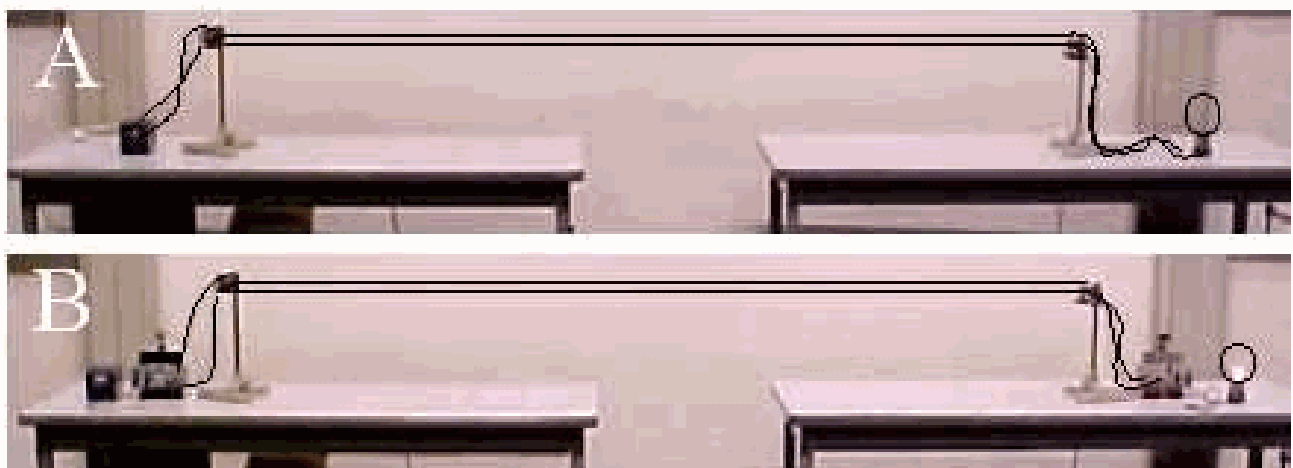
First it is shown that the glows brightly when connected to the power supply. The demonstration is set up as shown in Diagram and Figure 2 A. Tell the students that in order to simulate a long distance between the power supply and the lamp resistance wire is used between them.
The power supply is switched on, but the lamp shows no light. Using the voltmeter it is seen that there is no voltage across the lamp. Sliding the leads of the voltmeter along the long wires shows that all the voltage of the power supply is lost in these wires. The two identical transformers are connected into the circuit (see Figure 2 B). The power supply is switched on and the lamp lights brightly!
Explanation
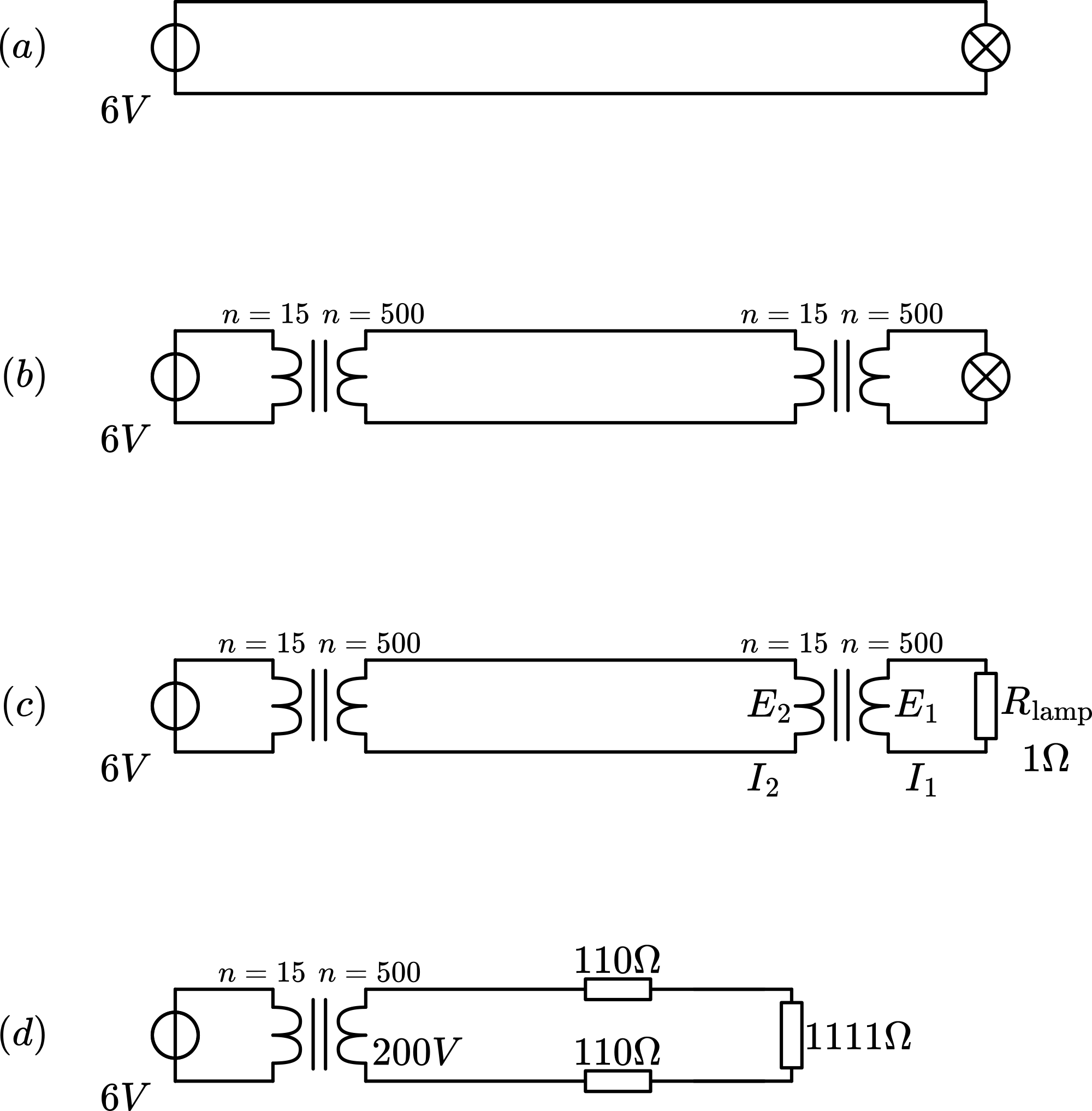
In the first part of the demonstration almost all power is lost in the long wires, because of the high resistance of these wires compared to the resistance-value of the lamp. In the second part of the demonstration, the first transformer steps the up to (using the voltmeter this can be checked). To transport power at such a higher voltage a much lower current is needed; the current in the “long” wires is now times lower than in part A of the demonstration. Then the power lost in these wires is times lower; the power loss in the transport wires is reduced more than a factor 1000! To calculate exactly we have to consider Figure 2 C.
The lamp has a resistance of about . Since and , we find . This results in that ‘sees’ as .
Figure 2 D explains the rest: The of the power supply is transformed by the first transformer to 200 V. Considering the resistance values, remains at the second transformer. This second transformer steps this voltage down to . This is enough to make the lamp glow.
Remarks
Take care with the in the second part of the demonstration.
If relevant, you can show that a bird is safe on such a high-voltage transmission line. Just grab one lead and hold it. Nothing happens. There will happen only something when you grab also the other lead by your other hand (do not try this!).
Sources
Mansfield, M and O’Sullivan, C., Understanding physics, pag. 527-529