Aim
To show the influence of the distance on the work done by a constant force.
Subjects
1M10 (Work)
Diagram
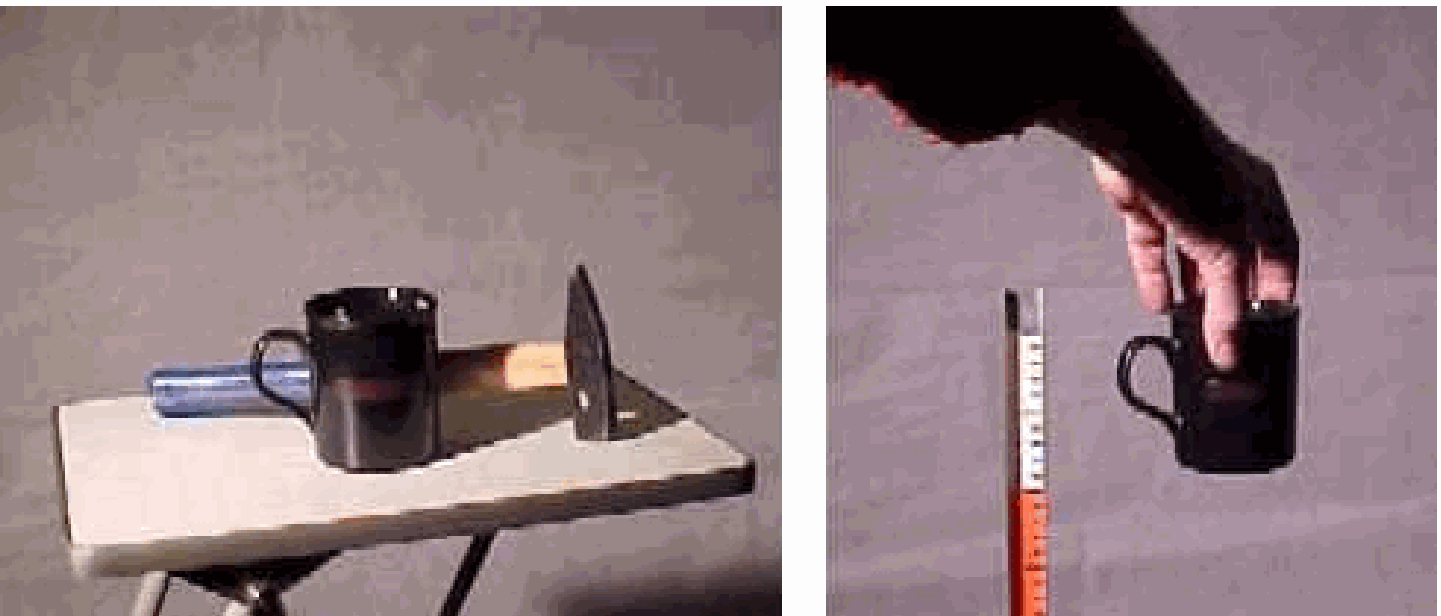
Equipment
Two identical soup-tureens.(Instead of soup-tureens also cheaper coffee-mugs can be used, or whatever ceramic object you prefer.)
Hammer.
Meterstick.
Presentation
Take hammer and soup-tureen and knock the soup-tureen in one blow to pieces. Then ask the students how much work it took to do this. Probably they will have no idea. Then the demonstration is performed in a controlled way:
First place the soup-tureen on the balance to determine its weight (). Then drop the soup-tureen on the ground from about 10cm height: The soup-tureen will survive. Next, repeating the demonstration, increase the height of fall in regular steps until the soup-tureen breaks.
Clearly the distance traveled by the constant force () determines the work on the soup-tureen.
In this way we strengthen the idea that it makes sense that the work done by a constant force depends on the distance, an idea that is rather intuitive at the outset.
Explanation
From the first demonstration it is clear that a certain amount of work is needed to break the soup-tureen.
In the second demonstration the force on the soup-tureen during the fall equals , and during the fall this force is constant. The only variable in the demonstration is the distance of fall. So this demonstration illustrates that the amount of work, which is dissipated in the soup-tureen when it hits the ground, depends on the distance traveled: A certain distance has to be traveled to equal the effect of the blow of the hammer.
Using and and (coffeemug), we find .
Remarks
Take care that in all demonstrations you drop the object in the same way, so that it will hit the ground in the same way. The way the ceramic object hits the ground depends on its orientation just before ground contact. (We make it fall bottom down.)