Aim
To show an example where the concept ‘impulse’ explains the phenomenon.
Subjects
1N10 (Impulse and Thrust)
Diagram
Equipment
Cover glass (we use ).
Wooden block (we use 7×3.5×2 cm).
Overhead projector.
Presentation
Preparation
The glass of the overhead projector and the cover glass are cleaned and polished.
Presentation
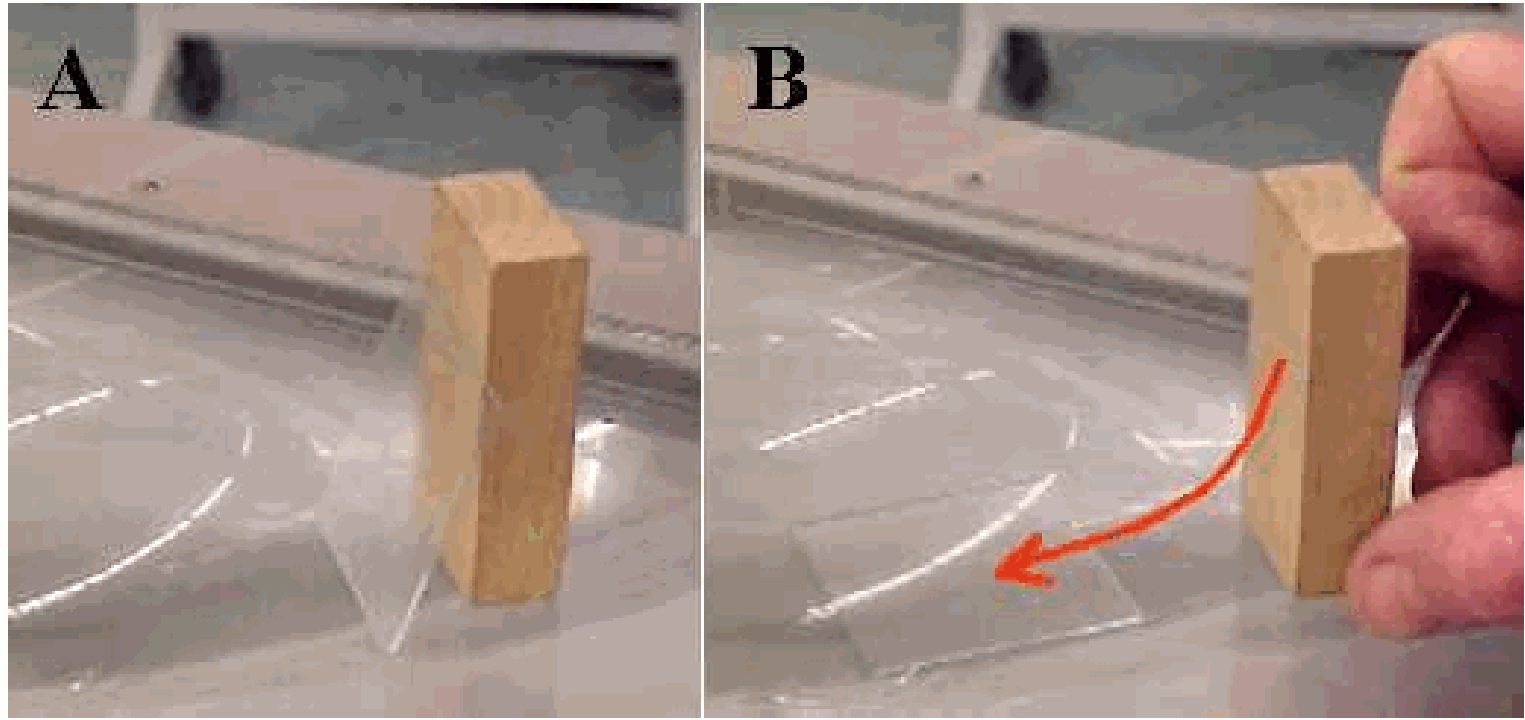
The cover glass rests against the wooden block (see Figure 1 A). By hand, the inclination of the cover glass is decreased by pulling the wooden block very slowly to the right (see Figure 1 B). At a certain moment the cover glass starts sliding: It moves downwards and away from the wooden block. Pose the question to the students: “What makes the cover glass move away from the wooden block?”
Explanation
During the sliding movement, five forces are acting: The weight , the normal forces and and the friction forces in and (see Figure 2; the friction forces are neglected).
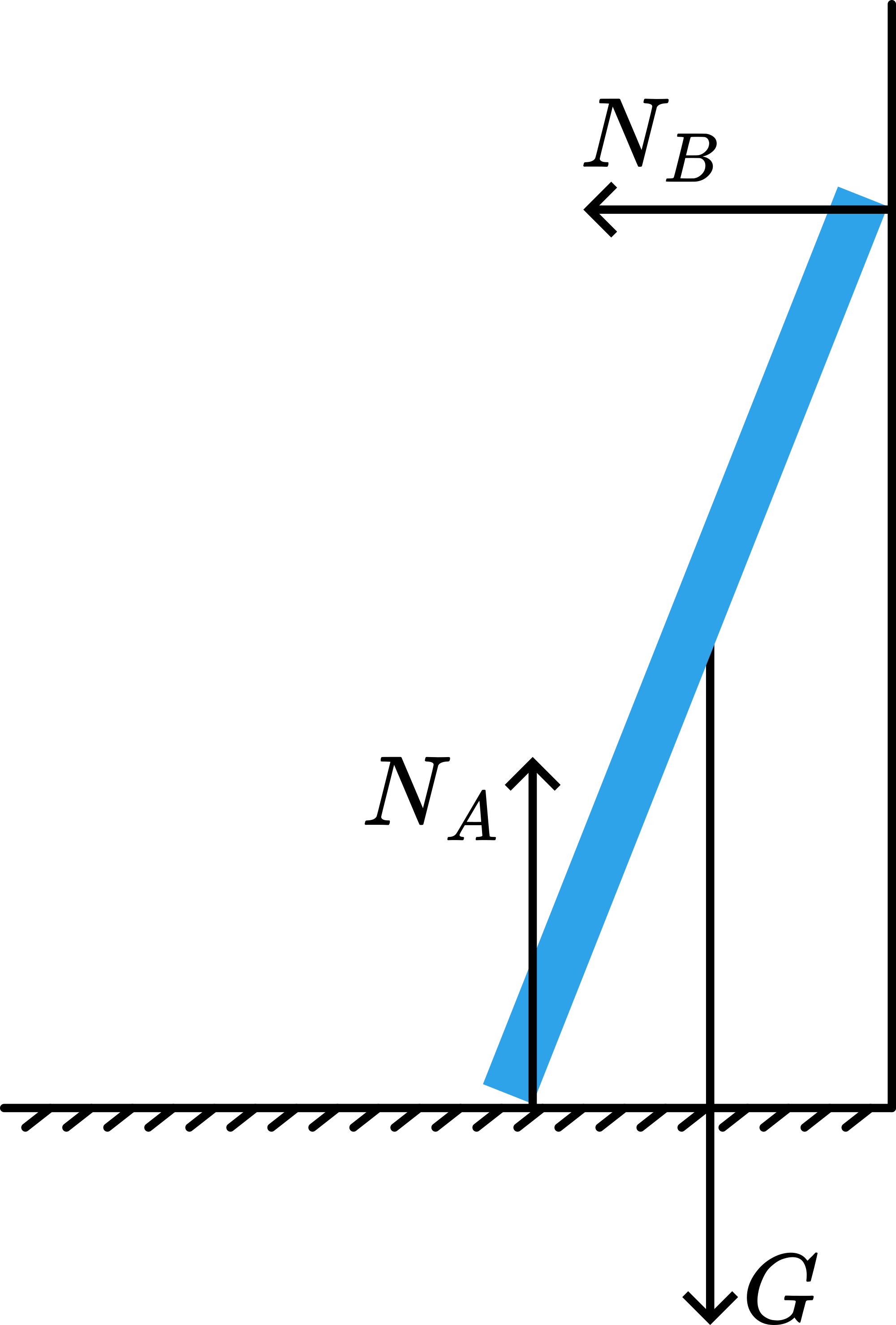
At a certain moment in the movement, leaves the wooden block. This is only possible if the cover glass has a component in its velocity that is directed to the left and correspondingly a momentum to the left. The only force directed to the left is . itself is not moving to the left, but gives the cover glass an impulse to the left equal to , being the time that slides the vertical wall. (Will the cover glass leave the vertical wall before point hits the ground?)
After some time the movement to the left stops due to friction forces between the horizontally sliding cover glass and the glass of the overhead projector.
Remarks
Notice that the force does no work!
This demonstration can be easily performed in a simulation program. The advantage then is that the friction on the ground can be made zero and the ladder (cover glass) will continue moving over the ground. Such a simulation is a useful follow-up of the demonstration in our real world. Also the question raised in the Explanation about the sliding point B can be answered by observing the movement of point B in that simulation.
Sources
Borghouts, A.N., Inleiding in de Mechanica, pag. 92
Mansfield, M and O’Sullivan, C., Understanding physics, pag. 123
Young, H.D. and Freeman, R.A., University Physics, pag. 228-229