Aim
To explore the conservation of momentum in inelastic collisions.
Subjects
1N20 (Conservation of Linear Momentum)
Diagram
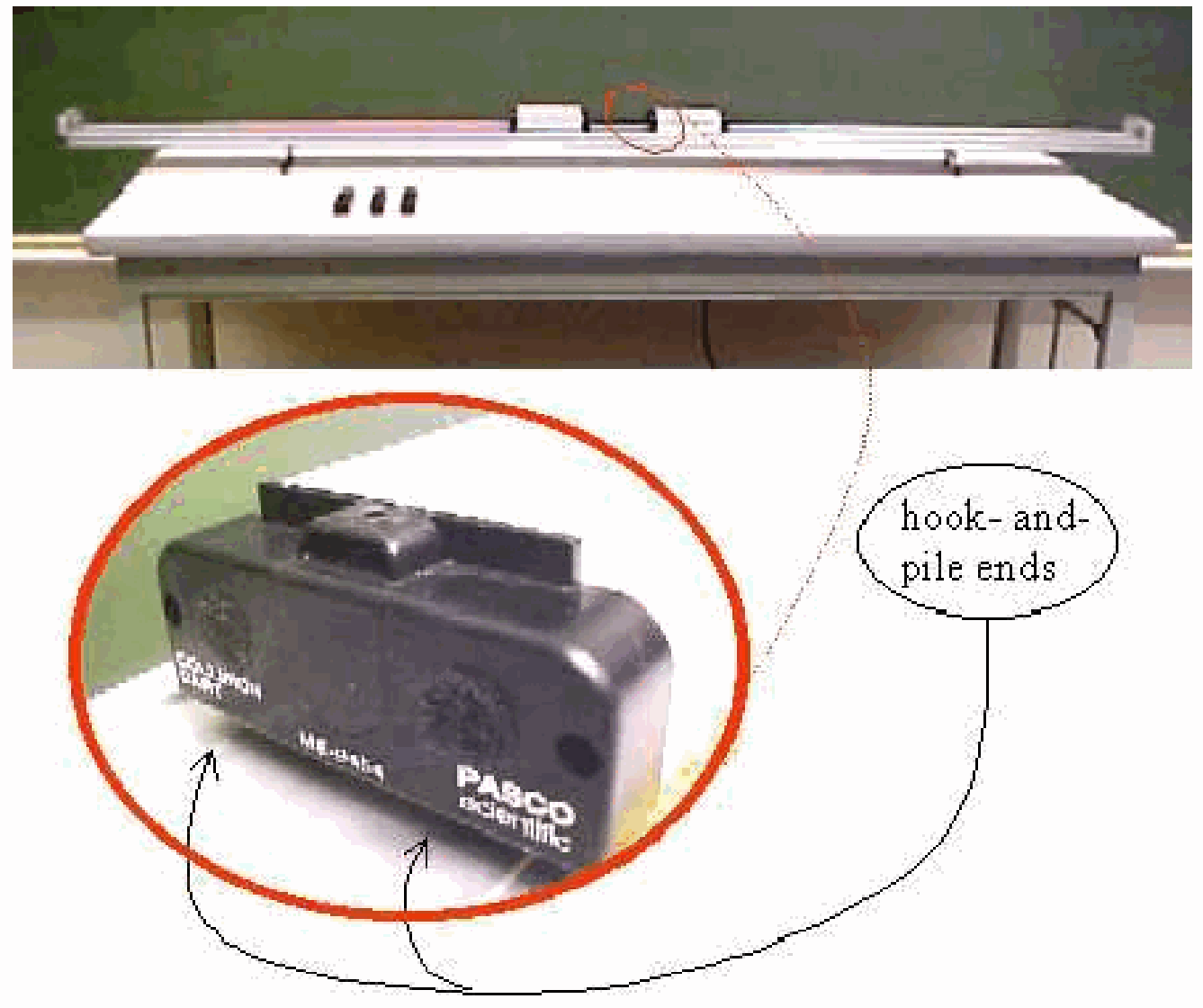
Equipment
Collision cart.
Dynamic cart.
Masses for carts.
Cart track, , with end-stops.
Mass balance.
Presentation
The cart track is carefully levelled (by setting a cart on the track to see which way it rolls). Both carts have hook-and-pile ends (not magnets!) so they stick together after collision.
Place both carts at the track ends and give them by hand a low equal speed toward each other. (It is surprisingly easy to make the two speeds roughly the same by moving your hands in mirror image motions.) In the middle of the track both carts collide and stop.
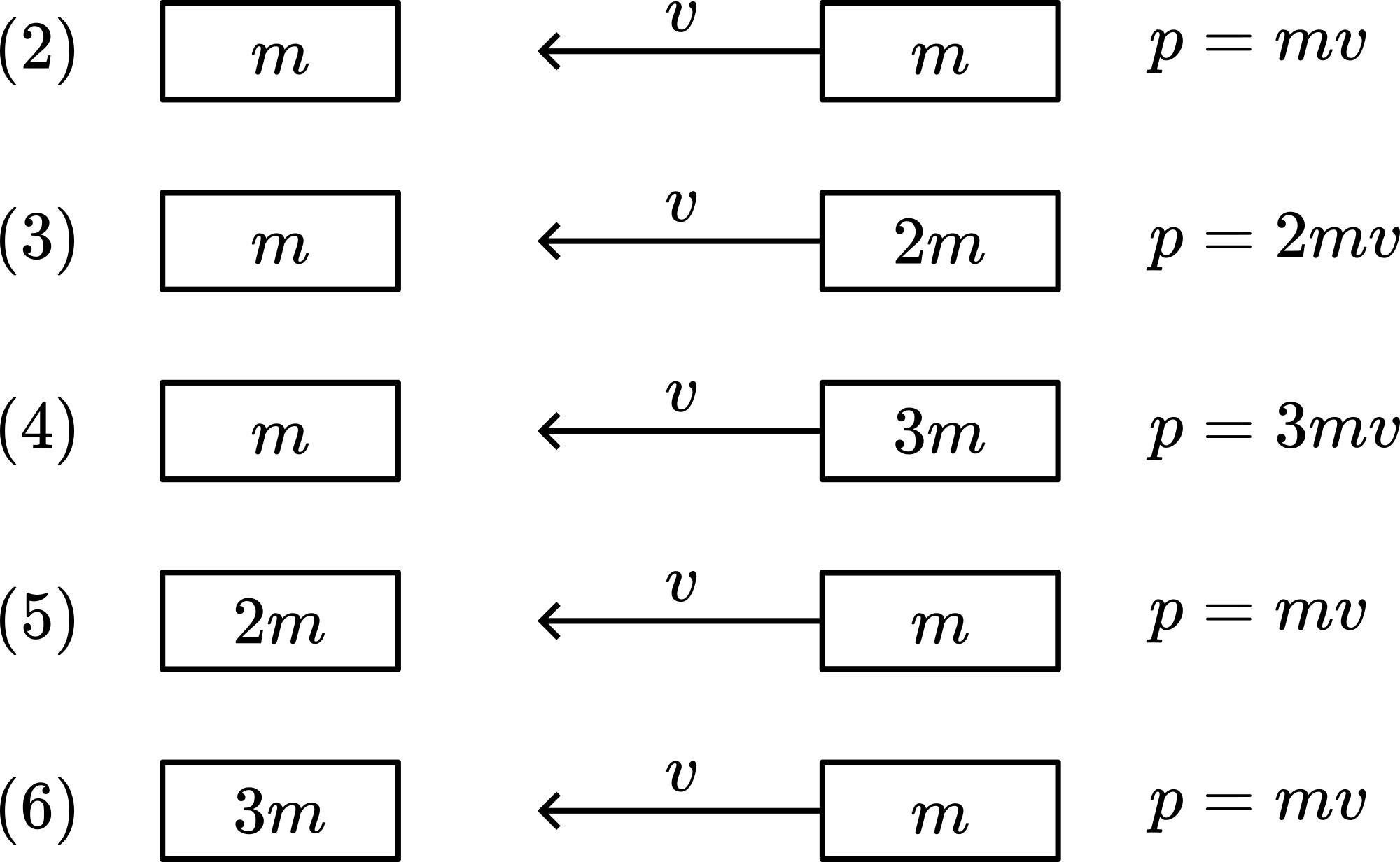
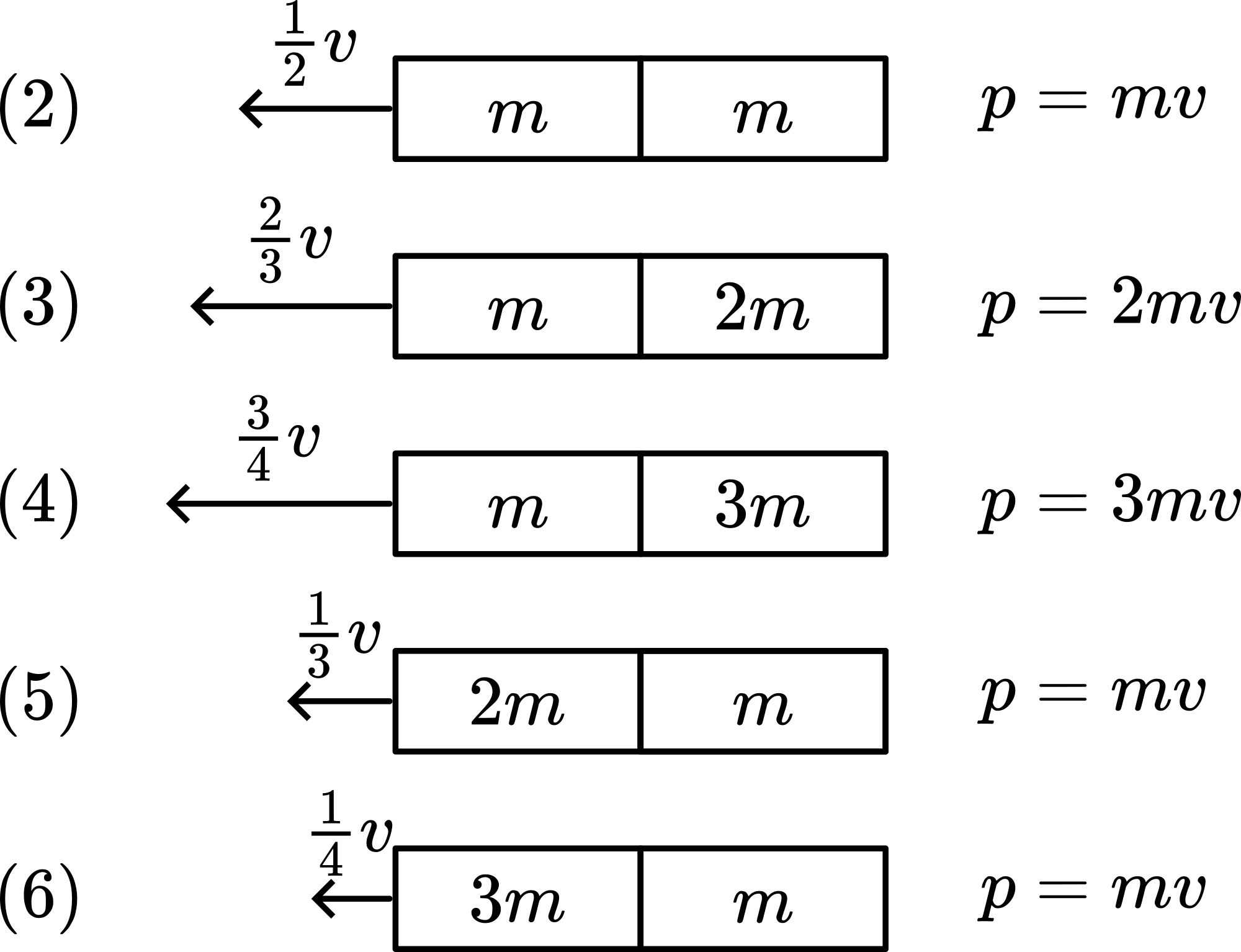
One cart stands at rest in the middle of the track. The other cart approaches at a certain speed (). After collision, both carts together move at a lower speed ().
One cart stands at rest in the middle. The other cart has mass added to it () and approaches at a certain speed (). After collision, both carts together move on. The speed is reduced a little.
As 3, but now a -cart approaches. After collision, both carts together move on. The speed is hardly changed.
The -cart stands at rest in the middle of the track. The other cart (m) approaches at a certain speed (v). After collision, both carts stick together and move on at a much lower speed.
As 5, but now with a -cart in the middle. After collision, both carts stick together and hardly move any longer.
Explanation
In presentation 1, the total momentum equals zero and remains so after the collision. In presentations 2 to 6, conservation of momentum leads to the diagrams shown in Figure 2 (before collision) and Figure 3 (after collision).
Video Rhett Allain
Video embedded from https://
Sources
Mansfield, M and O’Sullivan, C., Understanding physics, pag. 126-128
PASCO scientific, Instruction Manual and Experiment Guide, pag. ME-9458