Aim
A qualitative demonstration of the parallel axis theorem.
Subjects
1Q10 (Momentum of Inertia)
Diagram
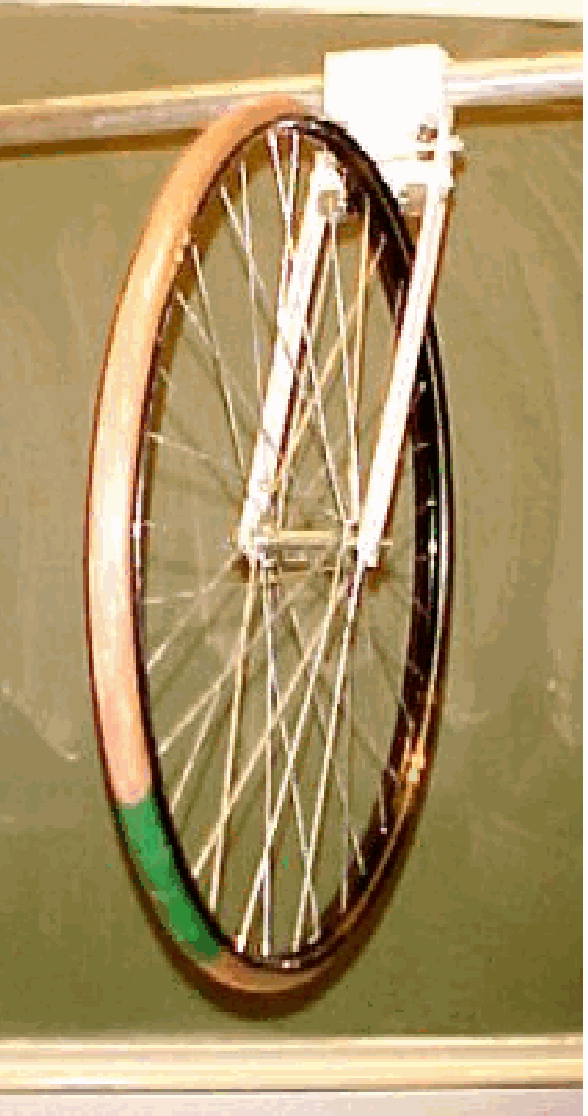
Equipment
Bicycle wheel with leaded rim.
Suspension-bracket with blocking-nuts.
Large frame to suspend the bracket and bicycle wheel.
Presentation
The wheel is free to rotate about its axis. Then the wheel is swung as a pendulum. The period of oscillation is noted. (It can also be shown that the period is independent of the speed of rotation of the wheel.) Now the wheel is fixed by turning the nuts in the bracket holding the wheel rim (see Figure 2).
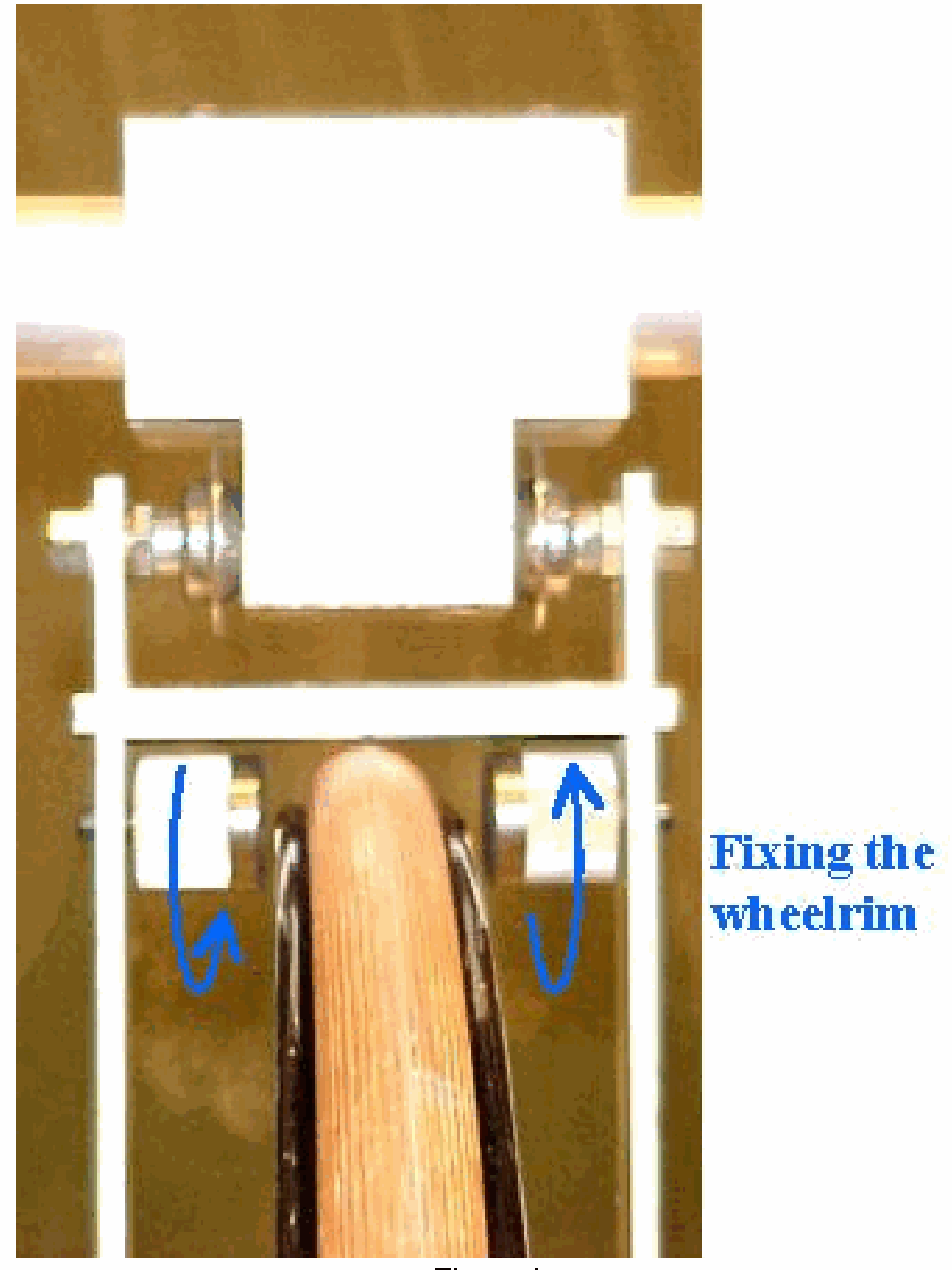
Again the apparatus is swung as a pendulum. The period observed is longer than that in the previous case.
Explanation
In the first part of the demonstration, the wheel can rotate about its axis and thus acts as though all its mass were concentrated at its axis. .
In the second part, the wheel swings as a rigid body and the total rotational inertia now includes the rotational inertia of the wheel about an axis through its centre of mass, , plus , so , making it a slower pendulum. Since the period of a physical pendulum equals , the pendulum is slower .
Sources
Meiners, Harry F., Physics demonstration experiments, part I, pag. 280.
Mansfield, M and O’Sullivan, C., Understanding physics, pag. 155-157.
Roest, R., Inleiding Mechanica, pag. 163-164 en 169.