Aim
To show the movement of a yo-yo and the force it exerts on the string that is holding it.
Subjects
1Q20 (Rotational Energy)
Diagram
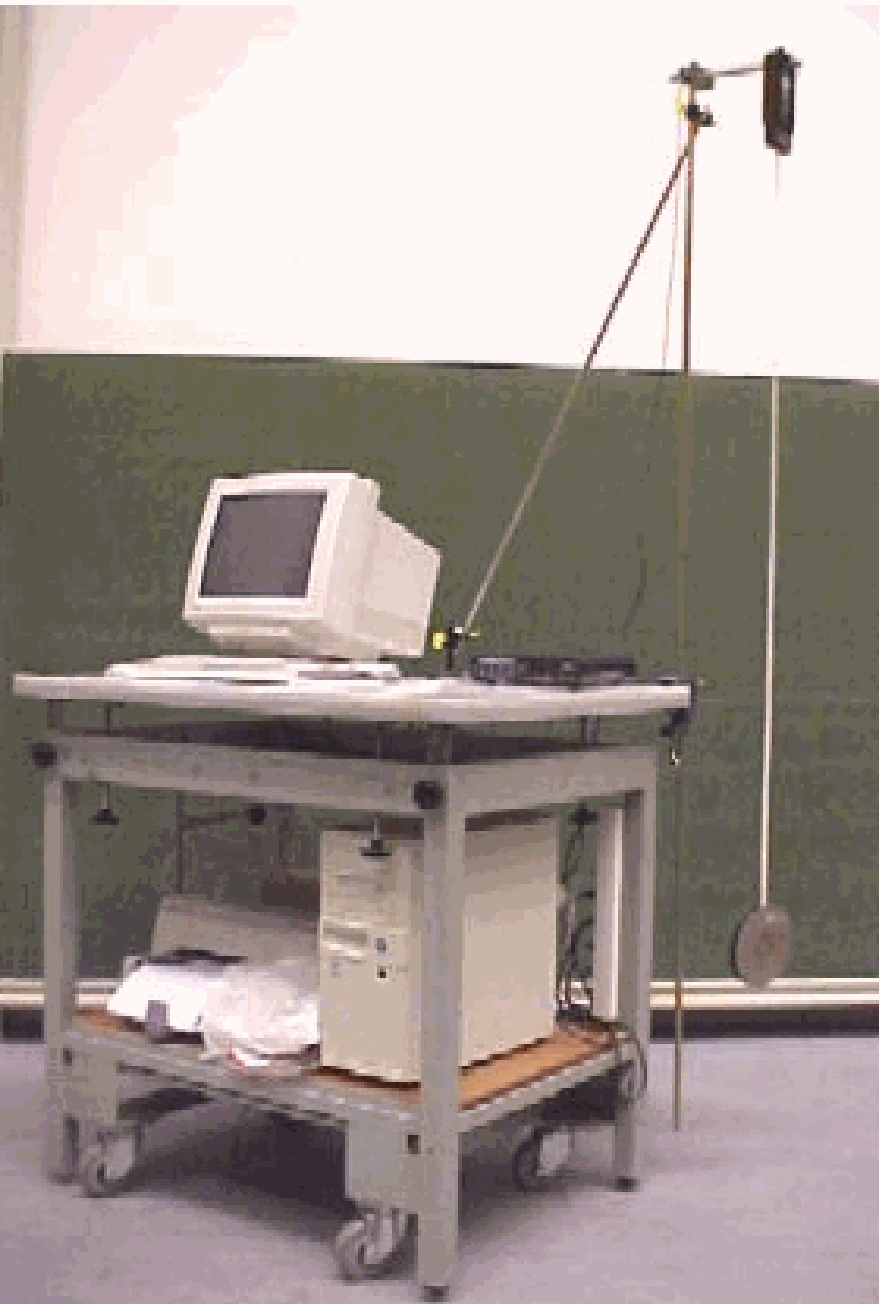
Equipment
Yo-yo.
Force sensor.
Data-acquisition system.
Projector to project monitor image.
Presentation
We all know the yo-yo: Two circular discs with a common shaft and a string several times wrapped around it. Hold the end of the string stationary and release the yo-yo. The string unwinds as the yo-yo drops and rotates with increasing speed. When the unwrapping is completed, the yo-yo climbs again, comes to a stop and starts over again. etc.
Suspending the yo-yo to a force sensor, a registration of the tension in the string is made (red graph in Figure 2 left). When, finally, the yo-yo has come to rest, such a registration is repeated (green line in Figure 2 left).
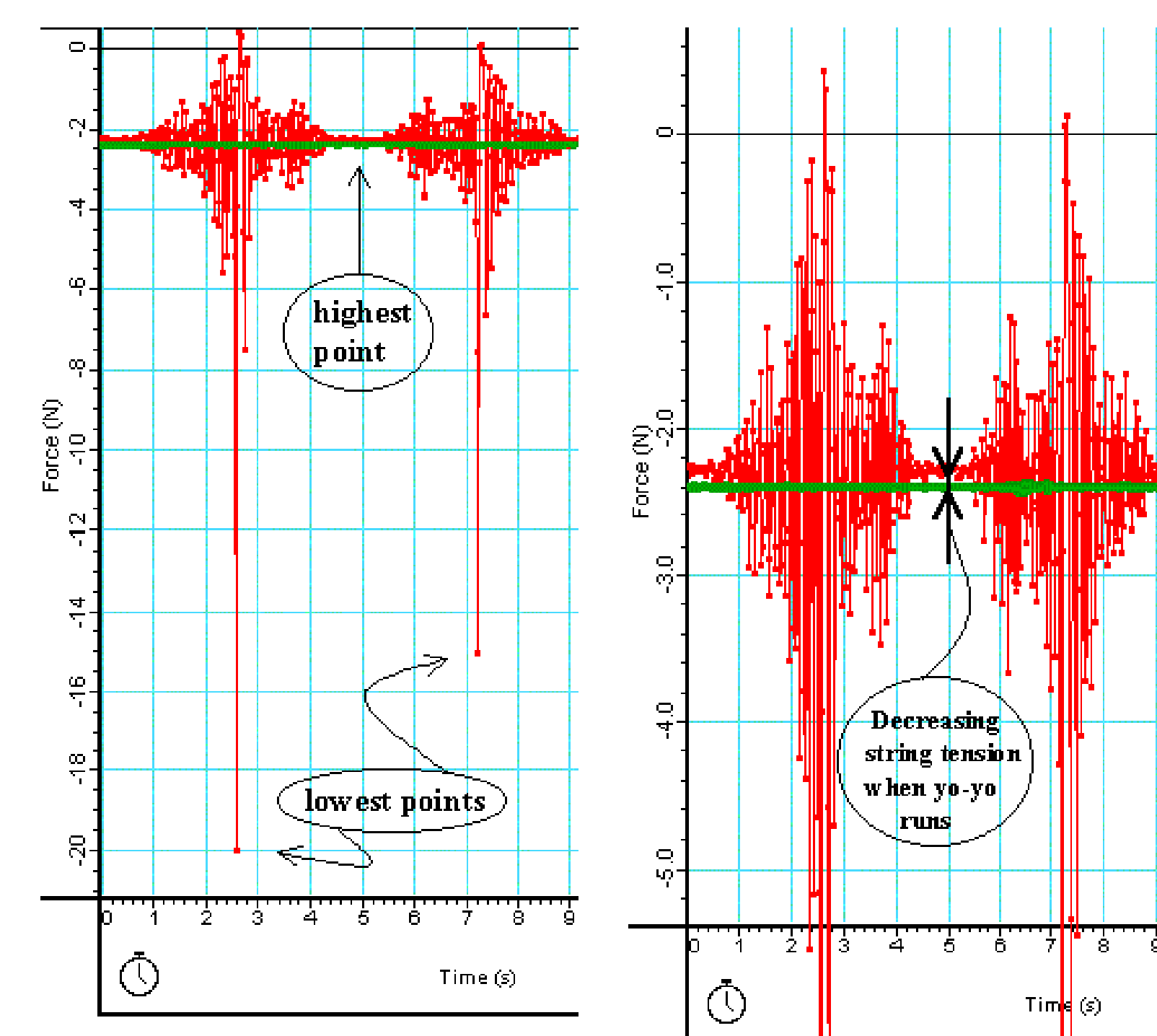
When studying these graphs, the jerk at the turning point is clearly observed. (Also a strong vibration.) See that the jerk at the turning point is much higher than the weight of the yo-yo.
Going from one jerk to the next, the highest position of the yo-yo is halfway between the two jerks. When a complete cycle is enlarged (see Figure 2 right), it is clear that during the complete cycle the string tension is lower than the weight of the yo-yo.
Explanation
The yo-yo accelerates (a) due to a force being the string tension and the mass of the yo-yo.)
When there is no string, then and (free fall);
With a string, is always smaller than :
When is just a little smaller than , then will be very small.
The angular acceleration of the roll during its fall can be found from , where
the net torque is given by .
The acceleration of the center of mass (a) is related to the angular acceleration of the yo-yo by , so the yo-yo accelerates downward by .
Our yo-yo is a simple double disc, so . It rolls at the circumference of the shaft (radius ), that’s why , and we find for the acceleration:
.
Because .
With our yo-yo we have and , so .
Also the string tension can be calculated now: , so: , showing that the string tension is just a little lower than the weight of the yo-yo.
Remarks
A worthwhile observation is, that when the string is unwrapped completely and the yo-yo starts climbing again, that the yo-yo’s translational velocity changes its direction to but keeps its rotation in the same direction. In other words: its momentum changes direction ( to ), but there is no change in angular momentum. The large change of momentum () at this point of the yo-yo’s movement explains the jerk (the change of momentum takes place in a very short time).
See also the demonstration Maxwheel in this database in order to link the measured string tension to the acceleration of the yo-yo. Usually we show these two demonstrations together.
Sources
Borghouts, A.N., Inleiding in de Mechanica, pag. 186-187
Roest, R., Inleiding Mechanica, pag. 183-185
Young, H.D. and Freeman, R.A., University Physics, pag. 303