Aim
To show that change in direction of angular momentum needs a torque.
Subjects
1Q40 (Conservation of Angular Momentum) 1Q60 (Rotational Stability)
Diagram
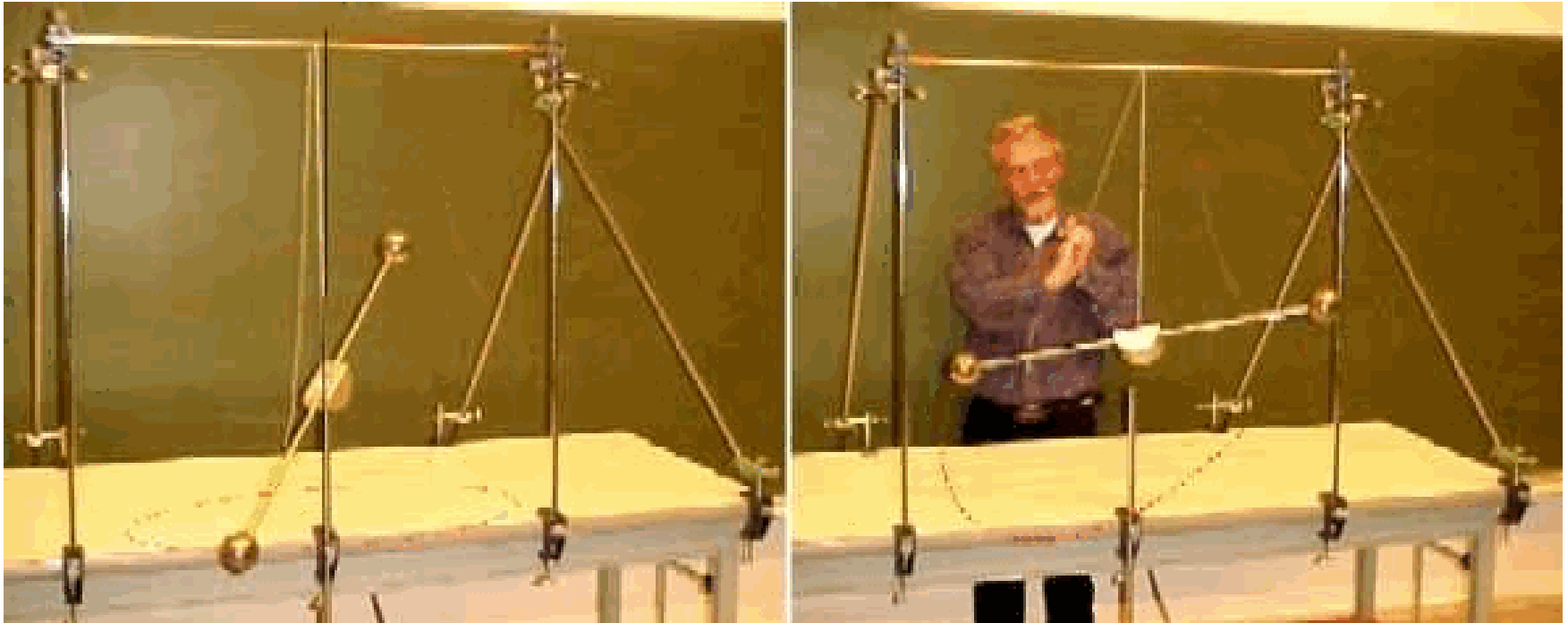
Equipment
Dumbbell pivoted on a support at a non-symmetry axis through the center of mass.
Frame in order to lift off the dumbbell from the support
Presentation
The dumbbell is placed on top of the support. A thread is fixed to the center of mass and thrown over the top of the frame and hold slack, away from the dumbbell. The dumbbell is given a rotation by hand. Make the students observe that the two masses of the rotating dumbbell describe two horizontal circles (Figure 2 A).
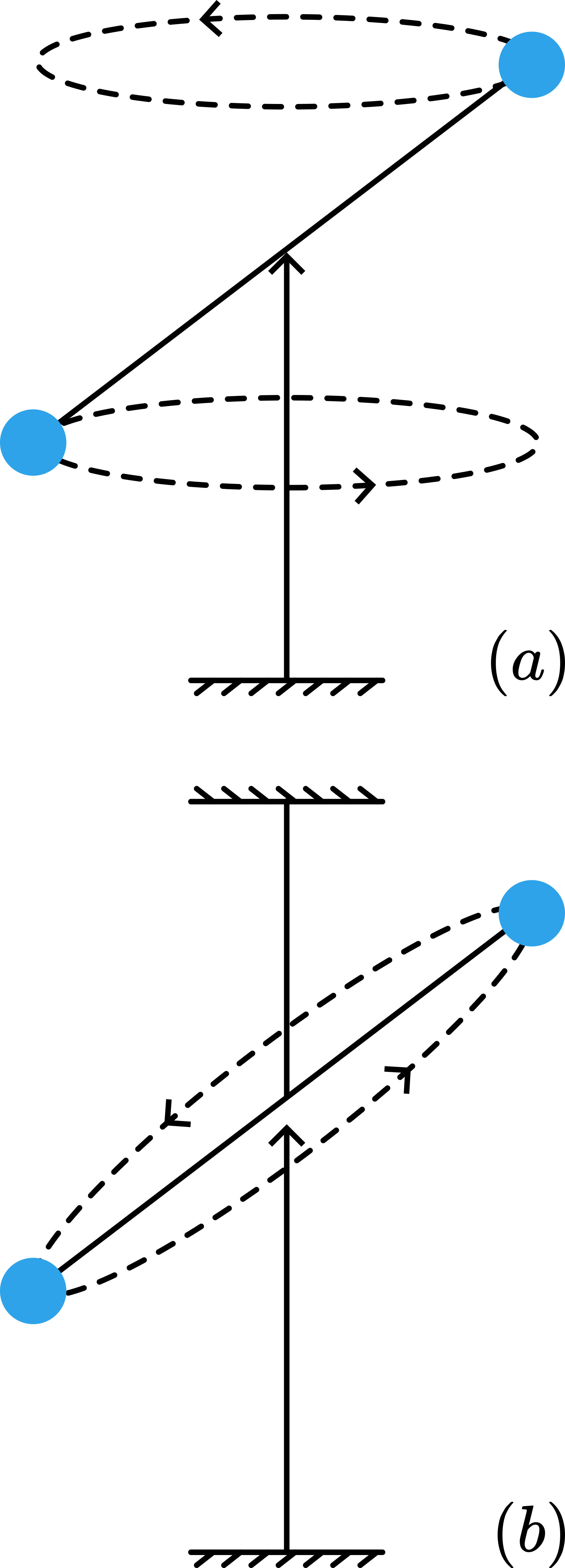
Lift the dumbbell from its support. Almost immediately it can be seen that now the rotation of the dumbbell takes place in one slanting plane (Figure 2 B).
Before lift-off it can be seen that while the dumbbell rotates, the vertical support shaft oscillates/shakes/wobbles strongly and yet it is a thick and strong steel shaft!
Explanation
The dumbbell-shaped object rotates about a non-symmetry axis through the center of mass O. Figure 3 A shows the angular momentum vector of the rotating dumbbell relative to at the instant drawn and while the dumbbell rotates the angular momentum vector describes a cone. So the angular momentum changes direction continuously. To do this a torque is needed. The ballbearing support at O gives that torque: A centripetal force is needed to move around in a circle (see Figure 3 B). This needs a torque . (Also gives this result.)
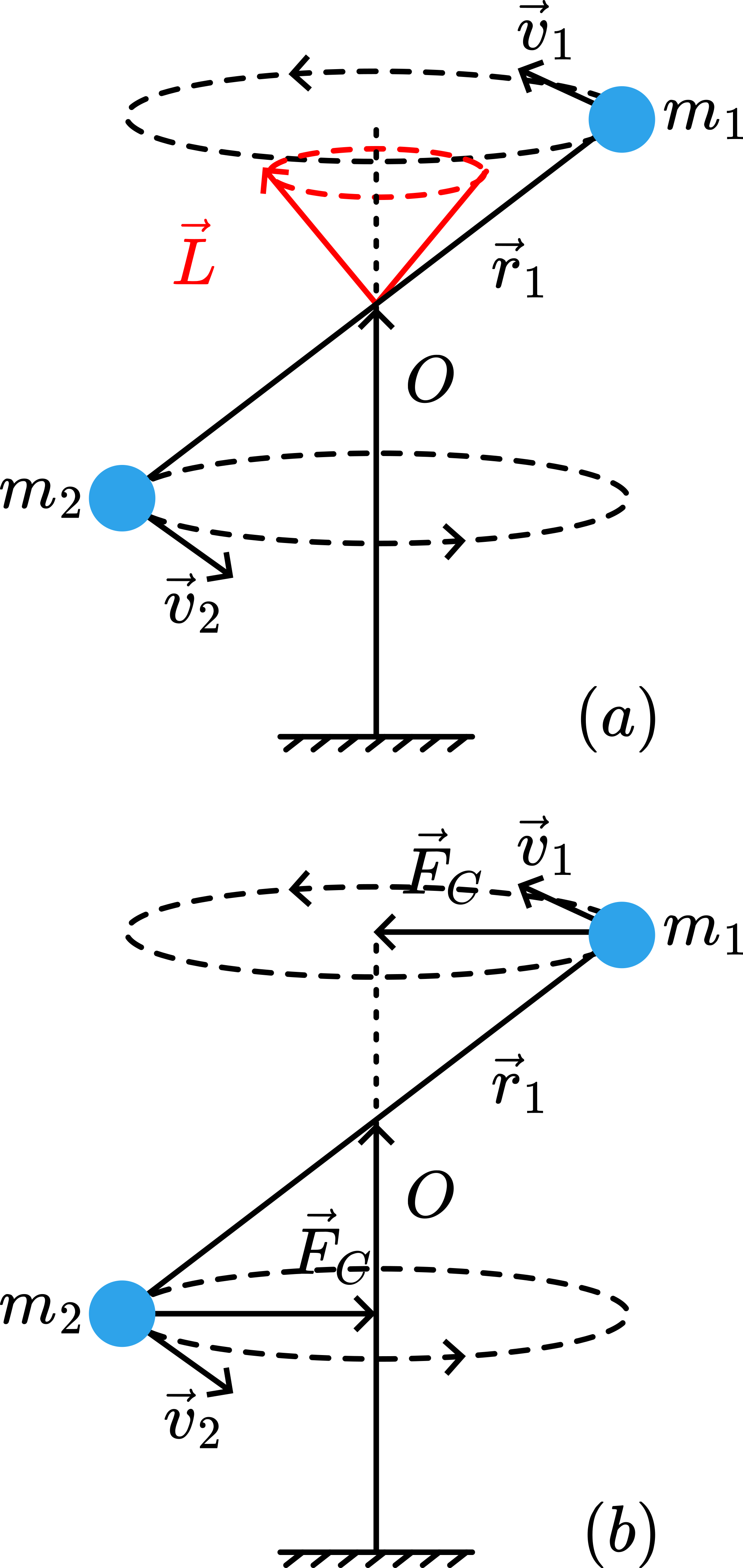
This torque also makes the support shaft wobble. The dumbbell needs to rotate in such a way as the direction of dictates at the moment of lift-off.
Remarks
The wobbling of the support shaft can also be described in terms of dynamical unbalance: The angular momentum ( ) and the angular velocity are not parallel.
Sources
Alonso, M/Finn, E. J., Fundamentele Natuurkunde, part 1, Mechanica, pag. 215-217
Borghouts, A.N., Inleiding in de Mechanica, pag. 221-223
PSSC, College Physics, pag. 352-355 and 366-367
Roest, R., Inleiding Mechanica, pag. 212-213
Giancoli, D.G., Physics for scientists and engineers with modern physics, pag. 287