Aim
To show the behavior of a stick to a short impulse.
Subjects
1Q60 (Rotational Stability)
Diagram
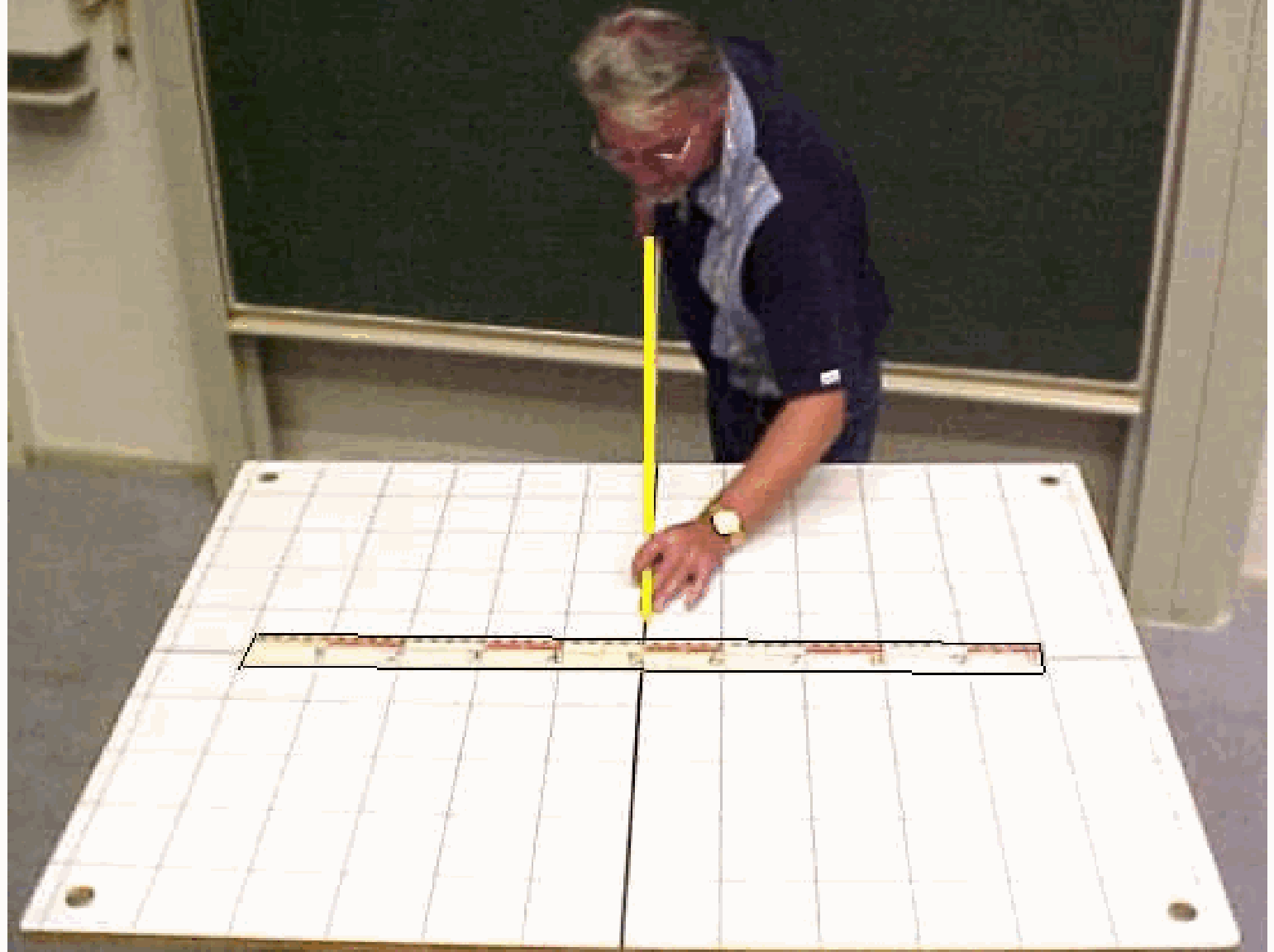
Equipment
Platform with grid, used as reference.
Ruler, .
Stick.
Presentation
Place the ruler with its centerline on the thick centerline of the grid (see Diagram). With the stick you give a short blow to the center of the stick (a movement like you are playing pool-billiards). There will result a translation of the stick.
Again place the ruler with its centerline on the grid. With the stick you give a short blow to the ruler e.g. at . There will result a translation and rotation of the stick.
With the stick you give a short blow to the ruler at . There will result a translation and rotation of the stick. Special is that it rotates around the point of on the ruler.
With the stick you give a short blow to the ruler at . There will result a translation and rotation of the stick. Special is that it rotates around the beginning of the stick.
The point, around which the stick rotates is called “percussion point”. In point 3 and -4 , this point is on the stick; in point 2 it is outside the stick.
Explanation
Due to the short blow, the ruler performs a movement that can be considered as consisting of two movements: a translation and rotation around its center of mass (see Figure 2).
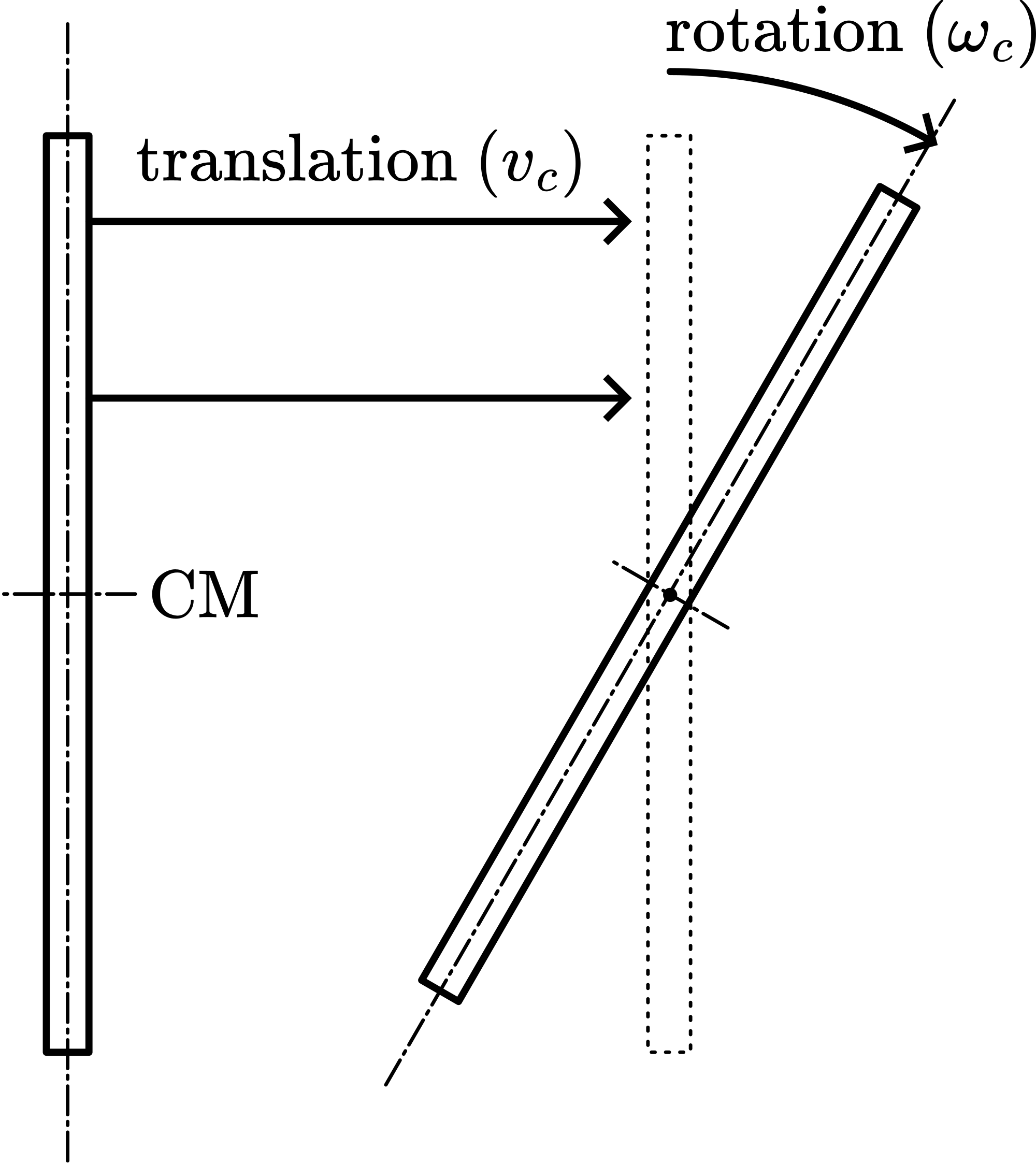
During the short blow force acts on the ruler. The total momentum of this force is . The ruler gets a speed , so the momentum of the ruler is . This makes .
Relative to the ruler has also an angular momentum (see Figure 3). So On one side of and have the same direction; on the other side and are opposite to each other. Looking at point A: . When point A remains at rest after the blow (A is then the so-called percussion point) then . This happens at . For this ruler: , making .
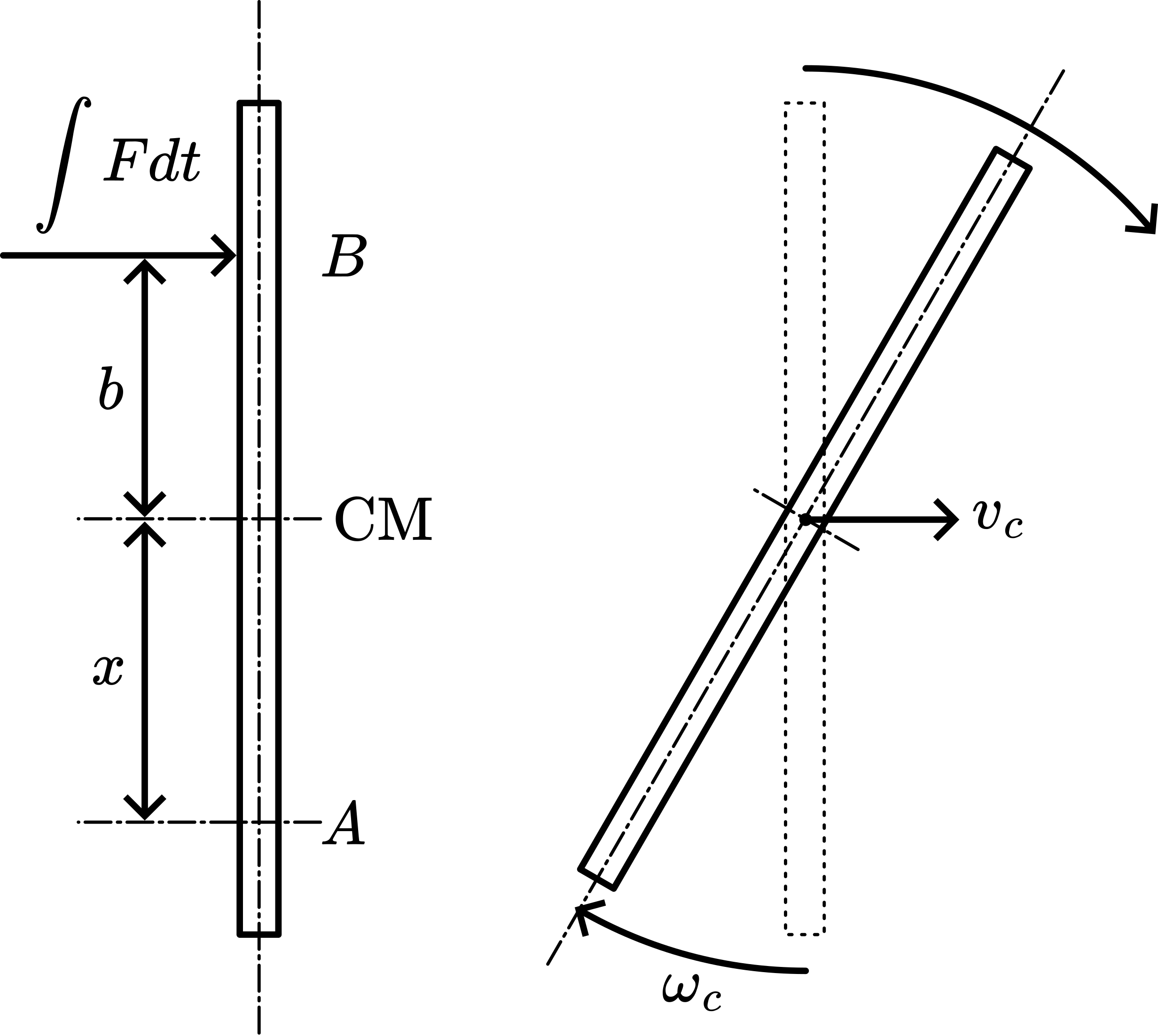
Applying this to the different situations of the Presentation shows the observed percussion points: in PresentationXX point 1 , point 3 and point 4 . In PresentationXX , the percussion point is outside the ruler .
Remarks
Playing billiards with a stick instead with a ball needs practice!
Sources
Borghouts, A.N., Inleiding in de Mechanica, pag. 182-183
Roest, R., Inleiding Mechanica, pag. 172-173 and 176-177