Aim
To show how the ideal gas temperature scale is defined.
Subjects
4A10 (Thermometry)
Diagram
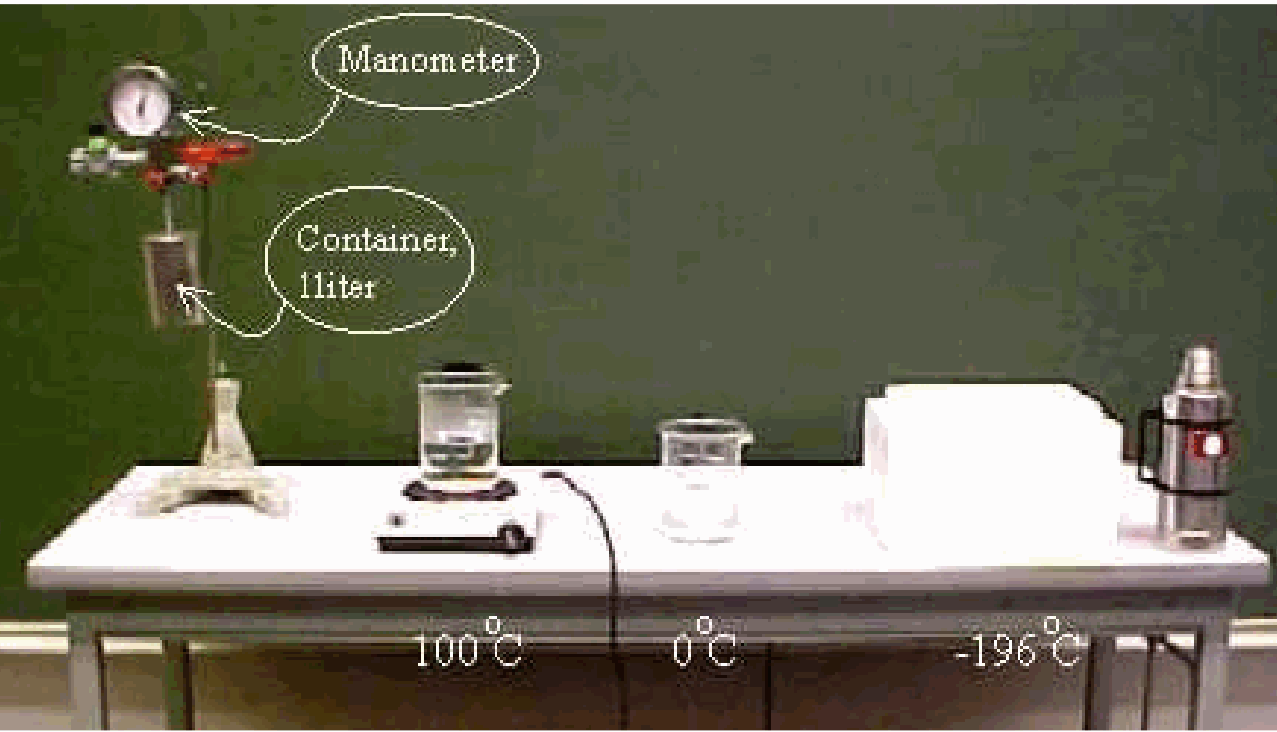
Equipment
One liter container, filled with and a pressure-meter mounted to it.
Clamping material.
Glass beaker, 2 liter, filled with boiling water.
Hot plate.
Glass beaker, 2 liter, filled with ice-water.
Polystyrene box that can be filled with liquid notrogen.
Prepared pT-graph on overhead sheet (-axis: to -axis: 0 to ).
Presentation
First, the container is dipped into the beaker with ice-water. The pressure reduces and after settling, the pressure is read. Then the container is immersed into the glass beaker with boiling water. The pressure rises and settles after some time: the pressure is read.
Finally, the container is placed in the polystyrene box and then liquid nitrogen is poured into it. While the container cools down the liquid nitrogen boils vigorously, quieting when the boiling point of the liquid nitrogen is reached. Then the pressure is read. The three measured points are fitted in the graph on the overhead sheet and it can be observed that the three measured points show a linear relationship, intersecting the -axis at around .
Explanation
The product of pressure and volume of a gas depends strongly on the temperature of that gas. So, pressure or volume can be used as a thermometric quantity.
Here, pressure is used as such and is kept constant (one liter) - hence, a constant volume gas thermometer. As , making , an appropriate temperature scale is given by . For calibration only one constant is needed. When we measure pressure at two temperatures and draw a straight line between them, we can extrapolate the temperature corresponding to any other pressure . We may observe that there is a hypothetical temperature at which the pressure is zero. This extrapolated zero-pressure temperature is used as the basis for a temperature scale: is directly proportional to this Kelvin temperature (see Figure 2)
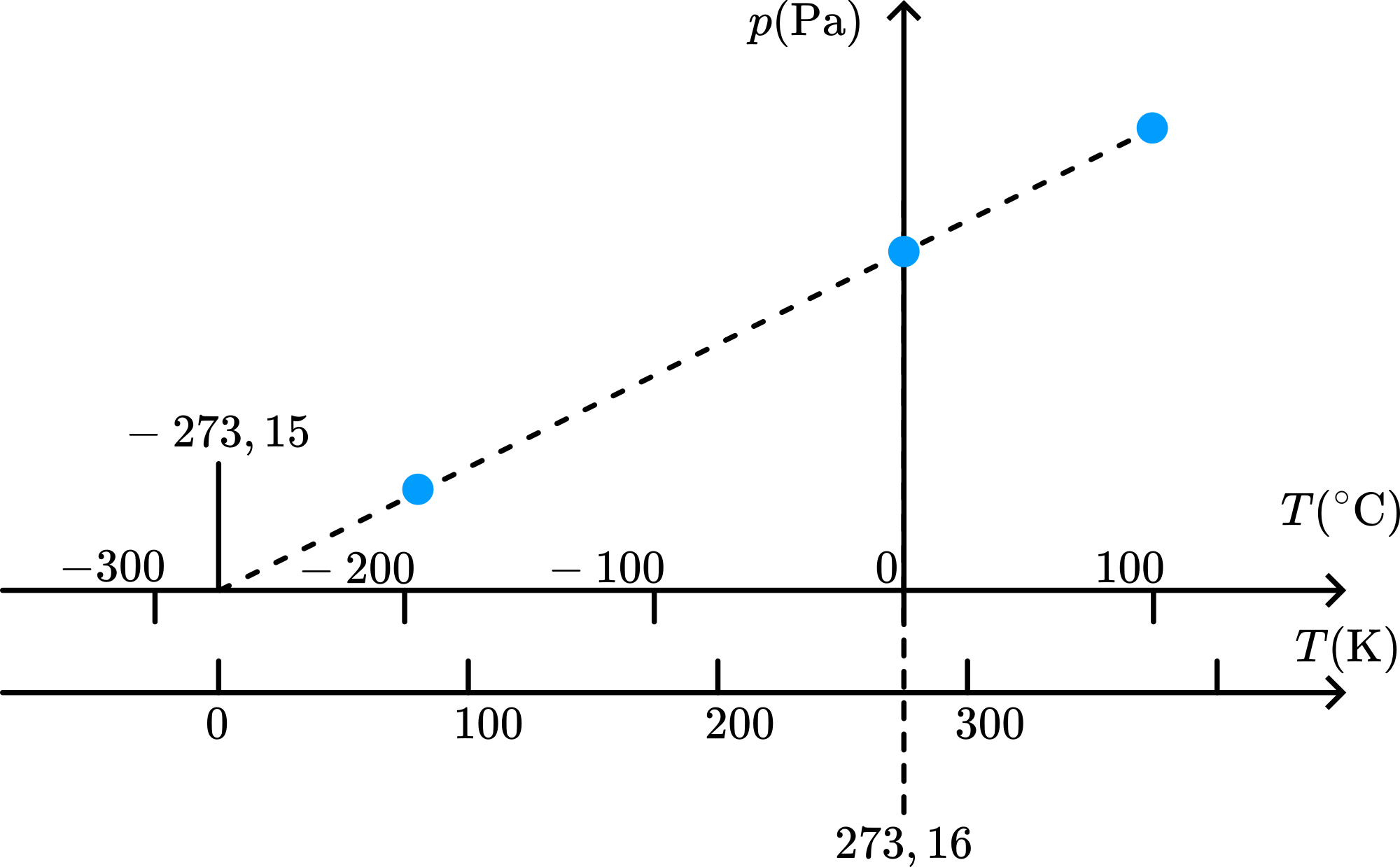
To complete the definition of one point of the graph is specified. For this the triple point of water is chosen. This occurs at and this point is defined as having the value (see Figure 2).
Remarks
Instead of the beaker with ice-water we sometimes use the room temperature as a point of measurement. Then we start the measurement with this point and so we save time in doing the demonstration.
Sources
Mansfield, M and O’Sullivan, C., Understanding physics, pag. 263-265 and 277
Young, H.D. and Freeman, R.A., University Physics, pag. 463-464