Aim
To show that a liquid thermometer is based on the difference between expansion coefficients.
Subjects
4A10 (Thermometry)
Diagram
Equipment
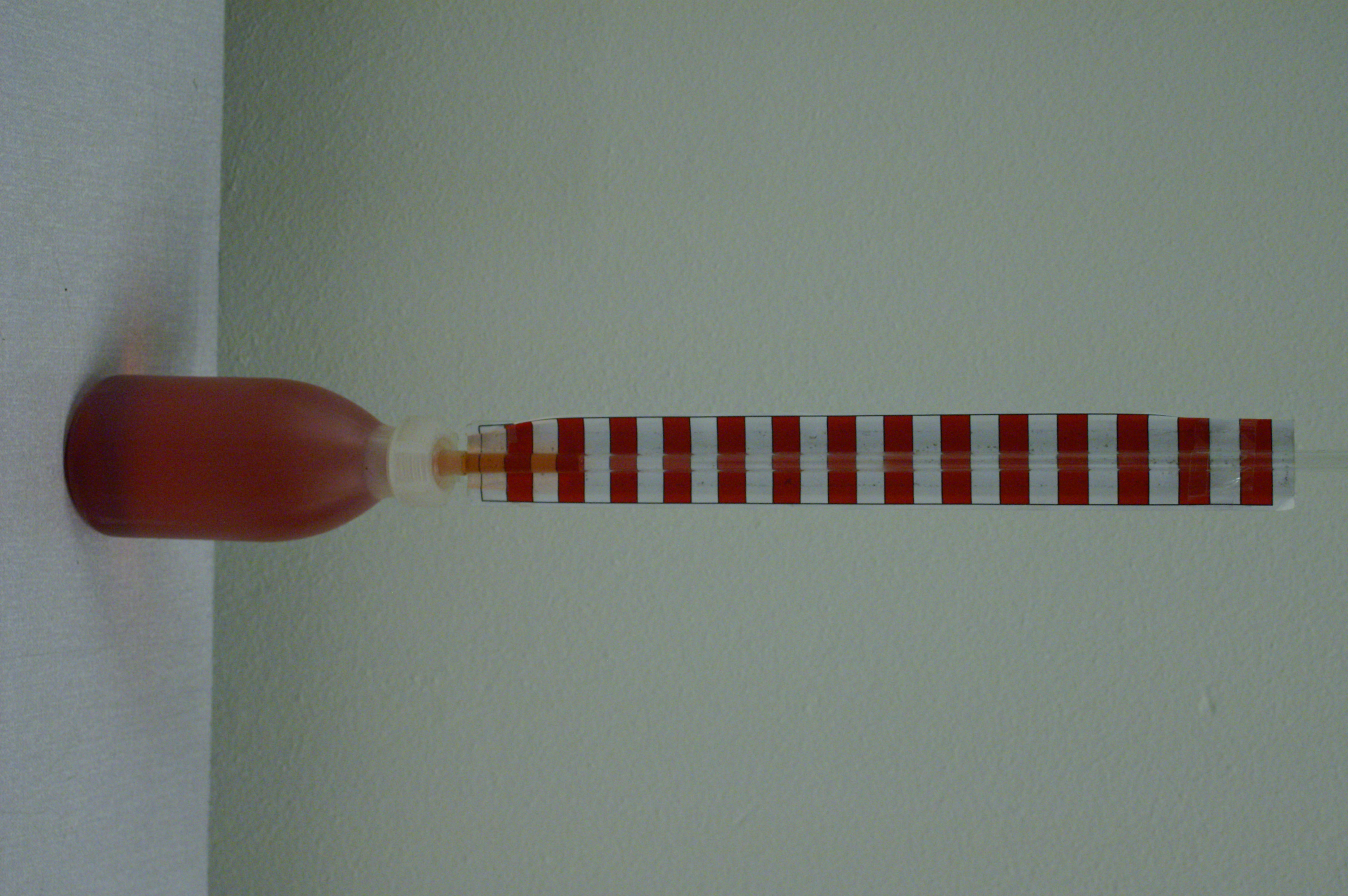
Bottle, , polythene.
Glass tube, , tightly fitted to the bottle.
-scale, stuck to glass tube.
Red ink to color the water.
Clamping material.
Two glass beakers, 2 liter, one filled with hot water, the other with ice-water.
Video camera and projector to project the image to a large audience.
Presentation
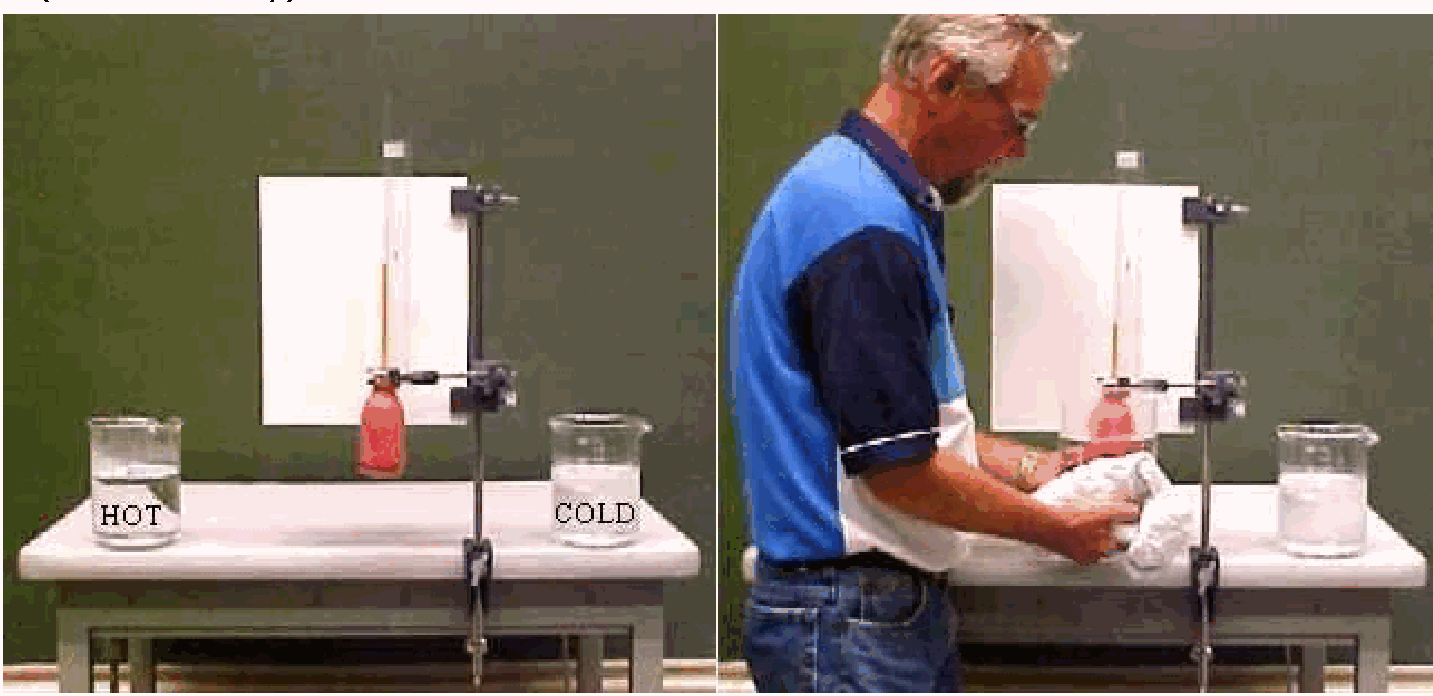
This thermometer is based on thermal expansion as basis of a scale of temperature. Students see the red colored water in the bottle that will be used for this purpose. To calibrate this thermometer we have a container with hot water and one with ice-water. The container with hot water is taken and held such that the bottle with red water dips in it. Immediately the level of the red water sinks dramatically. Students will be puzzled, because they expect a simple (almost dull) demonstration and now something contradicting their expectation happens. When the bottle with red liquid dips into the ice-water, the level of the thermometer rises.
Explanation
Liquid thermometers are based on the difference between the expansion coefficients of the liquid and the container holding the liquid. Usually the expansion coefficient of the liquid is higher than that of the material the container is made of, but when using polythene it is just the opposite (water: ; polythene: ). What we see is in fact a transition effect: The polythene bottle rises quickly in temperature, so the water level goes down, but when we take enough time the water will rise again because the red water heats up slowly. Also a glass container shows this transition effect, but so much less than when using polythene (expansion coefficient of glass: ).
Remarks
The result shown to the students is not a real thermometric quantity, since there is not a thermal equilibrium during the demonstration.
Fahrenheit encountered the thermometric effect of the glass containing the liquid when he accidentally applied different sorts of glass.
Video Rhett Allain
Video embedded from https://
Sources
Mansfield, M and O’Sullivan, C., Understanding physics, pag. 262-263 and 272-273