Aim
To show the harmonic motion of a spring-mass system
Subjects
3A40 (Simple Harmonic Motions)
Diagram
Equipment
Track, .
Cart.
Mass equal to the cart.
Two force-sensors, with mounting bracket.
Acceleration sensor.
Two springs.
Data-acquisition system and software.
Projector to project the monitorscreen.
Mass, three times the mass of the cart.
Stopwatch with large display.
Presentation
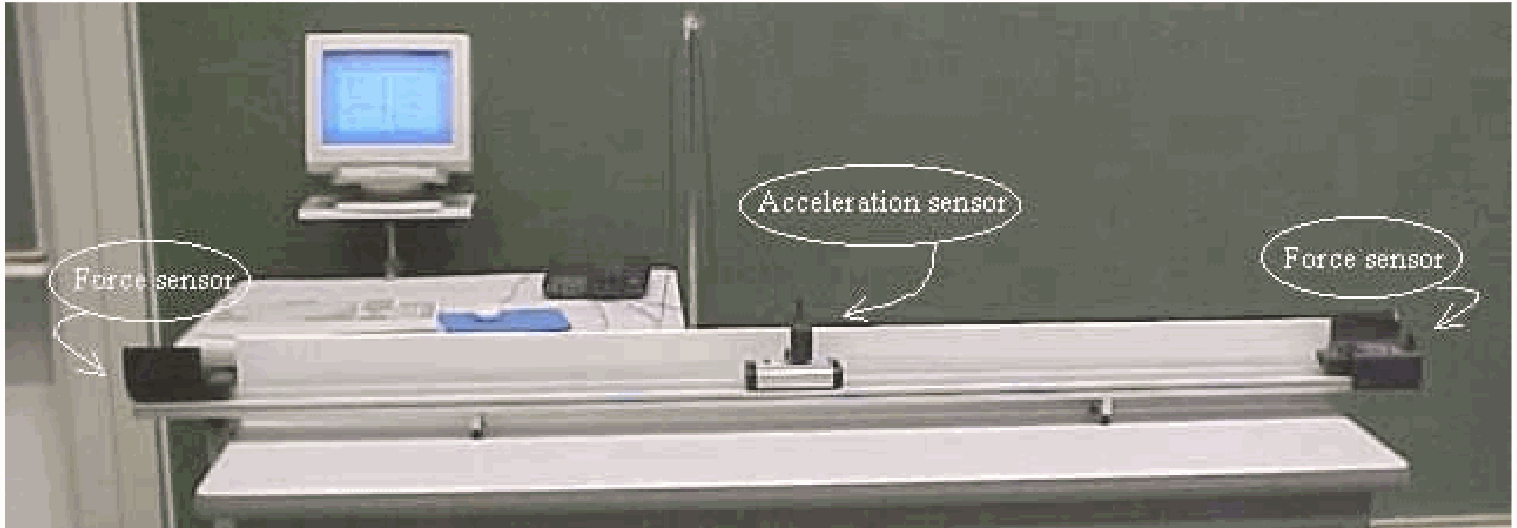
Set up the equipment as shown in the Diagram. On the monitorscreen four graphs are prepared: The springforces and and the resultant force on the cart and the acceleration of the cart (see 3a4004_figure_1.png1.
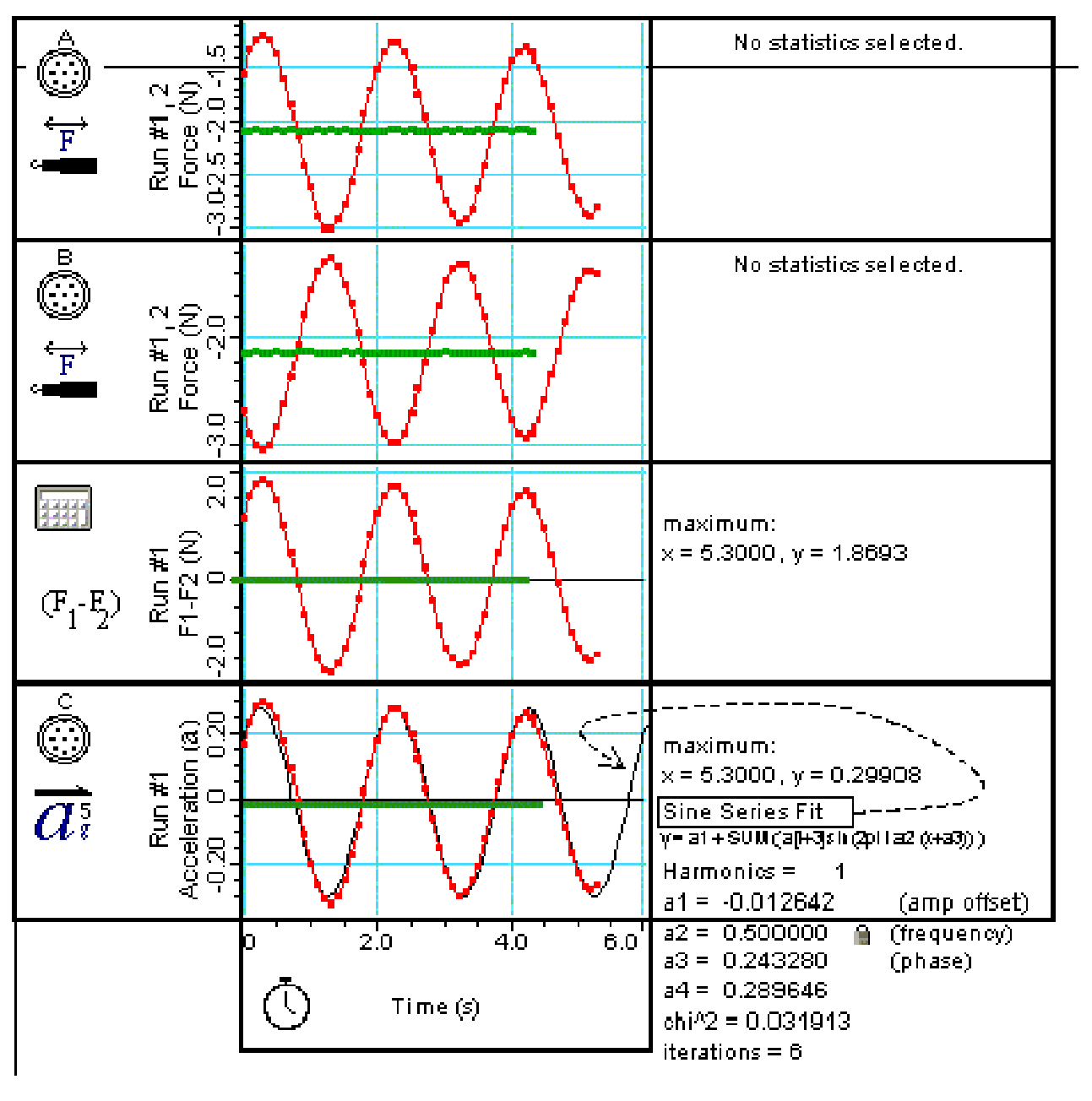
Collect data while the system is at rest. In the graphs and show a negative value and and are zero (see the green lines in Figure 2). Displace the cart from equilibrium and let it go. Collect data during about 4 complete swings of the system (the red curves in Figure 2). Make a sine curve-fit for the graph that displays the acceleration, to show that the motion is really harmonic.
Set the cart in motion and clock how long it takes to run five periods. Add masses to the cart so that its total mass is four times its original mass. Make the students predict what will happen to the period. Set the cart in motion and clock again five periods to check if the prediction fits.
Explanation
A mass is in SHM as long as its acceleration (a) is always directed towards a fixed central point and increases linearly with displacement. The force on themass is a springforce ( ). Applying Newton’s second law we get and hence , so .
Analysis shows that for SHM of a spring-mass system . So increasing the mass fourfold means a reduction of by a factor 2.
Remarks
The graphs of and acceleration show directly the linear relationship between and . So in this demonstration Newton’s second law is visible directly. The values of maximum and maximum , shown in the “statistics box” of the display (see Figure 2) give directly the value of : .
Sources
Mansfield, M and O’Sullivan, C., Understanding physics, pag. 47-52