Aim
To show that a transverse pulse moves faster on a lighter rope.
Subjects
3B10 (Transverse Pulses and Waves)
Diagram
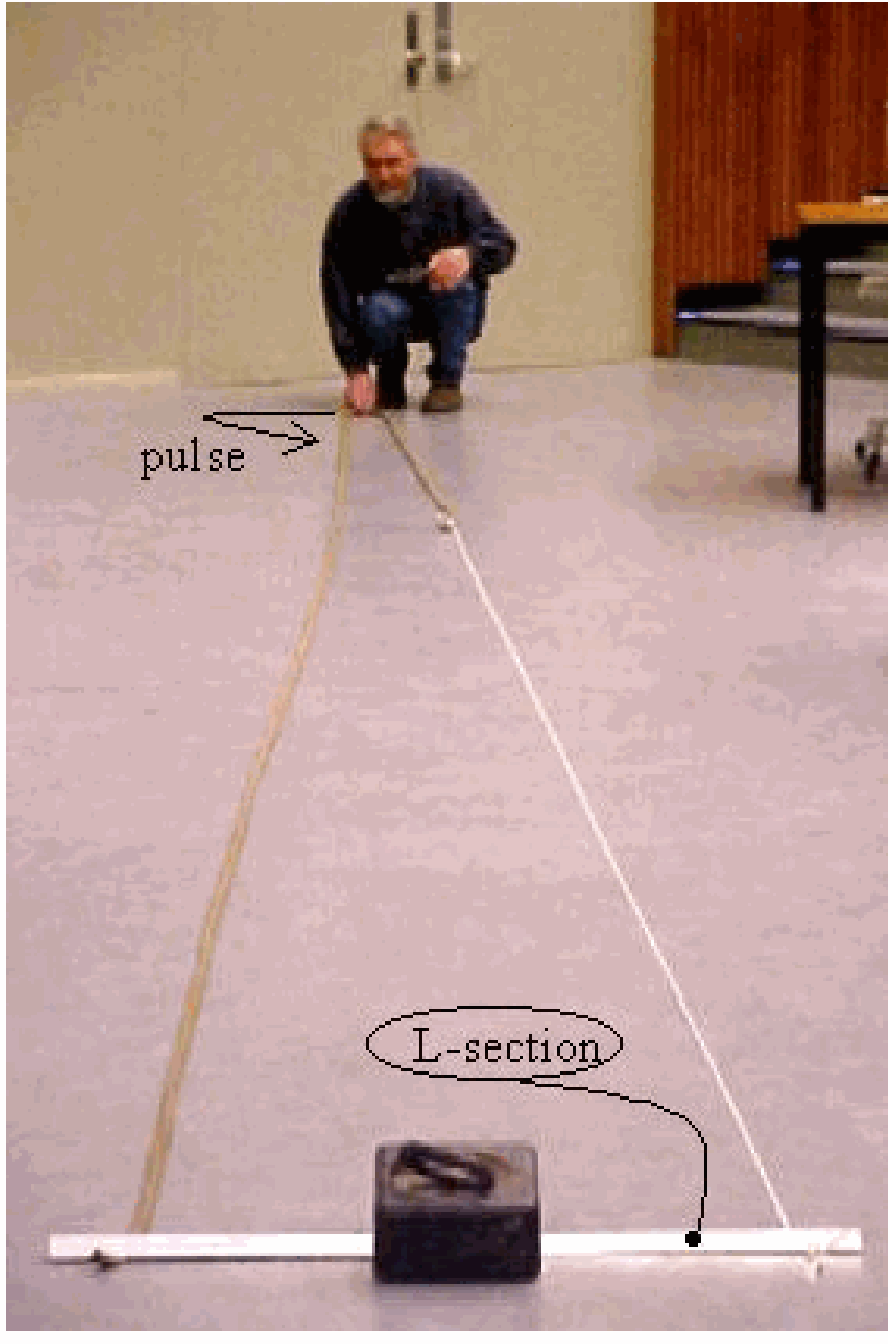
Equipment
Heavy rubber hose ().
Rope ().
Aluminum L-section ().
Heavy weight ().
Camera.
Projector.
Safety
In lifting and carrying the heavy weight, do so in the right way (use your legs when lifting the weight): Mind your back.
Presentation
The piece of rope is knotted to the rubber hose. The loose ends of rubber hose and rope are blocked by the L-section and heavy weight (see Diagram). The demonstration is set up in such a way that the instructor holds the rubber hose: One leg of the assembly is completely a rubber hose, the other leg: rubber hose tied to rope (piece of rope about of the total length of the leg).
The instructor gives, by hand, the combined end a sharp horizontal transverse pulse. Along both legs a crest travels. Clearly can be seen that as soon as the crest passes from rubber hose to rope it travels much faster: It overtakes the slower moving crest in the other rubber leg and is on its way back and “home” long before the slow crest even arrives at the L-section.
(Careful observation makes it possible to see also that, at the knot, where the crest passes from the rubber hose into the rope, there is not only transmission but also reflection.)
Explanation
The velocity of a pulse along a rope is being the tension along the rope
and its mass per unit length. Both legs have the same tension, so the observed difference in the velocity of propagation is explained by the difference in . The lower the higher .
In our situation we have:
.
Since , we find: .
So, the speed of the pulse on the hose is of the speed of the pulse on the rope. In demonstrating it is good enough to calculate roughly:
.
So the difference in speed of the pulses is around a factor 3 . This is more or less visible once you know this factor and the demonstration is observed a couple of times.
Remarks
Practicing this demonstration before presenting it is necessary to feel the right tension needed to make a clearly visible single pulse that is really short.
For good visibility of the traveling crest, observation along the legs is needed. That’s why a camera is placed at the end. A picture is projected by the projector as the Diagram shows.
Sources
Mansfield, M and O’Sullivan, C., Understanding physics, pag. 344-345.
Young, H.D. and Freeman, R.A., University Physics, pag. 600-605.
Jewett, J.W. and Serway, R.A., Physics for Scientists and Engineers with Modern Physics (seventh edition), pg 461-462.