Aim
To show how a transverse disturbance in a rubber hose reflects.
Subjects
3B10 (Transverse Pulses and Waves)
Diagram
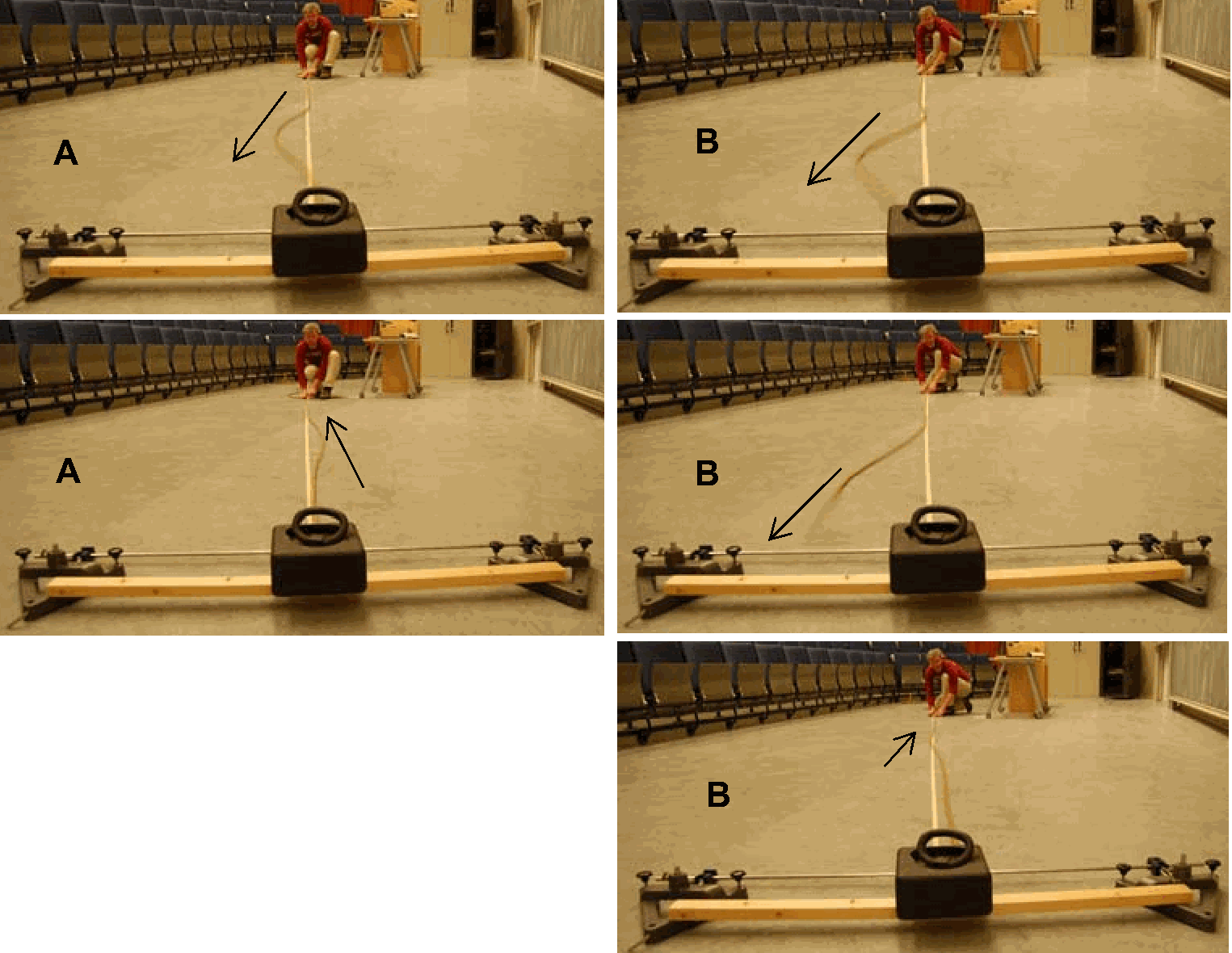
Equipment
Heavy rubber hose ( ).
Heavy weight ( ; see the construction in Figure 2 and Figure 3).
Tape
Oil.
Camera
Projector
Presentation
Lay the long piece of hose in a straight line on the floor in front of the lecture room. On the floor, this straight line is marked by tape (see Diagram). -At one end the hose is fixed (see Figure 2).
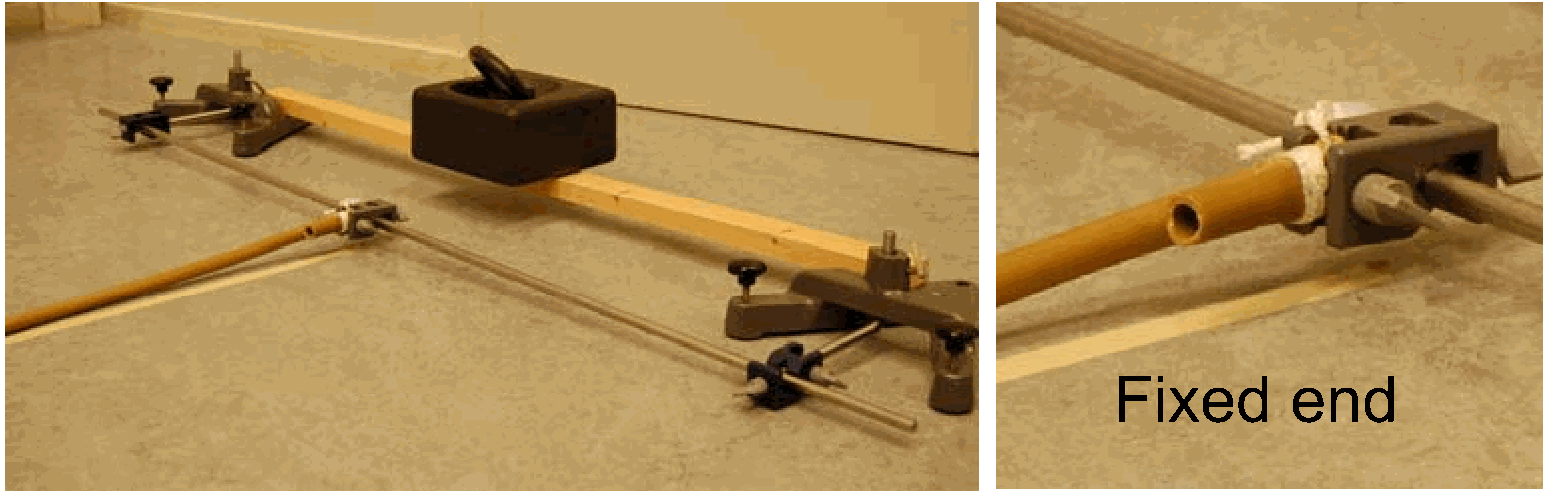
Reflections of transverse pulses (1)
Give, by hand, the free end of the hose a sharp horizontal displacement. A crest travels along the hose (see the pictures of Diagram A) and reflects at the fixed end as a trough.
Next the hose is fixed as a loose end (see Figure 3).
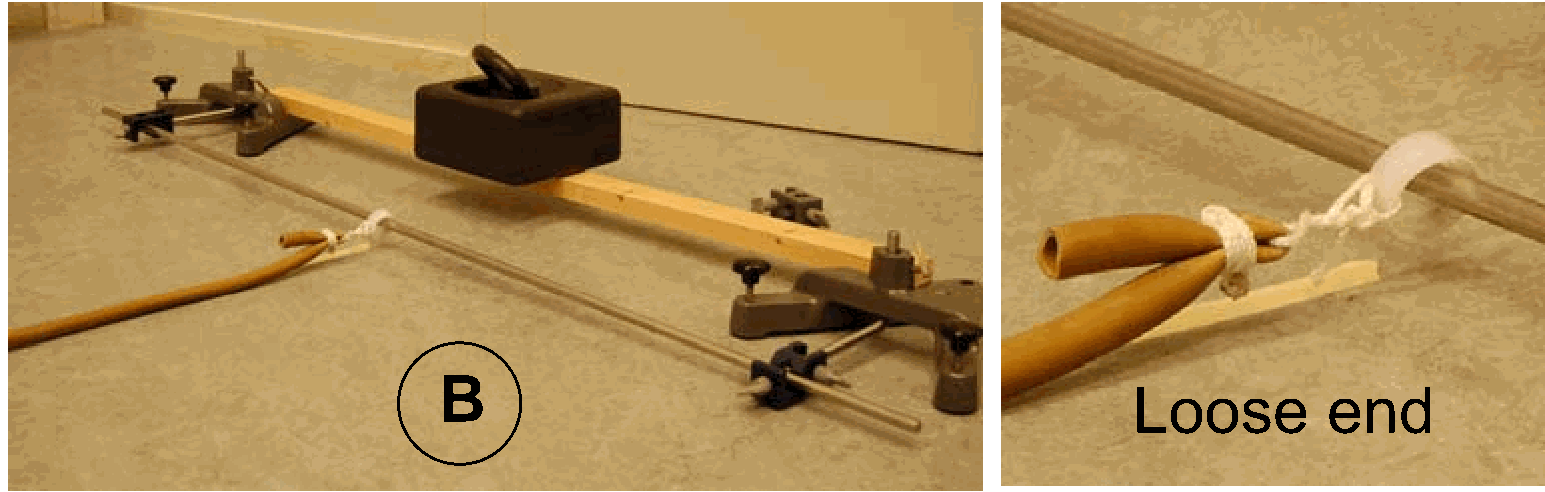
The end of the hose can now freely move sideways; it is a so-called “free end”. (We apply some oil on the metal shaft to reduce friction.) The demonstration is repeated and it can be observed that a crest traveling along the hose now returns as a crest (see the pictures of Diagram B).
Explanation
When the hose has a fixed end, an incoming pulse exerts a force on the support. The support then exerts an equal and opposite reaction force on the hose, effectively “kicking back” on it. In accordance with Newton’s Third Law and conservation of Momentum, this produces a reflected pulse that travels in the reverse direction.
When the hose has a free end, the free moving support exerts no transverse force. When the arriving pulse displaces the free end sideways, it even overshoots the arriving pulse. In the hose a force pulls it back to its rest position. This generates the reflected pulse, and so the direction of displacement is the same as for the initial pulse.
Remarks
Practicing this demonstration before presenting it is necessary. In preparing the demonstration, experiment with the tension in the hose and the amplitude of the pulse given in order to get a satisfactory demonstration. Adapt your pulse amplitude also to the relative strong damping. Also observe in the pictures of the Diagram that the demonstrator holds one hand on the line to prevent overshoot when a pulse is given on to the hose (notice his left hand in the pictures).
To observe the traveling crest, observation along the rubber hose is advised. That’s why we place a camera at the fixed end. The projector projects an image to the audience like the pictures in Diagram show.
When lifting and carrying the heavy weight (!) do it in the right way! Mind your back!
Sources
Ehrlich, Robert, Turning the World Inside Out and 174 Other Simple Physics Demonstrations, pag. 126.
Friedrich, Artur, Handbuch der experimentellen Schulphysik, part 1, Schwindungen, Wellen, Schall, Ultraschall, pag. 82.
Mansfield, M and O’Sullivan, C., Understanding physics, pag. 307-308.
Giancoli, D.G., Physics for scientists and engineers with modern physics (third edition) , pag. 402-403.
Young, H.D. and Freeman, R.A., University Physics, pag. 620-621.
Jewett, J.W. and Serway, R.A., Physics for Scientists and Engineers with Modern Physics (seventh edition), pg 461-462.