Aim
To present the acoustic Doppler effect, using beats produced by a swinging speaker.
Subjects
3B40 (Doppler Effect)
Diagram
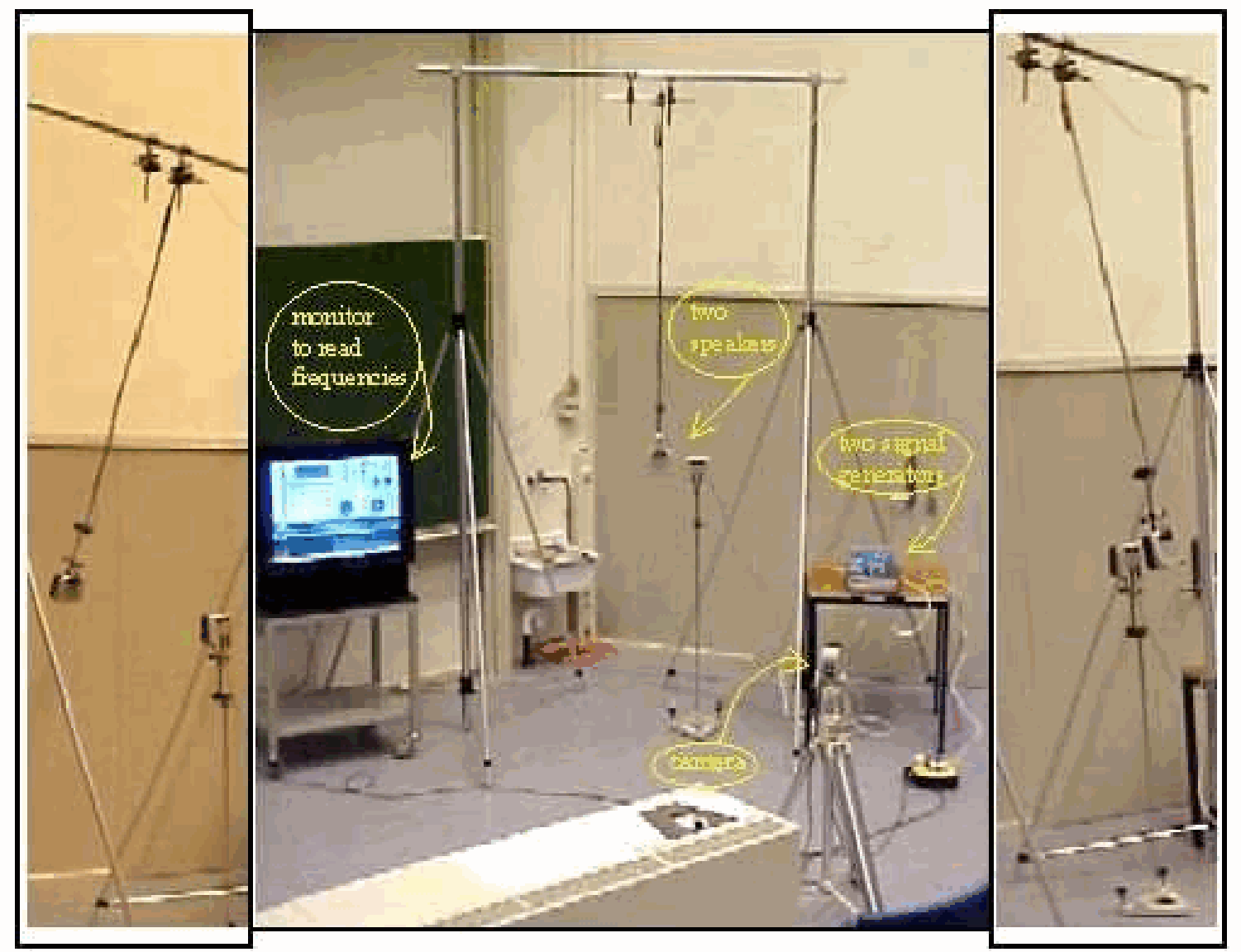
Equipment
Two loudspeakers, one standing, the other swinging (see Diagram).
Two signal generators, with high frequency stability.
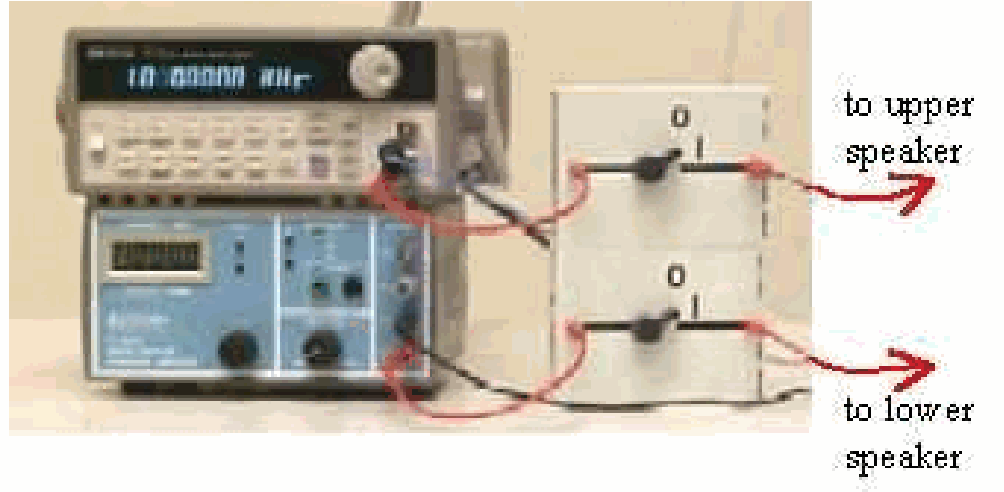
Two switches (see Figure 2).
Camera.
Monitor with large screen.
Presentation
The two speakers are mounted as shown in Diagram. One of the speakers is mounted as a pendulum with an arm of around . In the beginning the pendulum is not moving.
Both signal generators are set at (all four digits are significant!). Switching from one generator to the other (see the switches in Figure 2), both amplitudes are set in such a way that both speakers produce the same loudness (switching from one to the other no difference is heard).
Beats
Then the phenomenon of beats is demonstrated, because this is used as a means of observing the Doppler effect:
One of the signal generators is set at and a beat of is observed;
The signal generator is set at and again a beat of is heard;
The signal generator is set at and a beat of is heard;
The signal generator is set at and again a beat of is heard; Etc.
Notice that it is not possible to distinguish between the two speakers which of the two has the higher (or lower) frequency, and whether the beat heard is caused by an increase or decrease in frequency of one of the generators.
Same frequency
Both generators are set again at . The speaker mounted as a pendulum is given an amplitude of around 1 meter. Beats are heard by the audience when the speaker moves towards the audience and also when it moves away from the audience. Both beats are the same, so it is not possible to say that the frequency coming from the moving speaker is increasing or lowering in relation to its forward or backward motion. We can only observe that the sound coming from the moving speaker has changed by a couple of .
Difference in frequency
The pendulum speaker is at rest. Its frequency is set at . We hear a beat of 5 . Then the pendulum is made swinging. The audience hears that the beat frequency increases when the speaker swings towards them and that the beats almost disappear when the speaker moves away from them.
While still swinging we change that frequency to and now almost no beats are heard when the pendulum swings towards the audience and a high beat frequency is heard when the pendulum moves backwards.
Explanation
Beats
The beat frequency is just the difference in frequency of the two waves: .
Doppler
The shift to in the observed frequency, of a wave send with a frequency as result of relative motion, is (see Figure 3).
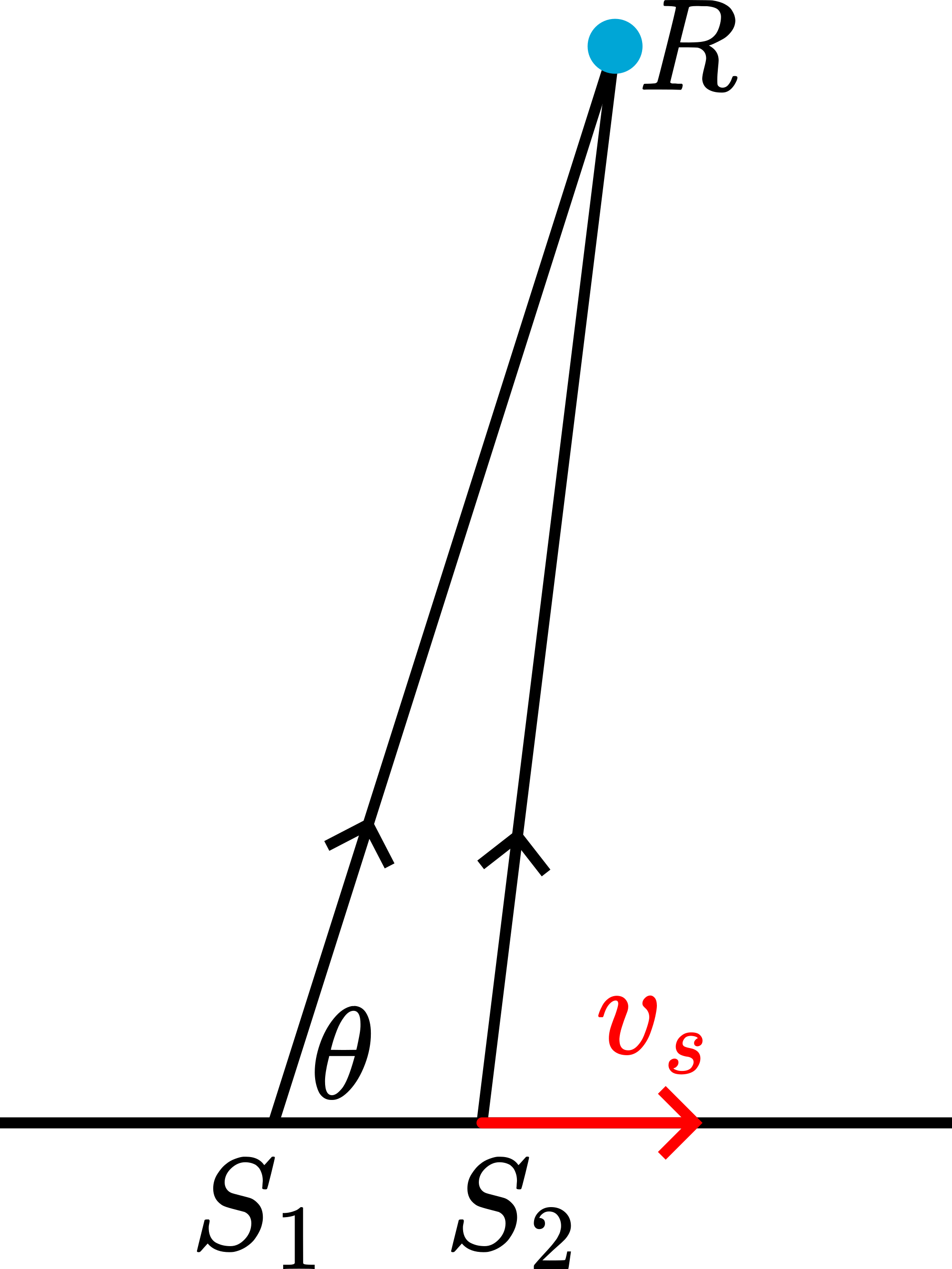
With (moving towards the audience) this reduces to: , showing an
increase in frequency, and when moving away from the audience, the formula
reduces to , showing a decrease in frequency.
Same frequency
The pendulum, having a length of around and given an amplitude of around , will have an average speed of around . When the speed of sound cequals 340 , a frequency of changes to when it approaches the audience and to when it moves away from the audience. In beatfrequency this gives in both cases the value of around . So no difference is heard between the two movements.
Difference in frequency
When the swinging speaker has a frequency of , it will be heard by an audience when it approaches them with , as (producing a beat of ) and when it moves away from them as (producing a beat of , so a very slow beat is heard).
When the swinging speaker is set at the situation is just the opposite: slow beat when the speaker approaches the audience, and fast when it moves away.
So, observing the beatfrequency we can in this way observe that the frequency increases as the speaker approaches you and lowers when the speaker moves away
Remarks
Contrary to the picture in Diagram we mount the two speakers above each other. The same is done with the two signal generators (see Figure 2). So, when the audience sees the two frequency displays of the two generators on the monitor screen, they know which frequency belongs to which speaker.
Calculating the frequency by means of or can be done quicker by means of or
Video Rhett Allain
Extra demo to illustrate the Doppler Effect.
Video embedded from https://
Sources
Giancoli, D.G., Physics for scientists and engineers with modern physics, pag. 430-435
McComb,W.D., Dynamics and Relativity, pag. 99-101
Meiners, Harry F., Physics demonstration experiments, part I, pag. 513-514