Aim
The triple point of water is a fascinating phenomenon in which water exists simultaneously in the solid, liquid, and gaseous state. This state occurs under very specific conditions of pressure and temperature. In this demonstration, that state is achieved. This invites a sense of wonder: how can part of the water evaporate, part of it freeze, and part of it remain liquid all at the same time? This question offers a starting point for conceptual deepening in phase transitions and phase diagrams.
Subjects
4C31 (Cooling by Evaporation)
Equipment
Ice cubes
Erlenmeyer flask
Pre-cooled Erlenmeyer flask (from the freezer)
Bell jar or vacuum system with pump
Preparation
Make sure the pre-cooled Erlenmeyer flask lies ready for use in the freezer. Put an ice cube in a plastic bag and wrap it in a cloth. Hit it with a hammer to make small ice splinters. Place several ice cubes in an Erlenmeyer flask and allow them to melt partially. Set these items up together with the bell jar so everything is ready for use.
Procedure
Explain to the students what you are about to do.
Predict
Ask the students:
“What do you think will happen to the water if we lower the air pressure under the bell jar?”
Have them write down their prediction. Their expectations might, for example, be: the water will boil, it will freeze, nothing will happen, or it will freeze and boil at the same time.
Explain
Have students explain, in small groups or in a whole-class discussion, which knowledge they are using to support their prediction. Encourage the use of terms such as latent heat of vaporization, pressure reduction, and phase transitions, for example by asking follow-up questions when a student mentions them.
Observe
Pour the ice-cold liquid meltwater into the pre-cooled Erlenmeyer flask and add a small ice splinter as a crystallization nucleus. Then place the Erlenmeyer flask under a bell jar connected to a vacuum pump, switch on the vacuum pump, and allow the pressure to decrease. Within a few minutes, it becomes visible that the water begins to boil while ice forms at the same time. Bubbles remain trapped under the ice until they find a way to escape. The triple point has been reached: all three phases are present simultaneously.
Explain
Discuss the observed phenomenon. Have students revise or confirm their initial explanation. Now formally introduce the concept of the triple point and show a phase diagram of water with the triple point marked. Emphasize that the temperature remains nearly constant around and that the pressure has dropped to approximately .
Physics Background
The triple point of water is the unique point in the phase diagram at which solid water (ice), liquid water, and water vapour can all exist together in equilibrium. For water, this occurs at and . In the demonstration, the water is initially a cold liquid. As the pressure is reduced, the boiling point drops, so the water starts to boil at a very low temperature. Boiling requires energy, which is taken from the water itself as latent heat of vaporization. This cools the water enough for part of it to freeze. Because the system is now near the triple point, part of the water evaporates, part freezes, and part remains liquid. The result is a dynamic thermodynamic equilibrium in which all three phases coexist.
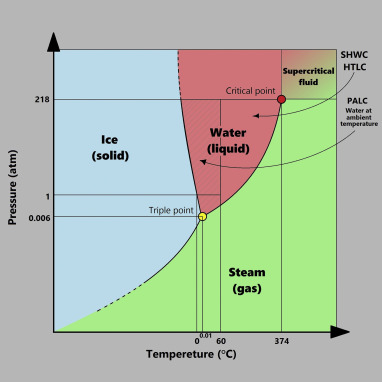
Figure 1:Phase diagram of water. Reprinted from Dembek en Bocian (2020), Pure water as a mobile phase in liquid chromatography techniques, TrAC Trends in Analytical Chemistry, 123, 115793, Dembek & Bocian (2020)
Follow-up / Extension
Have students draw a phase diagram in which they indicate how the experiment moves from the liquid state to the triple point, and explain why.
- Dembek, M., & Bocian, S. (2020). Pure water as a mobile phase in liquid chromatography techniques. TrAC Trends in Analytical Chemistry, 123, 115793. 10.1016/j.trac.2019.115793