Aim
To show the interference of two coherent beams of light.
Subjects
6D10 (Interference From Two Sources)
Diagram
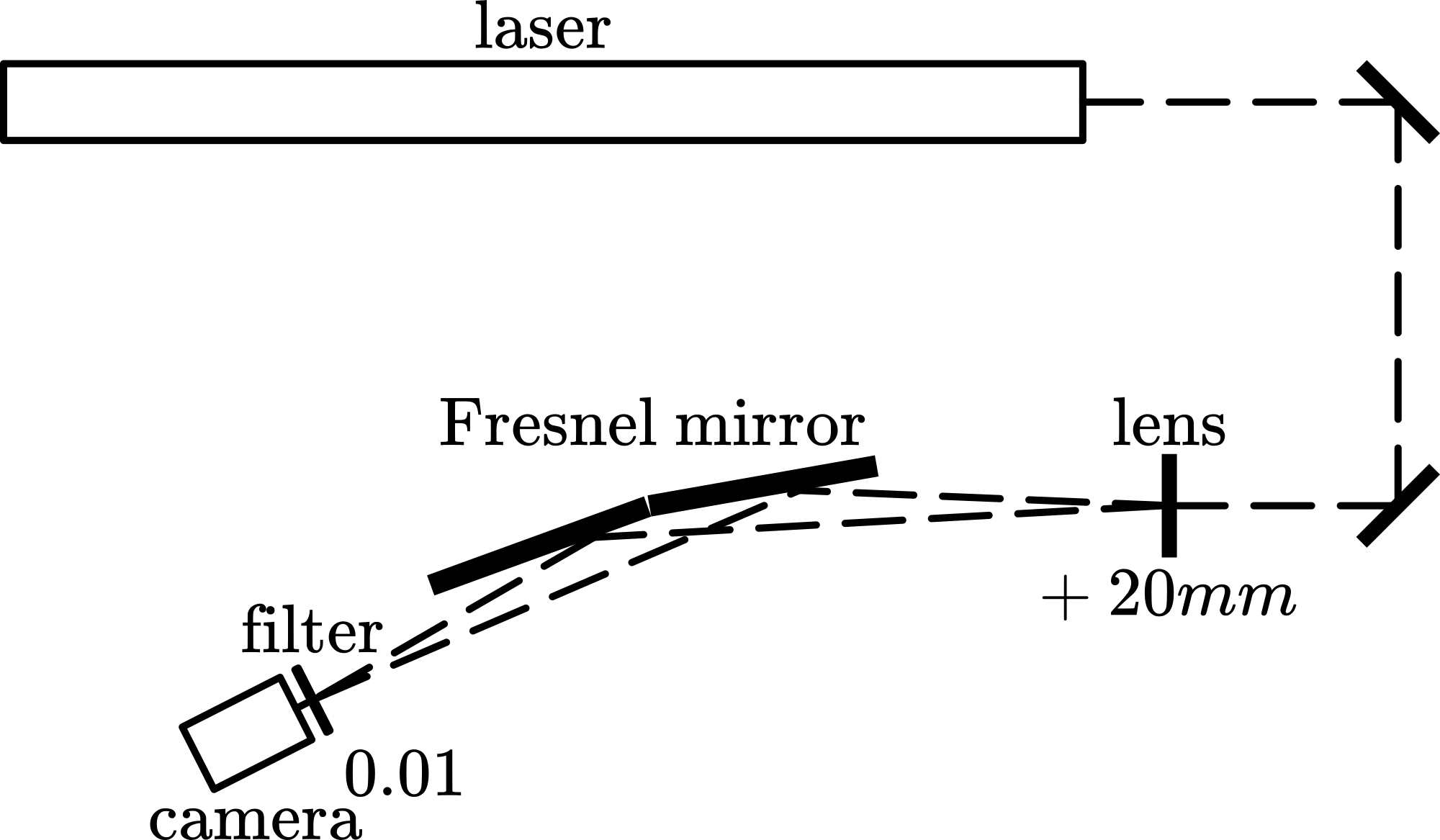
Equipment
Laser (50mW)
Simple lens (we use )
Fresnel double mirror
White screen/wall
Video-camera.
(Video-camera, lens removed. Instead of the lens we use a grey filter, ; see “Remarks”).
Large-screen video-monitor, or projector.
Presentation
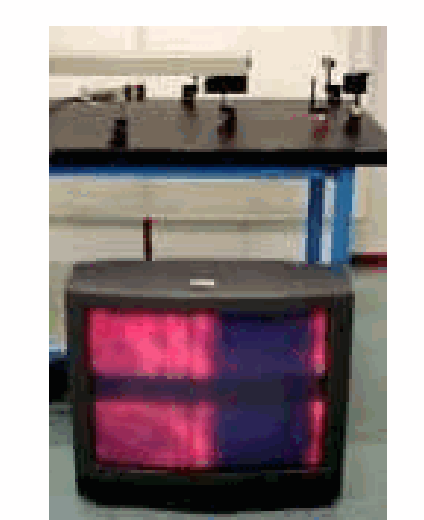
The room is darkened and the laser is switched on. By means of the lens an illuminated disk is projected on the white screen. The Fresnel double mirror is adjusted so that the two halves of the mirror are parallel. The mirror surface is shifted into the diverging light beam, approximately parallel to it and turned just that much so that the beam of rays strike both mirror halves equally. Two light spots (half circles) are visible on the screen/monitor, separated by a dark zone (see Figure 2).
Turning the adjustment screw of the Fresnel mirror, the movable part of the mirror is tilted and the two light spots start overlapping. From a distance, an intensification of the light in the overlapping zone is clearly observed. Then, at a closer look, by means of a camera, a clear interference pattern is observed. (see Figure 3).
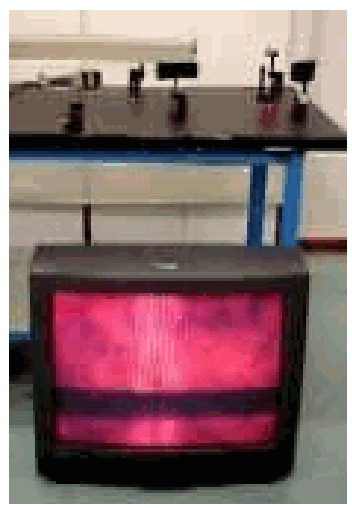
Stress especially the clearly visible increase in intensity of the fringes themselves and the zero intensity between them, illustrating respectively the constructive - and destructive interference. The separation between the fringes becomes less the more the movable mirror is pivoted.
Explanation
One part of the wavefront coming from point is reflected from the first mirror and the other part is reflected from the second mirror (see Figure 4).
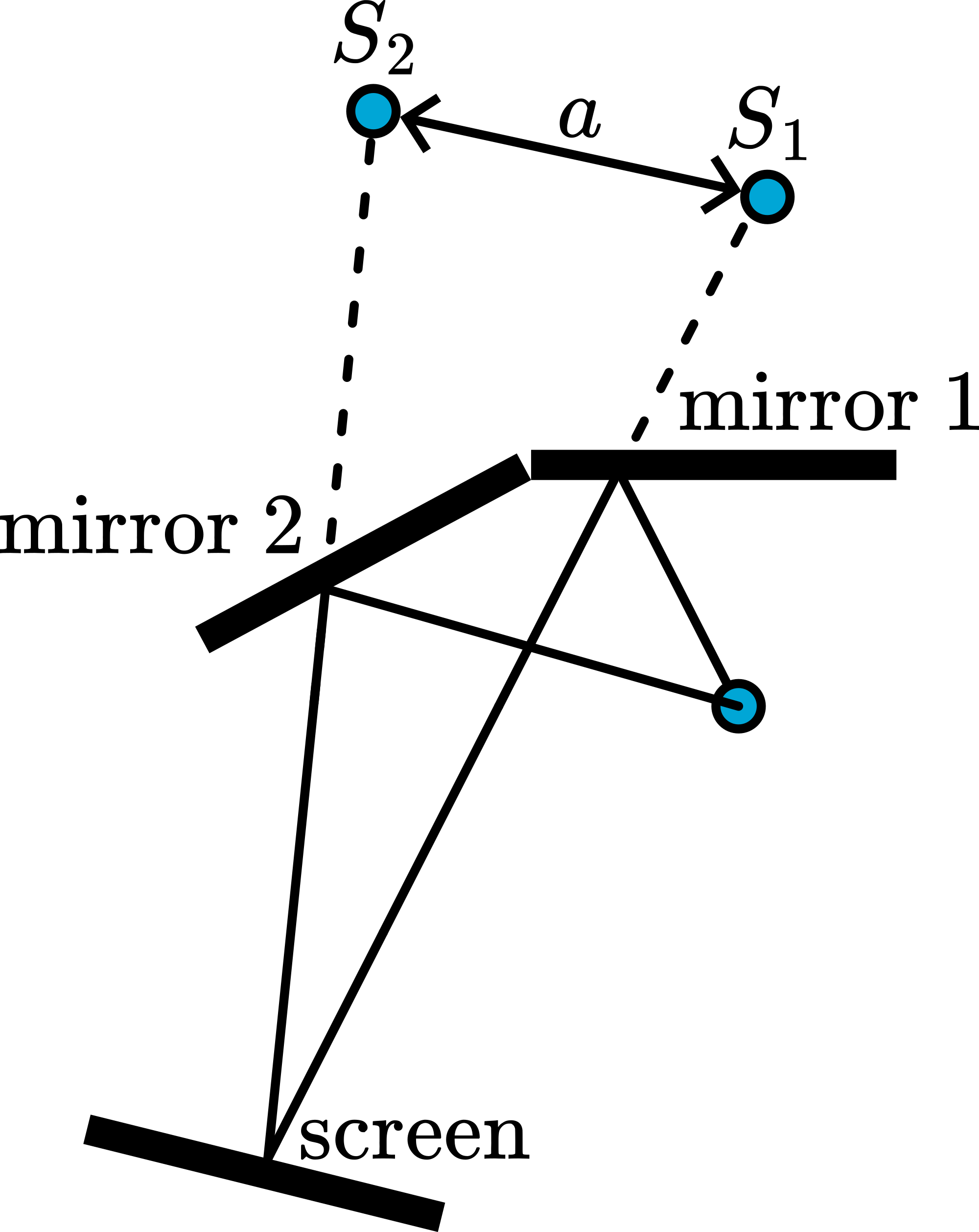
An interference field exists in the region where the two reflected waves are superimposed. The mirror images and can be considered as separate coherent sources, placed a distance apart. The separation ( ) between the fringes is given by ( being the distance between the plane of the two sources and the screen).
So the more the double mirror is pivoted, the larger the distance between the images and will be and thus the fringe separation decreases.
Remarks
In the demonstration the distance between the fringes can be enlarged by placing the screen not perpendicular but more and more parallel to the reflected beams.
You can also use the sensitive screen of a video-camera as a screen on which the interfering beams are projected. Then a video-monitor shows the much enlarged pattern.
Sources
Hecht, Eugene, Optics, pag. 390
Phywe, University Laboratory Experiments, part Vol. 1-5, pag. 2.5
Leybold-Heraeus, Physikalische Handblätter, pag. DK 535.412;c