Aim
To show the interference of two coherent, virtual, sources (wavefront splitting).
Subjects
6D10 (Interference From Two Sources)
Diagram
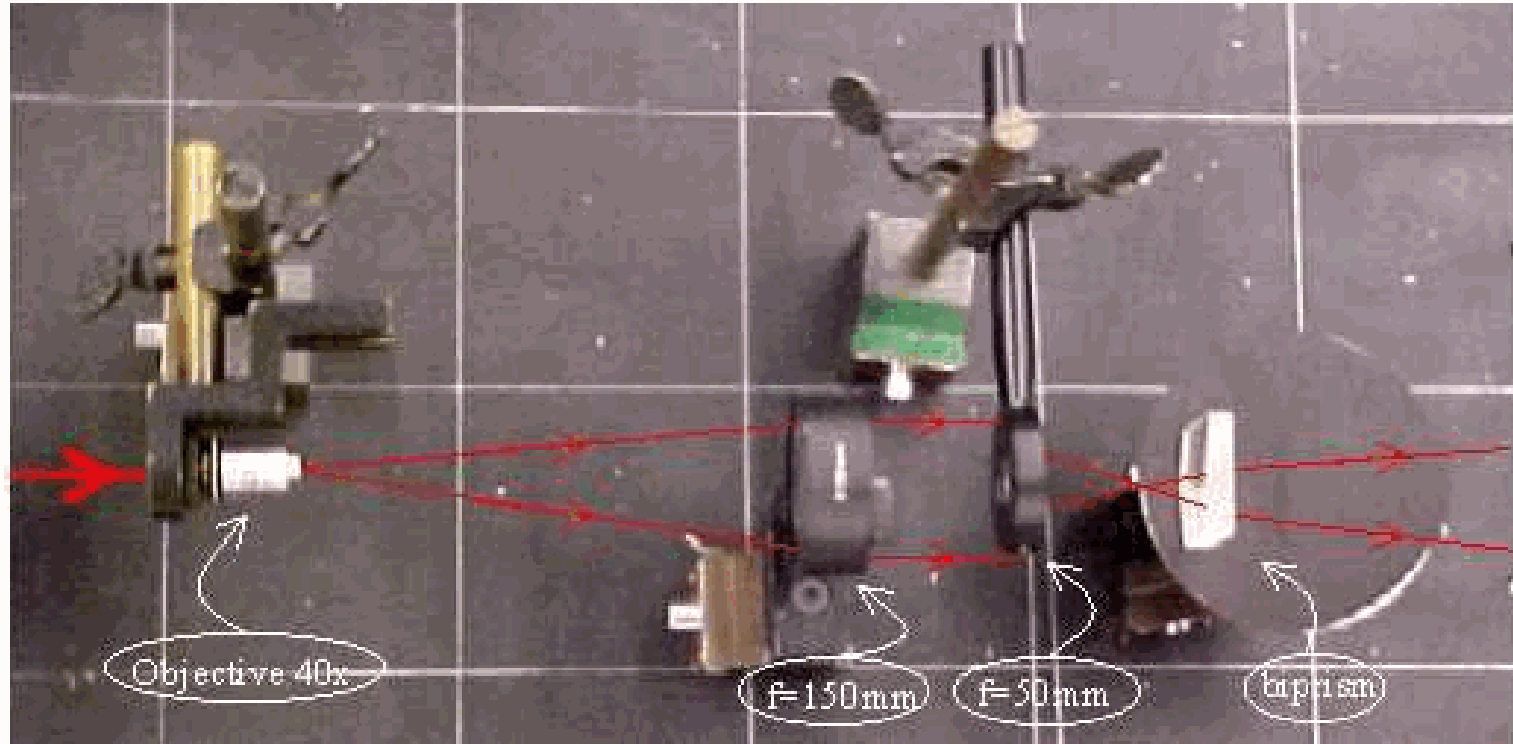
Equipment
Laser.
Microscope objective (40x)
Lens, .
Lens of short focal length (we use )
Double prism.
Viewing screen/wall.
Presentation
Preparation
The laserbeam is switched on and expanded using a telescope consisting of the microscope objective and the converging lens of . The expanded beam is then focussed by the lens of .
Presentation
On the viewing screen, a couple of meters away we see a large circular light spot. (Blowing smoke into the lens set-up enlightens the light path).
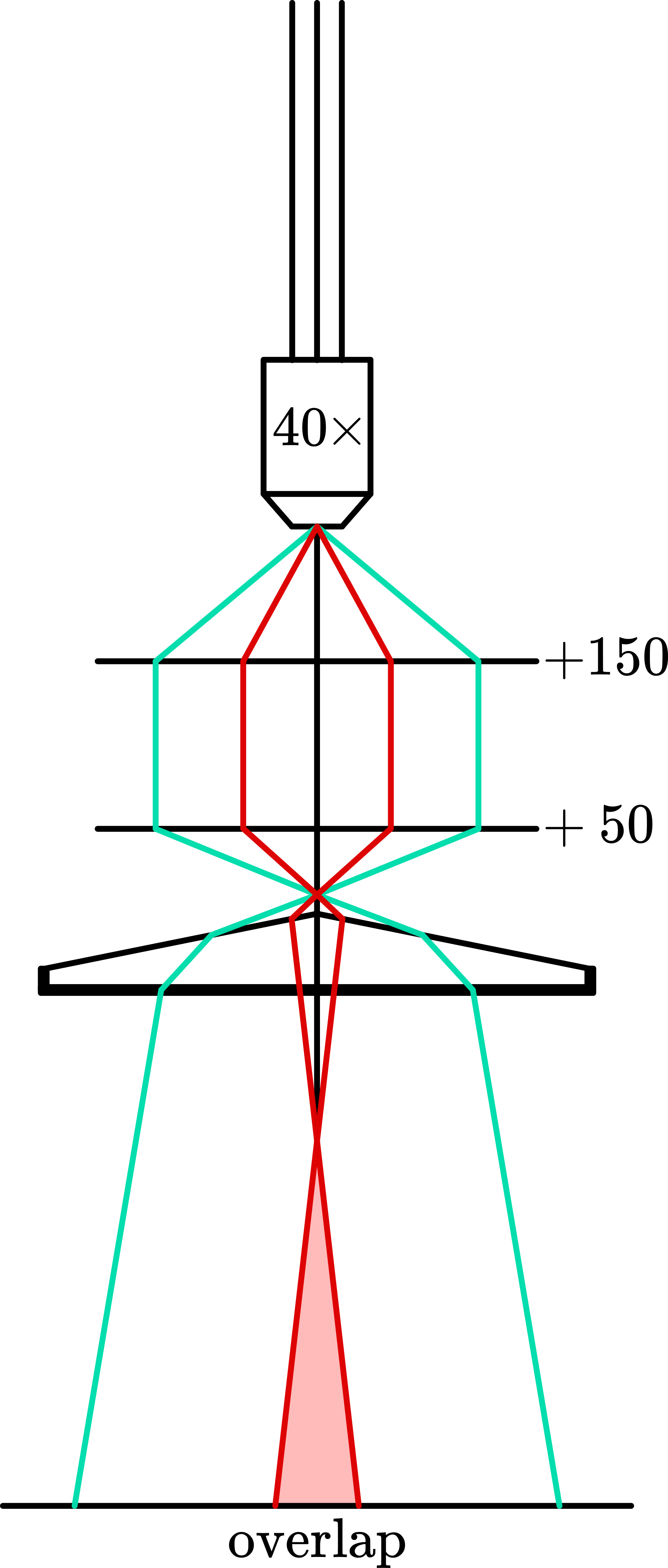
When descending the biprism (apex line vertical) into the diverging beam, close to the focal point (see Figure 2), we see that the original circular light spot is refracted into two half circle segments and that in the centre these two halves overlap (see Figure 3), narrowing the original lightspot.

The centre shows an increase in light intensity. When the biprism is moved closer to the focal point of the lens, we will easily see that the centre contains fringes, lines of positive and negative interference. When the biprism is close to this focal point the fringe spacing is large; when the biprism is moving away from the focal point, the fringe spacing is smaller but can still be observed when the viewing screen is tilted.
Explanation
See Figure 4. The left portion of the wavefront is refracted to the right, the right portion to the left. In the region of superposition interference occurs.
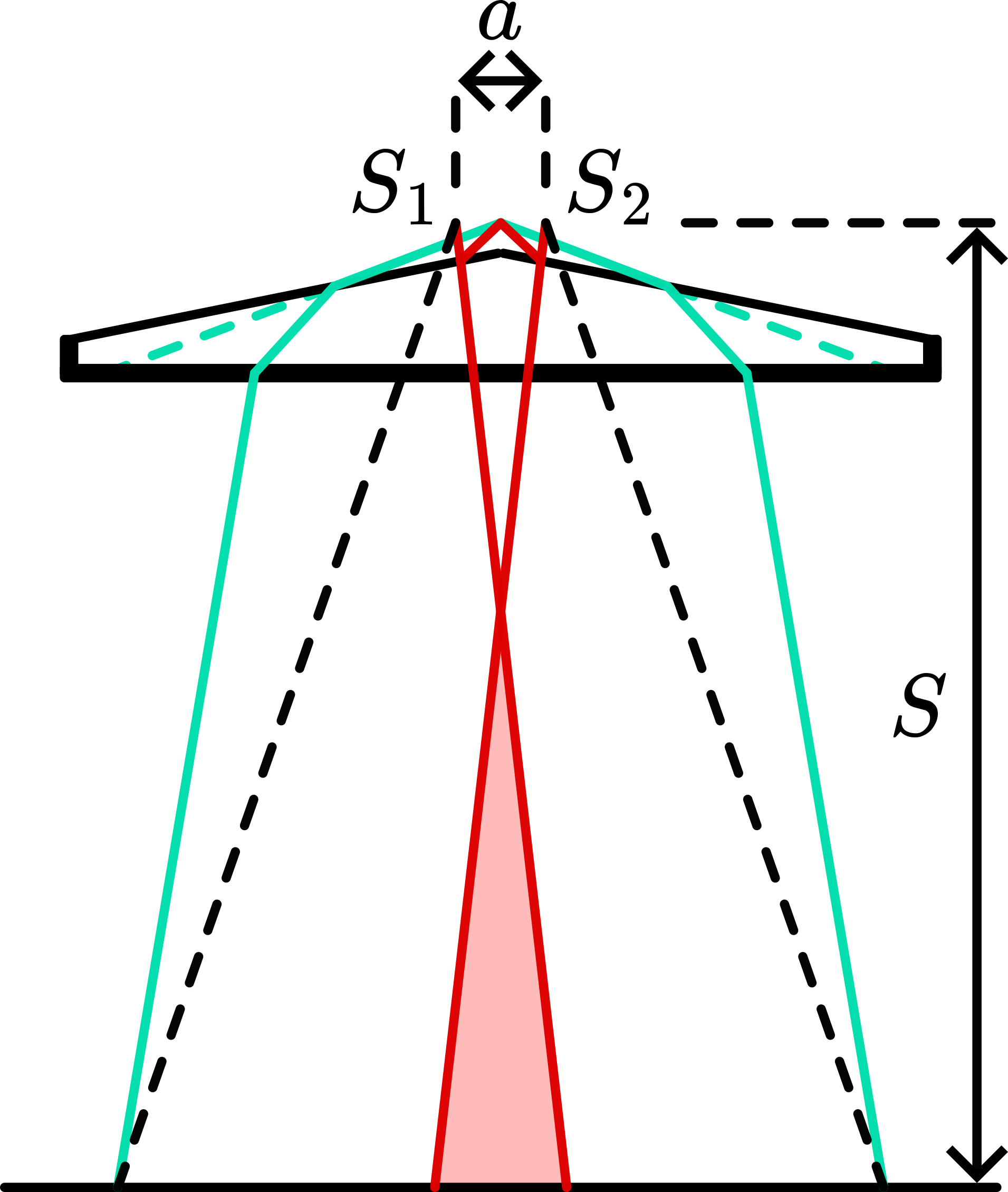
The virtual sources and can be considered as separate virtual coherent sources placed a distance apart. The separation of the fringes ( ) is given by: ( being the distance between the plane of the two sources and the screen).
Remarks
When the biprism approaches the focal point too close, the interference image becomes distorted. This happens largely due too the fact that we use spherical lenses in stead of cylindrical.
Sources
Hecht, Eugene, Optics, pag. 391
Leybold-Heraeus, Physikalische Handblätter, pag. DK 535.412;d
Phywe, University Laboratory Experiments, part Vol. 1-5, pag. 2.5
Sutton, Richard Manliffe, Demonstration experiments in Physics, pag. 403