Aim
To show how the resistance of copper wire depends on temperature.
Subjects
5D20 (Resistivity and Temperature)
Diagram
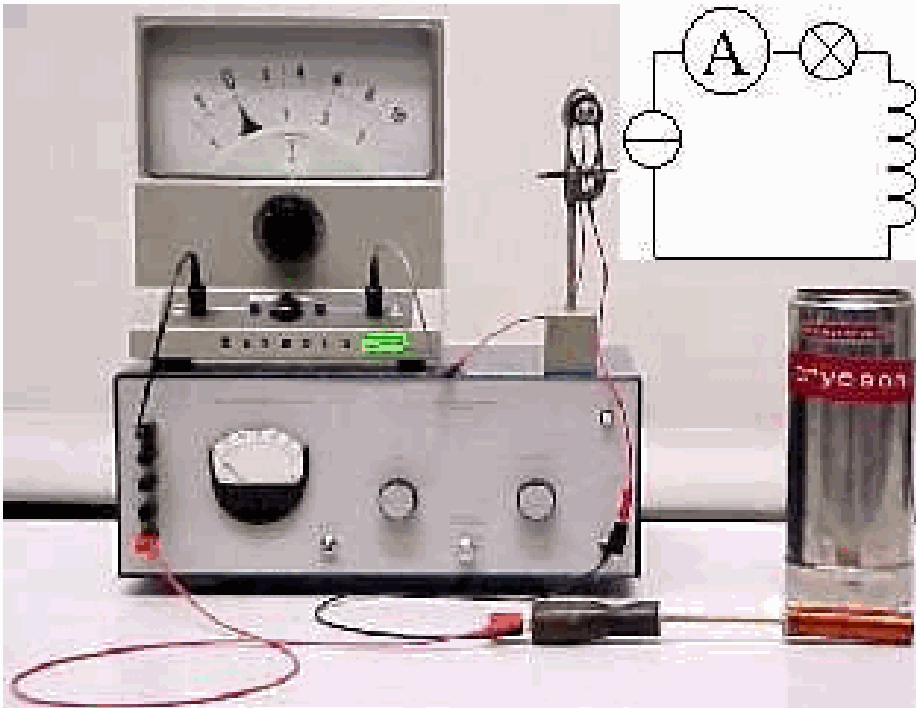
Equipment
Coil with handgrip
Lamp (we use )
Power supply
Dewar with liquid nitrogen
Current meter with large display
Presentation
The power supply is used as a current source, limited at . Increase the voltage of the power supply until the lamp just glows (reduce the light in the lecture hall). Then the coil is dipped into liquid nitrogen and slowly the lamp will glow brighter and brighter. The increase in current can also be observed at the current meter.
When the coil is lifted out of the liquid nitrogen, the current reduces slowly and the glowing of the lamp becomes more faint.
Explanation
Copper has a resistance temperature coefficient of . This resistance temperature coefficient indicates the relative change in resistance per Kelvin:
. When the coil is dipped into the liquid nitrogen, it experiences a temperature drop of about (boiling point at ). This means that the relative change in resistance equals about ! (Actually, the relative change in resistance is lower, because is not a constant.)
Sources
Sutton, Richard Manliffe, Demonstration experiments in Physics, pag. 226