Aim
To show how the resistance of a semiconductor (P-Ge) depends on temperature.
Subjects
5D20 (Resistivity and Temperature)
Diagram
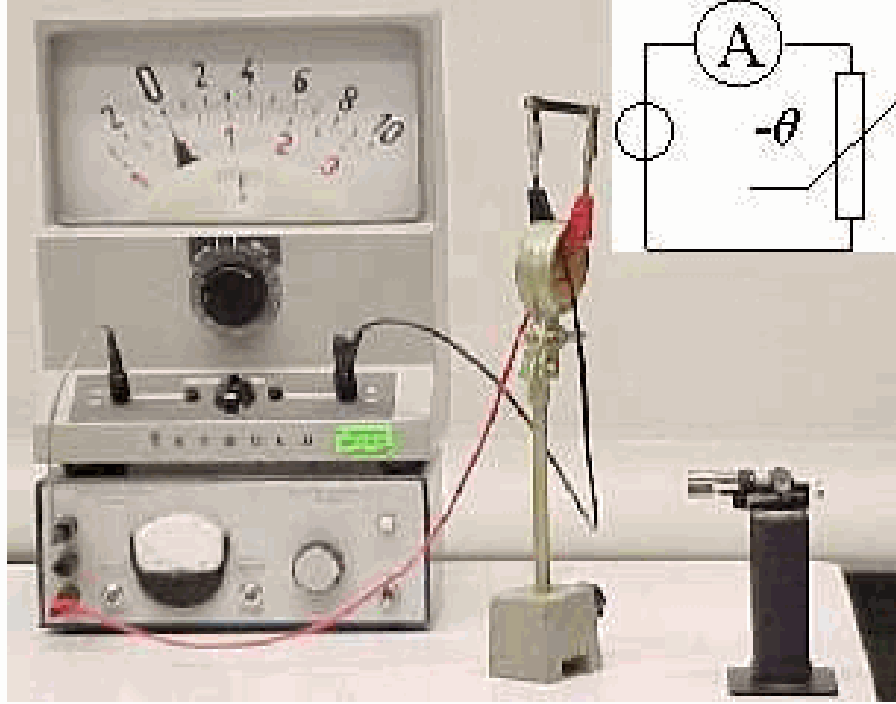
Equipment
Bar of P-Ge
Power supply
Current meter with large display
Gas flame
Presentation
Set the Ammeter at a -scale. The voltage of the power supply is raised until a current of about flows in the circuit. The bar of is heated by the gas flame and soon the current rises to a much higher value. After a short time of heating the gas flame can be removed and the current continues to rise, faster and faster, only limited by the power supply.
Explanation
The resistance of a semiconductor drops with temperature because at a higher temperature there are more free charge-carriers in it.
The current flowing in the material heats it up: The heat leaving the piece of material is proportional to (Newton cooling). When there will be thermal equilibrium and the temperature is constant. Reaching such an equilibrium takes some time.
In this demonstration lowers due to a rise in temperature and so , rises due to a rise in temperature. When this rise is faster than the rise of an ever faster rising of (like an avalanche) will result.