Aim
To show the granular appearance of laser light on reflection from a diffuse surface.
Subjects
6D20 (Lasers)
Diagram
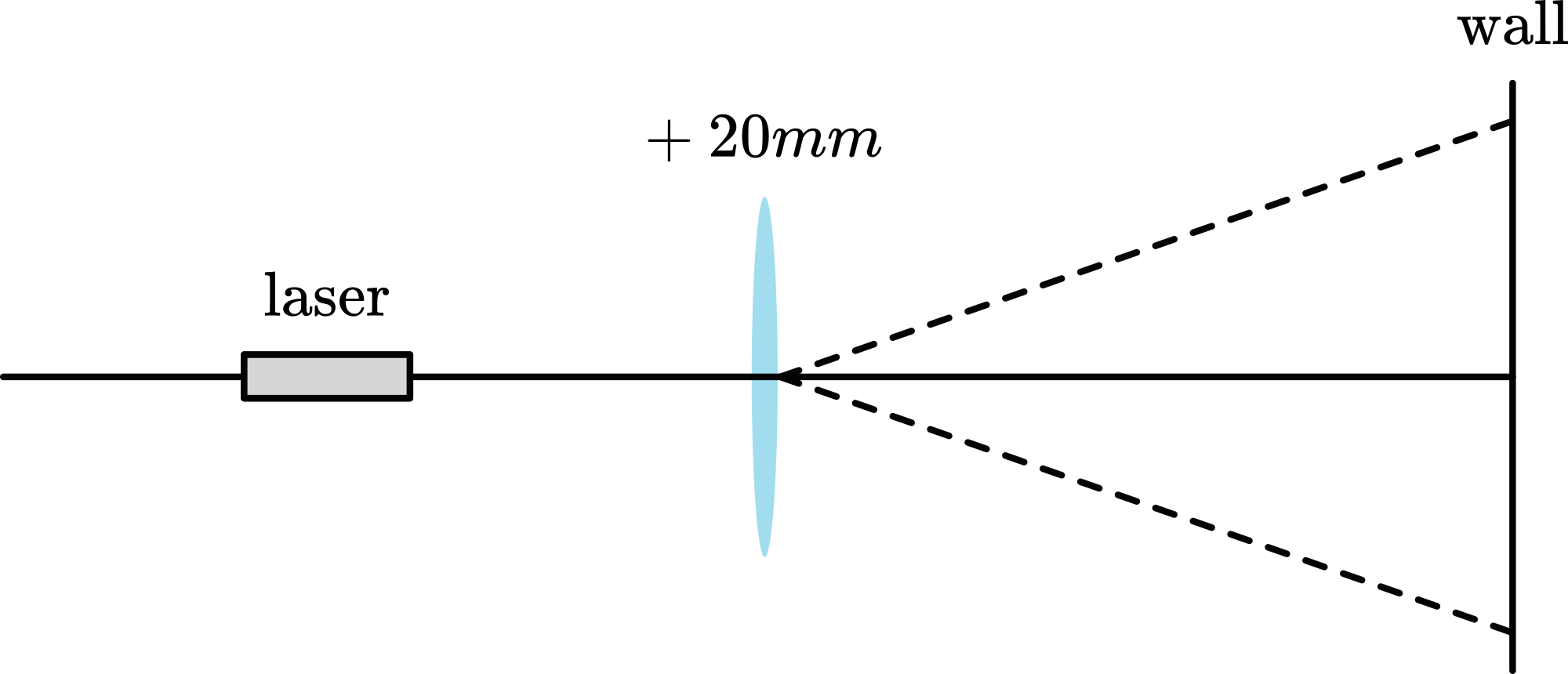
Equipment
Laser
Simple lens (we use )
Wall (diffuse surface)
Presentation
The room is darkened and the laser is switched on. An illuminated disk is projected on the wall. To the observers, this disk appears with bright and dark regions.
Stepping away from the screen makes the grains grow in size.
Squinting also makes the grains grow.
Move your head to the right and the pattern will also move to the right.
Hold a pencil at varying distances from your eye so that the disk appears just above and around it and at each position focus on the pencil. At every focus the grains are clear.
Put a lens in front of your eye (we use ), blurring everything but the granular appearance of the spot remains perfectly distinct.
Explanation
The laser light is scattered from a diffuse surface. This light is spatially coherent and it will fill the surrounding region with a stationary interference pattern. At any position in space the resultant field is the superposition of many contributing scattered wavelengths. A real system of fringes is formed of the scattered waves that converge in front of the screen. After forming the real image in space, the rays proceed to diverge, and any region of the image can therefore be viewed directly with the eye approximately focussed.
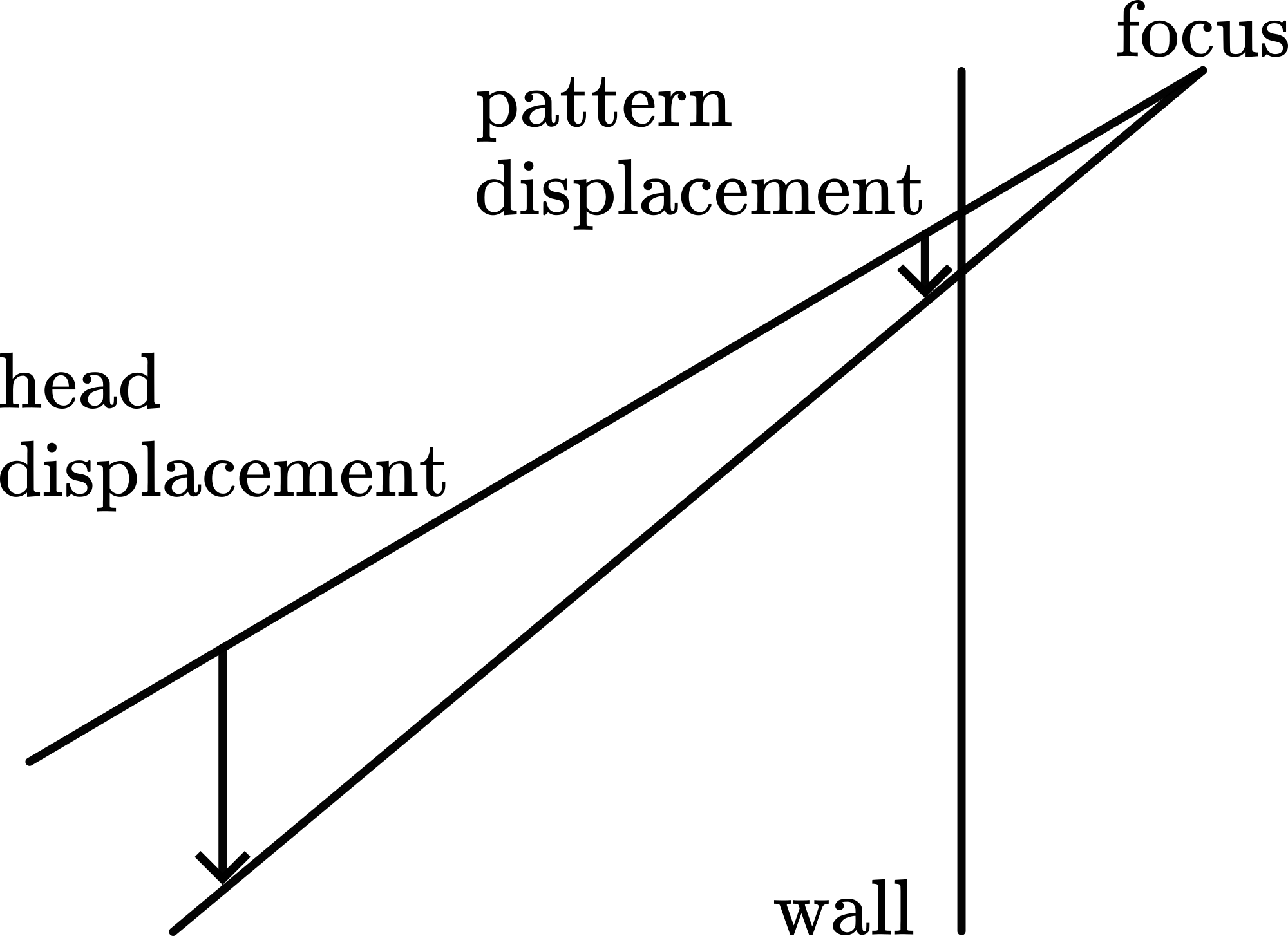
The constructive and destructive interference occur in the eye.
The diverging rays appear to the eye as if they had originated behind the scattering screen (see Figure 2). This is a result of chromatic aberration: normal and farsighted eyes tend to focus red light behind the screen. (A nearsighted person in front of the screen.)
Sources
Hecht, Eugene, Optics, pag. 595-596
Jewett Jr., John W., Physics Begins With an M... Mysteries, Magic, and Myth, pag. 387, 397