Aim
To show the interference in a thin soap film.
Subjects
6D30 (Thin Films)
Diagram
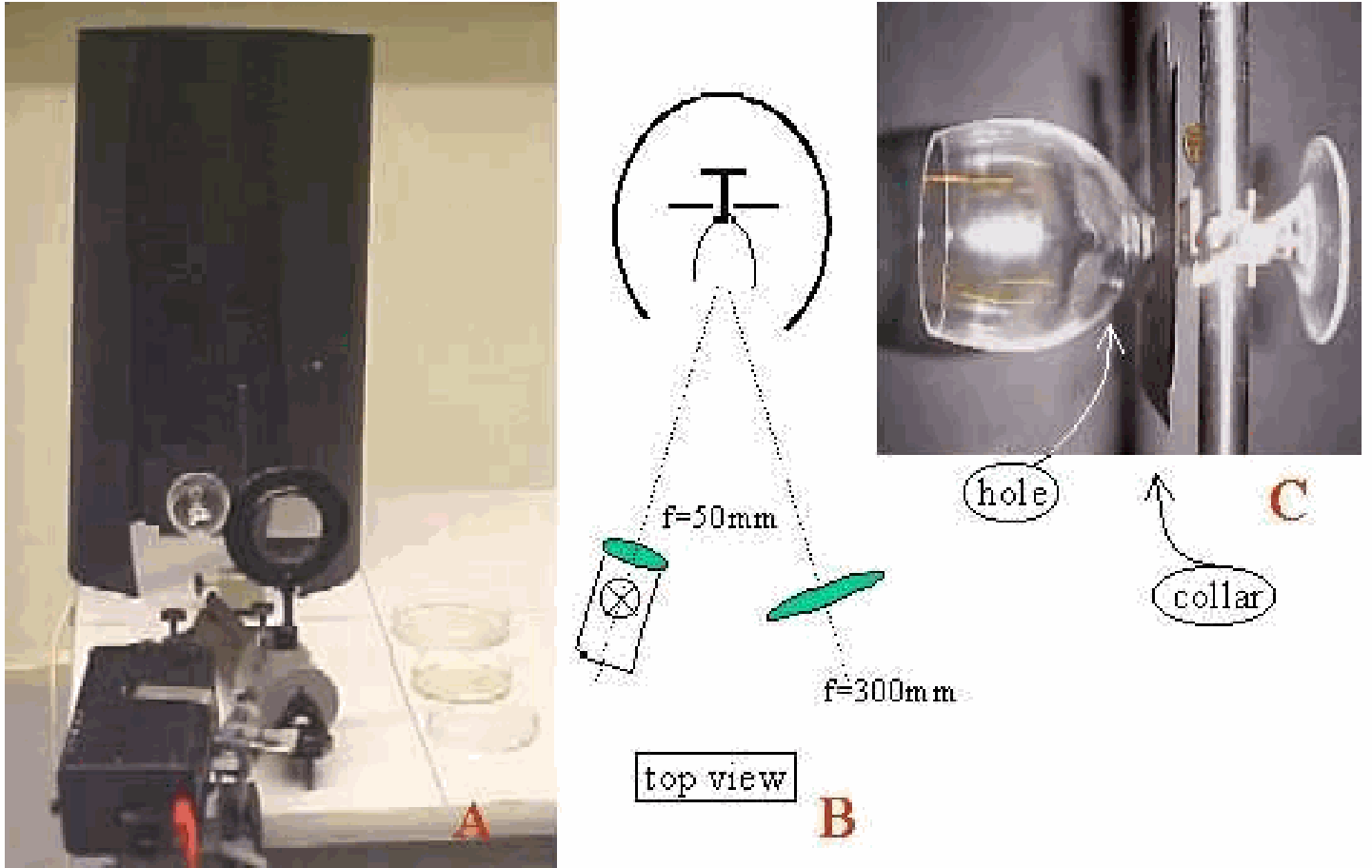
Equipment
Wineglass with a small hole cut in its cup, and a collar of black paper around its stem (see Diagram C).
Lamp, 12V/90W
Condenser lens, .
Imaging lens, .
Short optical rail.
Round screen of black paper, to screen straight transmitted light (see Diagram C).
Petri dish with a soap solution
Presentation
Having set up the demonstration as shown in Diagram, an image of the rim of the wineglass is projected on the wall. Using a felt pen you mark the position of the wineglass on the table. Using your finger you can show that the projected image is upside down. Dip the wineglass in the soap solution, so that the rim of the glass has a film on it. Put the glass back in its marked position.
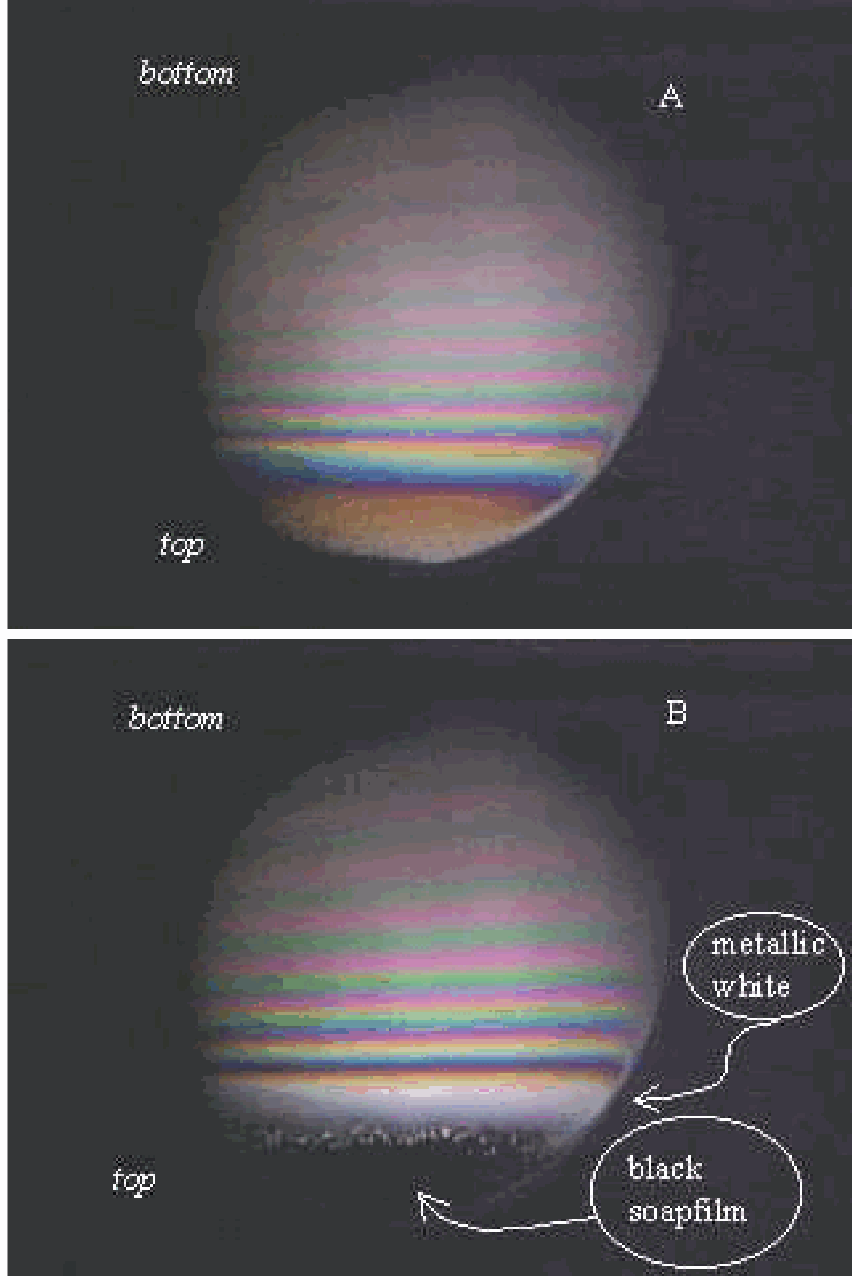
First, the image is whitish, but very soon a reddish haze appears, transforming into red and white stripes. Gradually more colors appear (see Figure 2 A) and when full color rainbows appear, also black stripes show themselves. Finally a broad whitish band appears on the upper side, abruptly followed by complete darkness (see Figure 2 B). Then the film breaks.
The demonstration is repeated a couple of times because the color transformations go pretty fast. Sometimes it needs to be repeated because the soap film breaks too soon.
Explanation
A soap film consists of a thin layer of water sandwiched between two layers of soap molecules. When the film is held vertically, gravity causes the water to drain downward, making the top of the film thinner and the bottom thicker.
Light is reflected from both the front and back surfaces of the soap film. These reflected waves combine and produce interference. Some wavelengths (colors) interfere destructively and are canceled, while others interfere constructively and are reinforced. Because different film thicknesses favor different wavelengths, varying thickness across the soap film produces the changing colors observed.
Black region The light waves reflected from the front surface of the soap film undergo a phase inversion (a phase shift of ), whereas those reflected from the back surface do not. As a result, in soap films whose thickness is much smaller than the wavelength of visible light, the reflected waves interfere destructively, producing almost no reflected light.
White region Further down the film, where the thickness reaches approximately one-quarter of the wavelength of blue light, blue light is strongly reflected. At this point, the film thickness is about one-eighth of the wavelength of red light, assuming the wavelength of red light is roughly twice that of blue light. As a result, some red light is also reflected. Consequently, the transparent film exhibits a metallic white sheen that gradually becomes increasingly blue toward the black region.
Regions of thicker films
When the film reaches a thickness equal to one-half of the wavelength of blue light, the reflected blue waves interfere destructively and are canceled. At the same time, the film thickness is approximately one-quarter of the wavelength of red light, causing red light to be strongly reflected. In general, blue light is suppressed at every integral multiple of one-half of its wavelength, while it is strongly reflected at every odd multiple of one-quarter of its wavelength.
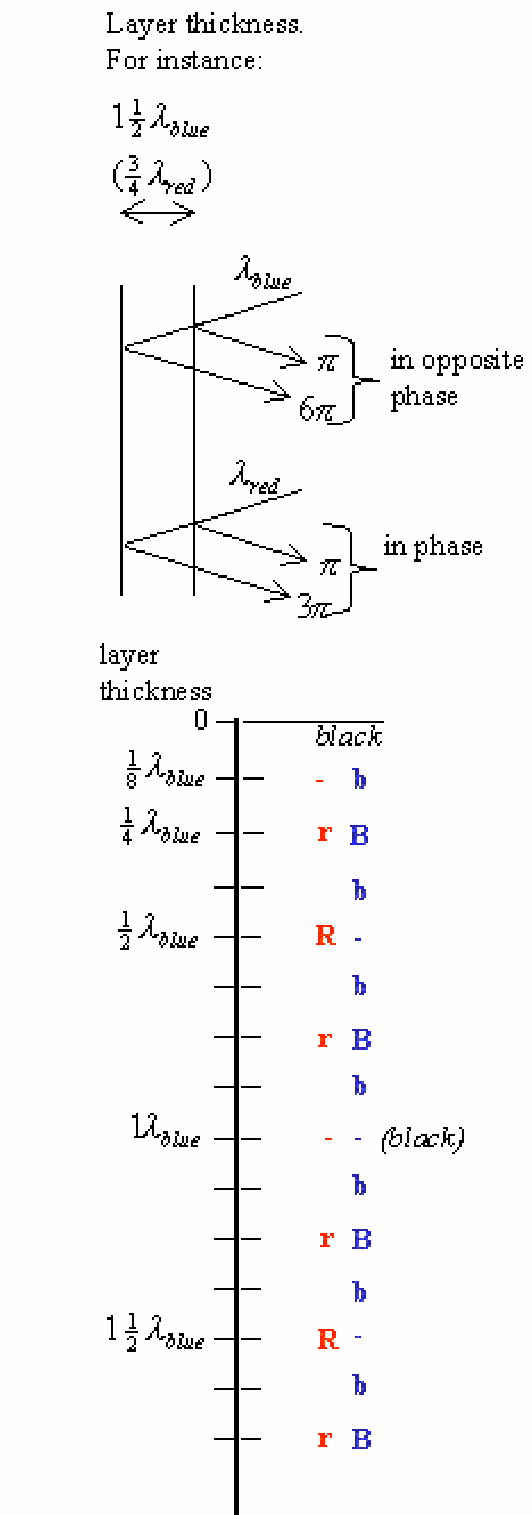
The same holds for red light. Figure 3 shows the result of this simplified blue-red dance. This figure clarifies that red dominates blue: the maximum of blue has always some red in it, while the maximum of red is “pure” red. In incandescent lamplight this is even stronger, due to the fact that red has a higher intensity in that light than blue.
Remarks
The color pattern can also be easily observed in normal daylight. But for a larger group projection will be necessary.
The wineglass has a small hole cut in its cup. When you use an ordinary wineglass you will notice that the soap film will bend inward. Colors can still be observed, but projecting a sharp image is not possible.
Robert Hooke first reported observing the transparent film in a letter to the Royal Society. His account suggests that he believed the film did not actually exist in the regions where it appeared transparent. However, a simple experiment - piercing the seemingly invisible film and thereby causing it to break- clearly demonstrates that the transparent film is still present.
See also the demonstration “Oil film”.
Sources
Biezeveld, H. and Mathot, L., Scoop, Natuurkunde voor de bovenbouw, part 4/5 vwo, pag. 128-129
Giancoli, D.G., Physics for scientists and engineers with modern physics, pag. 877-879 and 880
Hecht, Eugene, Optics, pag. 398
PSSC, College Physics, pag. 137-141