Aim
To show the interference in thin oil films.
Subjects
6D30 (Thin Films)
Diagram
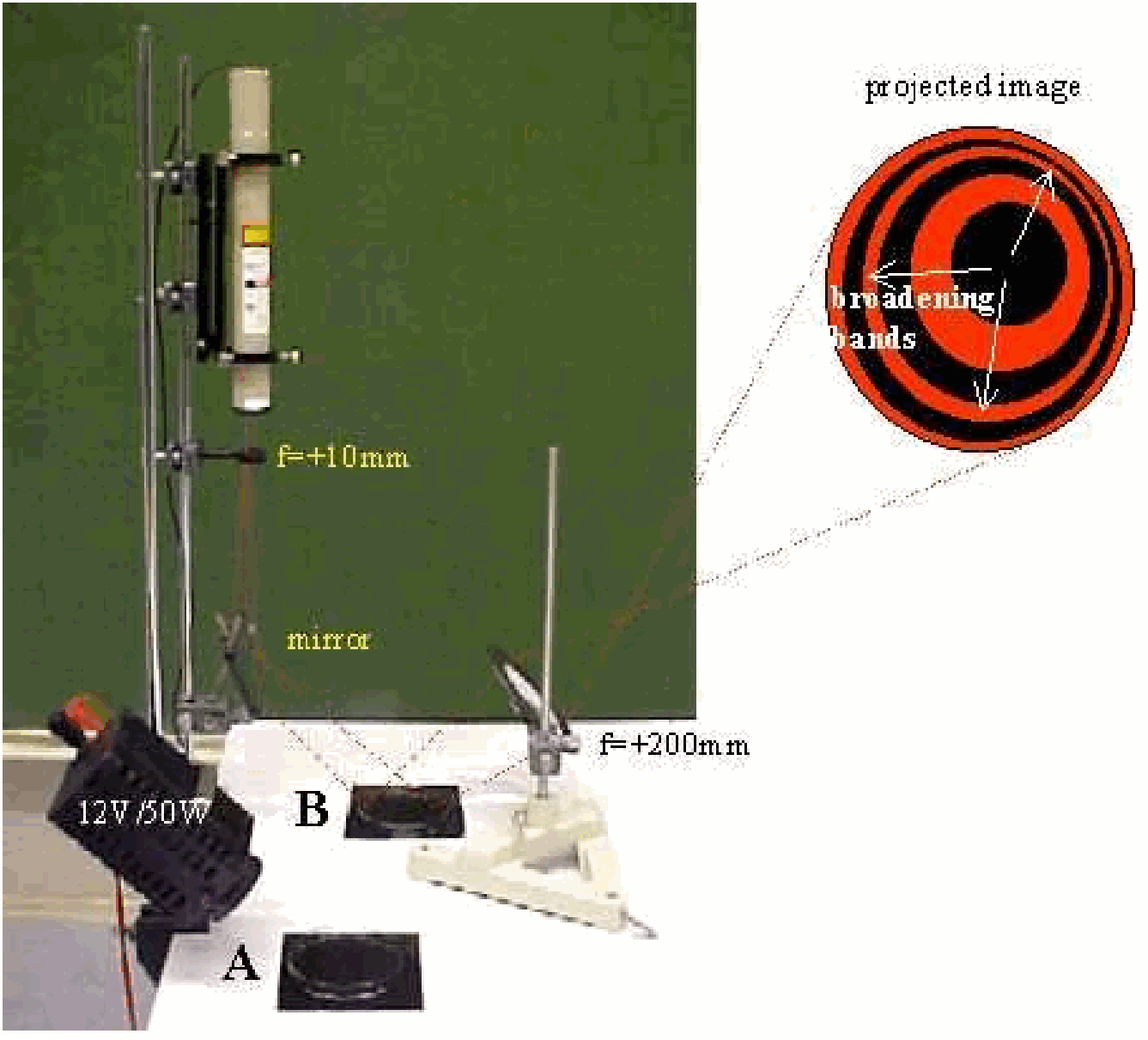
Equipment
Two Petri dishes, diam. .
Two square pieces of mat black paper, wetted and put under Petri dishes.
Lamp, 12V/90W.
Condensorlens,
Lens, , diam. (we use Leybold 46010).
Laser, red, .
Lens, .
Adjustable mirror.
Motor oil in wash bottle.
Stick, diam.=.
Presentation
The demonstration is prepared as shown in Diagram.
First the demonstration is performed with white light, so the lens should be placed near the Petri dish A. The dish is filled with a layer tap water. The lens projects an image of the water surface on the wall (see Figure 2 A). By means of the wash bottle a drop of oil is deposited on the water surface. The drop spreads out quickly, no colors are observed; only the very attentive students have seen colors at the rim of the oil spot that moved quickly outwards.
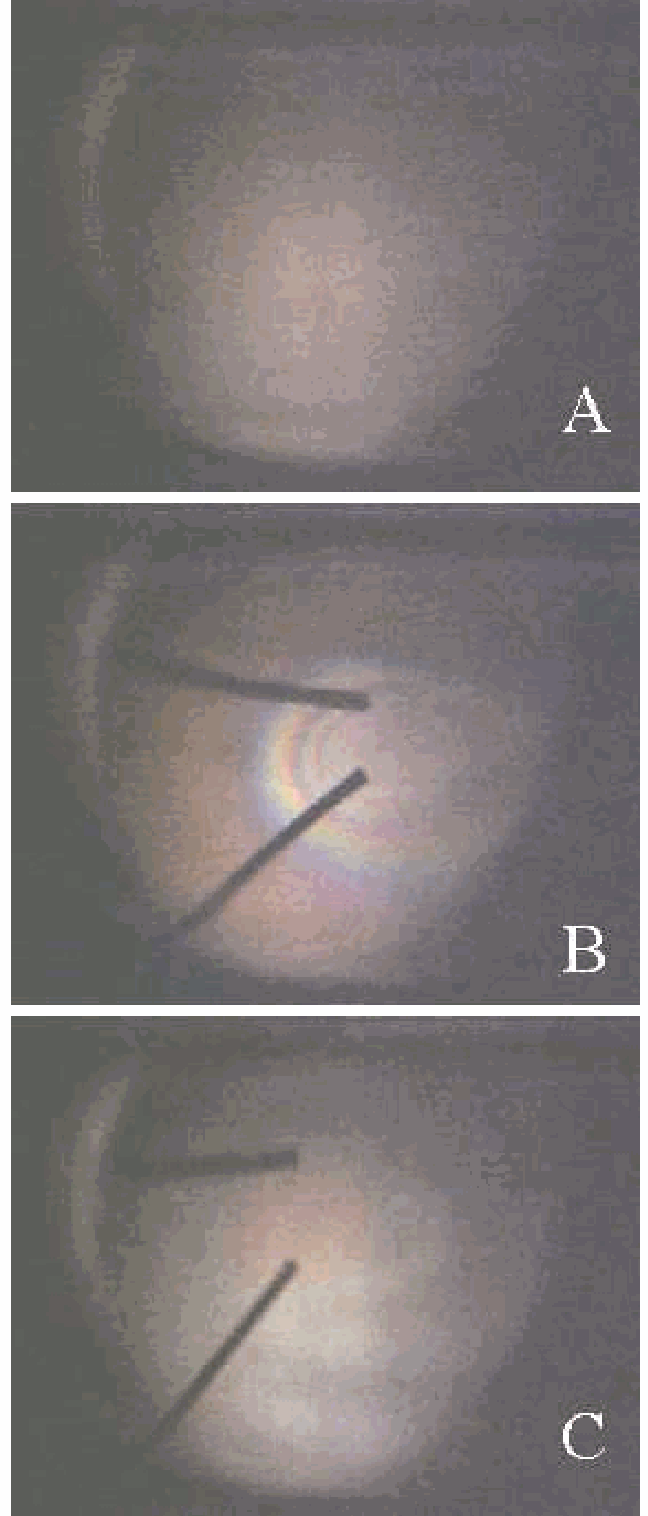
The Petri dish is cleaned and a new layer of tap water is poured in it. The thin stick is dipped in the oil and by tipping the stick on the water surface a small oil drop is positioned on it. Immediately it spreads outward in a spot and clearly colors are observed (see Figure 2 B). After a short while the broadening stops and the oil spot is seen showing one color only (sometimes reddish or yellowish or green or blue or.. -see Figure 2 C). In applying more small drops of oil on the preceding oil spot, the process of observing changing color patterns can be repeated. The advantage of placing drops on the preceding oil spots is that the speed by which the colors move and change diminishes and the process can be followed better.
The demonstration is repeated in monochromatic red laser light. The -lens makes a diverging bundle of light and via the surface mirror the water in Petri dish is exposed. Using the stick, a small drop of oil is put on the water surface. It is really amazing how clearly visible the fringed pattern of closely spaced black and red circles appears and broadens. Also in this demonstration the process of broadening is slowed down when applying more drops of oil on the foregoing oil spots.
Explanation
The thin oil film (thickness in the order of the wavelength used) serves as an amplitude splitting device (see Figure 3).
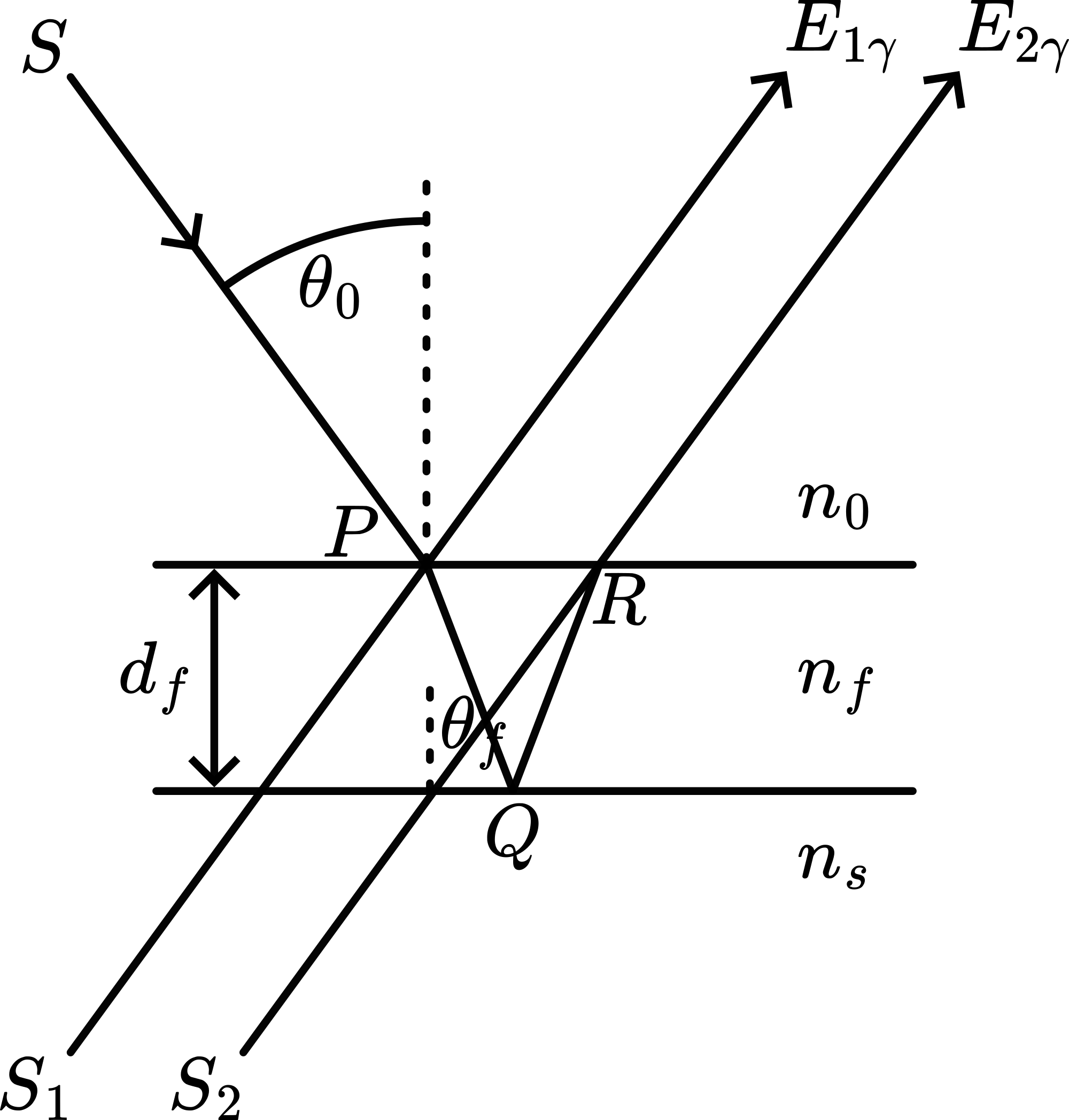
Light reflects from the top and from the bottom of the oilfilm (from the first - and the second interface), so that and may be considered as arising from two coherent sources ( and ). When the two parallel reflected rays are brought together on the retina of the eye, they add up, producing interference of light. (In this demonstration the lens brings the parallel rays together in the projection on the wall.) There is a phas edifference between the two rays of
. Using Snell’s law
, we obtain . So the phase difference is proportional to , and for a certain thickness of film some wavelength add up out of phase and are cancelled while other wavelength add up in phase and are strengthened: Different thicknesses of oil film cancel/strengthen different colors.
While the oil spreads out across the water surface, thickness varies and a changing color pattern appears. When the spreading stops, the oil film will finally have equal thickness everywhere and only one color appears.
When the oil film is very thick (the first demonstration described in “PresentationXX”) becomes too weak to give a visible result in interference. This is also observed in the part of the demonstration where we heap oil spot on oil spot and colors appear weaker and weaker.
When the demonstration is performed in monochromatic light in has only one value and for a number of thicknesses or , ( being any odd integer) giving the possibility of complete extinguishing that light.
Remarks
The black paper under the Petri dishes is wetted in order to make the underground more black.
See also the demonstration “Soap film”.
Sources
Giancoli, D.G., Physics for scientists and engineers with modern physics, pag. 877-879
Hecht, Eugene, Optics, pag. 393-399
Karel Knip, Alledaagse wetenschap, Wetenschapsbijlage, pag. 17mei-2003