Aim
To see/feel the centripetal force.
Subjects
1D50 Central Forces
Diagram
Equipment
Tube, with rounded edges, .
Piece of rope, .
Two rubber stoppers .
A number of weights . We use thick washers.
Paperclip.
(Stopwatch).
Presentation
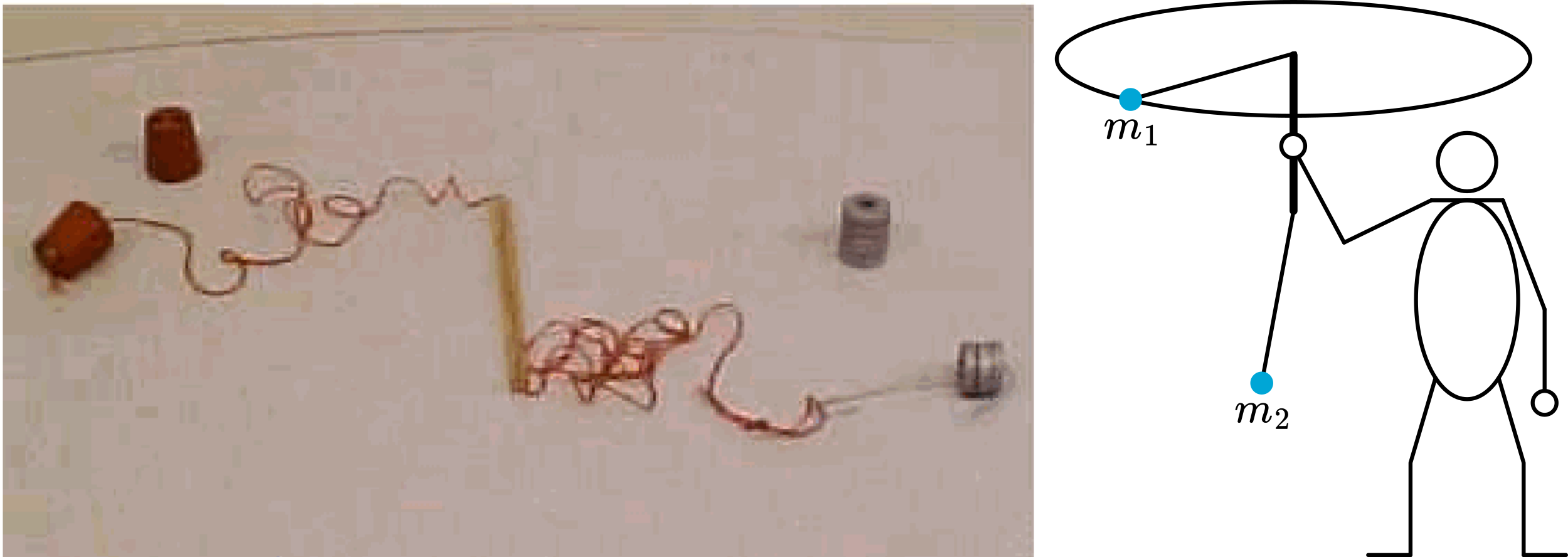
The diagram shows the components and how to use them. By swinging the tube slightly, the mass begins to move in circles above your head. The demonstrator must swing at a specific frequency to balance the system.
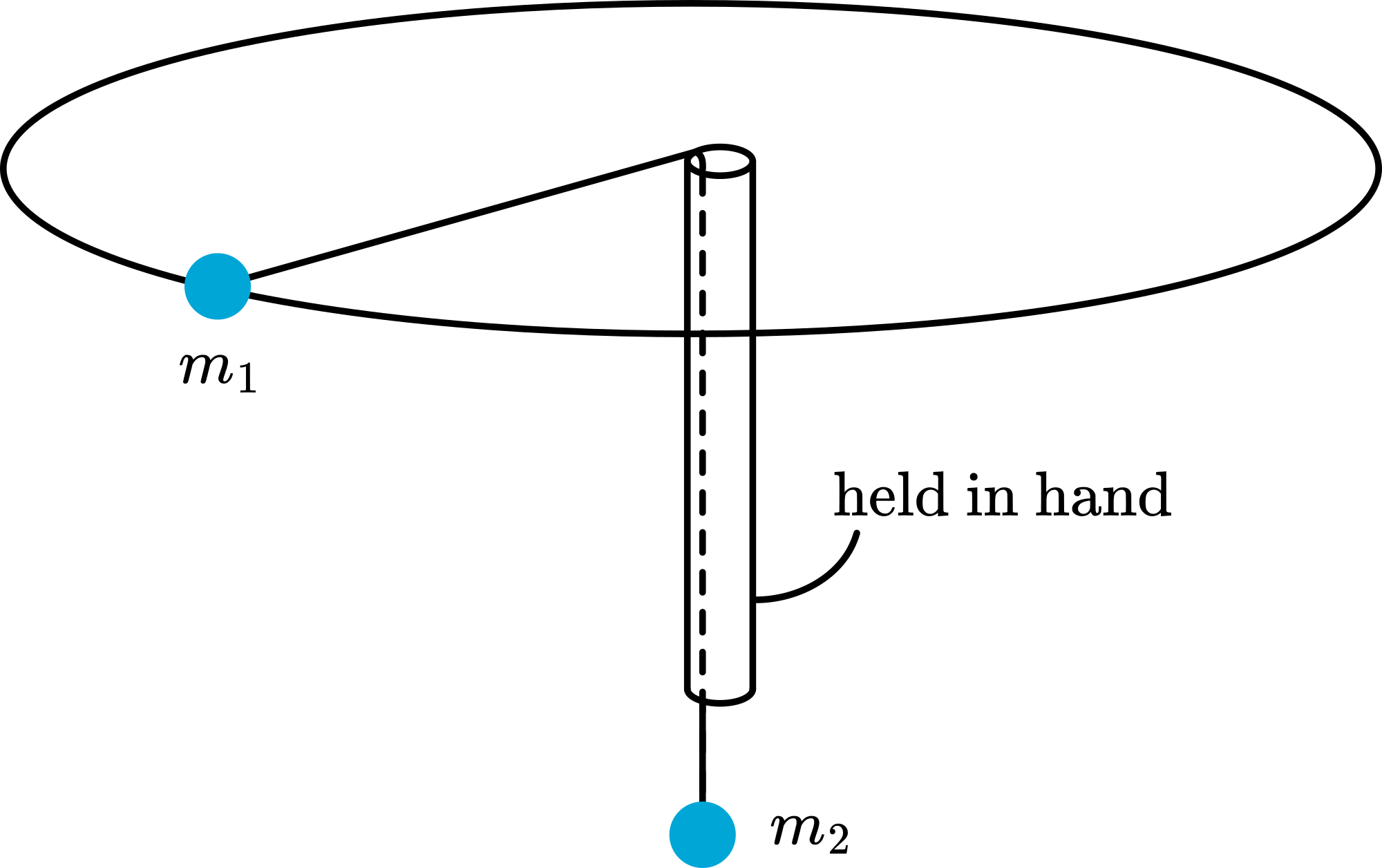
When the demonstrator slows down to a lower frequency, moves downward, causing ’s circular path to become smaller and smaller. Speeding up causes to rise, and
moves in increasingly larger circles.
The demonstrator first swings in a stable circular motion. Then, by pulling downward, speeds up dramatically, tracing tighter and tighter circles.
If time permits, the relationship between the variables in this demonstration can be verified more exactly. Just below the tubing, a paperclip is fixed to the rope used as a marker to make go round in a circle with fixed . A stopwatch can be used to time the frequency.
When is doubled by adding another rubber stopper to it, a lower frequency is needed to balance the system.
When is increased, a higher frequency is needed to balance the system.
When half the rope length is used (shifting the paperclip), a higher frequency is needed to balance the system.
Explanation
Analysis shows that movement at a constant speed ( ) of a mass ( ) in a circle with radius can be described by . In our demonstration the tension ( ) in the string provides the force needed for , and , (see Figure 3).
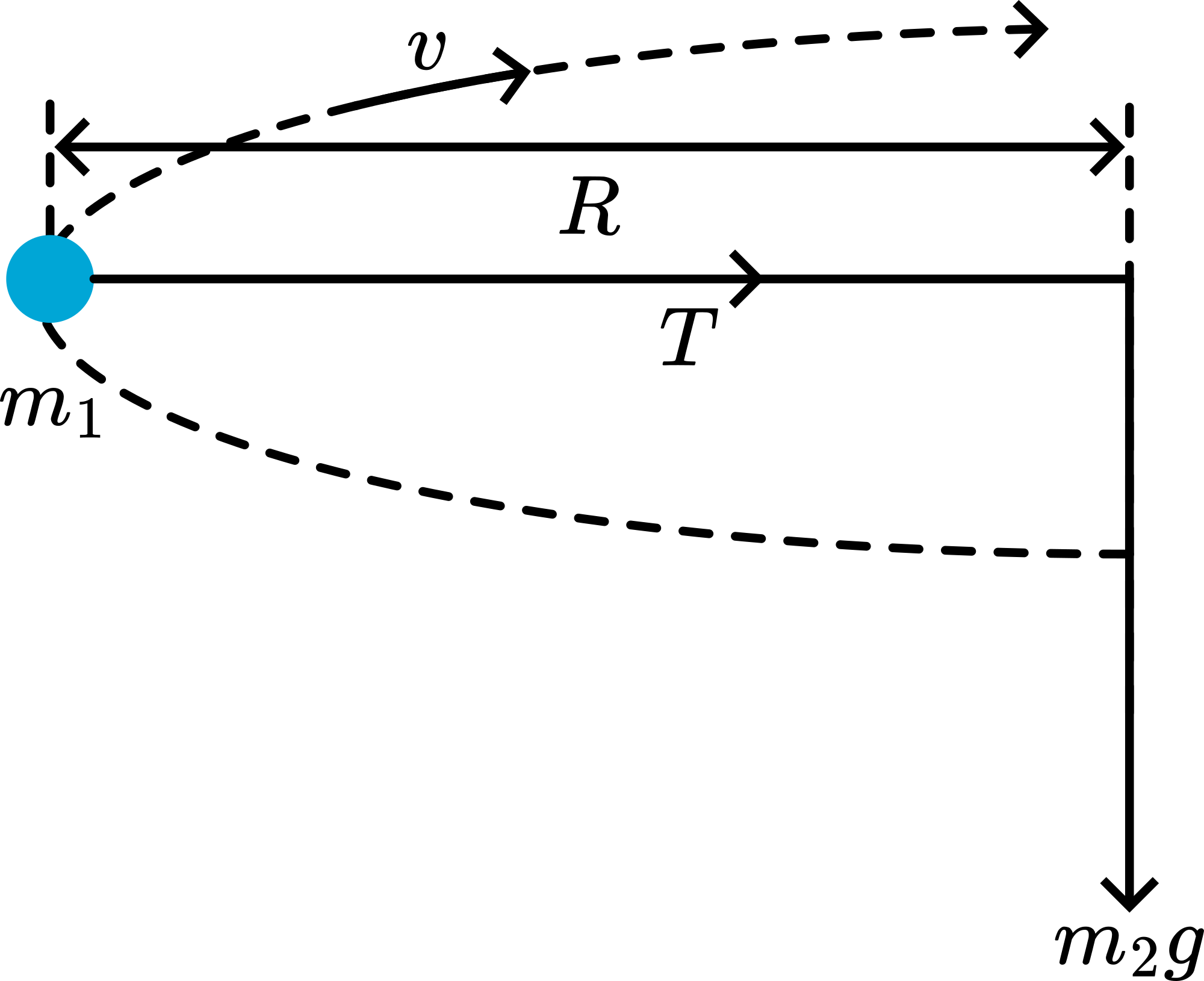
First, the demonstrator showed a balanced situation, after which he slowed down . The centripetal acceleration, describing such a slower movement, will be lower . But is a fixed value, so will pull inwardly. As shows, this proces is cumulative and ends at the centre of the circle.
When is pulled downward, the string tension increases substantially, and so does . According to , and given that decreases, increases significantly.
Doubling means that the centripetal acceleration provided by the string tension will be halved . To keep moving in the same circle, must decrease by a factor of according to .
Increasing raises the string tension, so the provided increases . To keep moving in the same circle, has to increase.
When is halved but the tension in the string remains the same, the provided also remains constant. To keep moving in a (smaller) circle, must increase by a factor of according to .
Remarks
Practice the demonstration before you show it. A practiced hand is needed to make go round properly.
Rubber stoppers are used as masses moving in circles for safety reasons.
The spinning mass should be light compared to the hanging weight (about a factor of 3), because otherwise the angle between the string and the vertical will not approach . This leads to more friction, and due to the slanting rope (forming a cone around the circle), the analysis changes.
In the last part of the presentation (grabbing and pulling downward), the demonstrator will feel that quite a lot of force is needed. It is, of course, most instructive for the students if they experience this force themselves (perhaps during the coffee break?).
Sources
Ehrlich, Robert, Turning the World Inside Out and 174 Other Simple Physics Demonstrations, pag. 72-73
Mansfield, M and O’Sullivan, C., Understanding physics, pag. 68-71 and74-75