Aim
Showing that the period of a conical pendulum changes only noticeably at large angles.
Subjects
1D50 (Central Forces)
Diagram
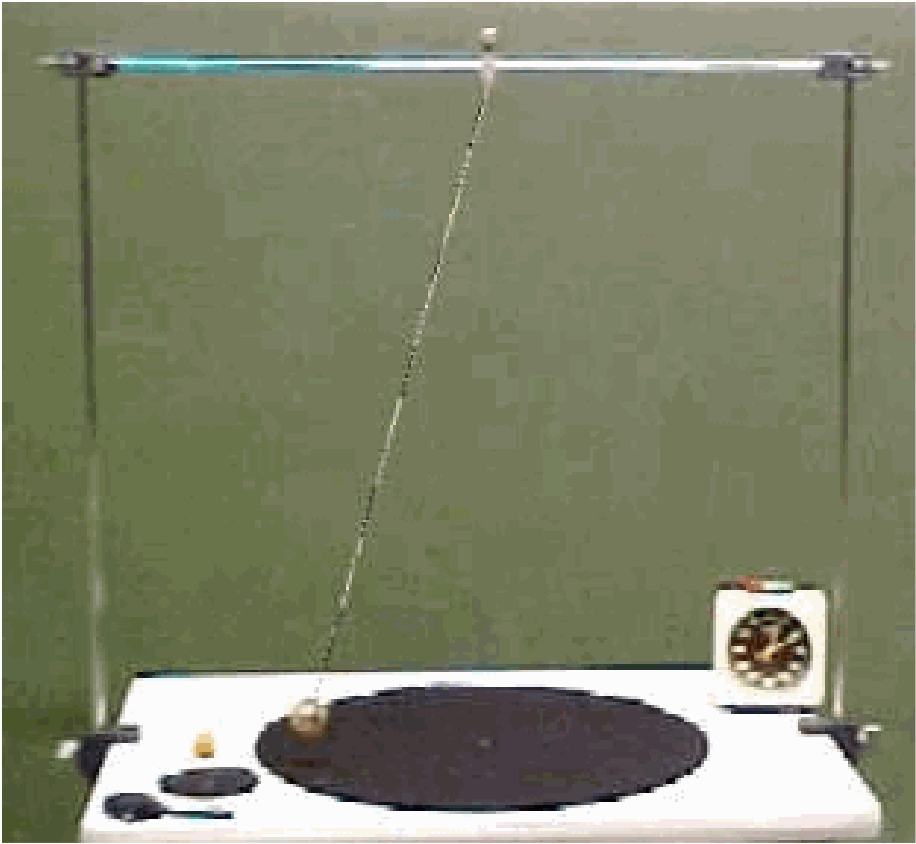
Equipment
Ball suspended on a thread.
Clamping material.
Large paper circle, .
Small paper circle, .
Stopwatch with large display.
A small ball suspended on a thread
Presentation
Set up the conical pendulum as shown in Figure 1 . Place the small paper circle under the pendulum and let the pendulum swing conically along the circumference of the paper circle. Record the time required for 10 periods. Repeat but now with the large paper circle. Our recordings yielded respectively 18.2 and 17.5 seconds.
Now, take the pendulum by hand and make it swing conically and slowly increase its speed. The increase in angular velocity becomes easily noticeable at very large angles.
Explanation
The period ( ) of a conical pendulum is given by (see Figure 2).
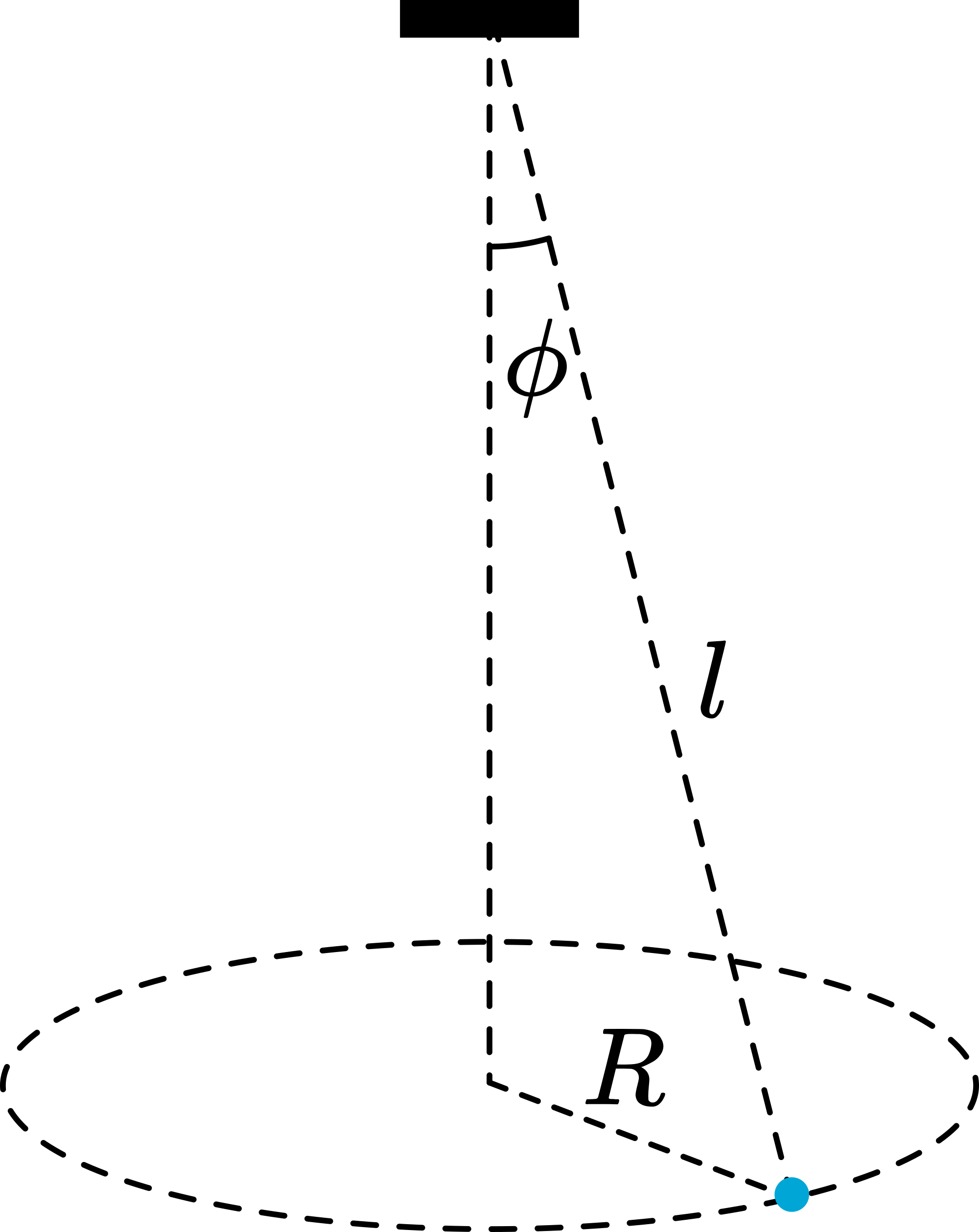
So
Table 1 shows that from to only changes , while from to this change is about . Hence at large angles , changes noticeably.
Table 1:table
| 0 | 1 |
| 15 | 0,98 |
| 30 | 0,93 |
| 45 | 0,84 |
| 60 | 0,71 |
| 75 | 0,51 |
| 80 | 0,42 |
| 85 | 0,30 |
| 89 | 0,13 |
Remarks
The position of the vertically suspended pendulum at rest is marked on the table. The paper circles have a hole in the center, making them easy to position accurately by aligning the hole with the mark.
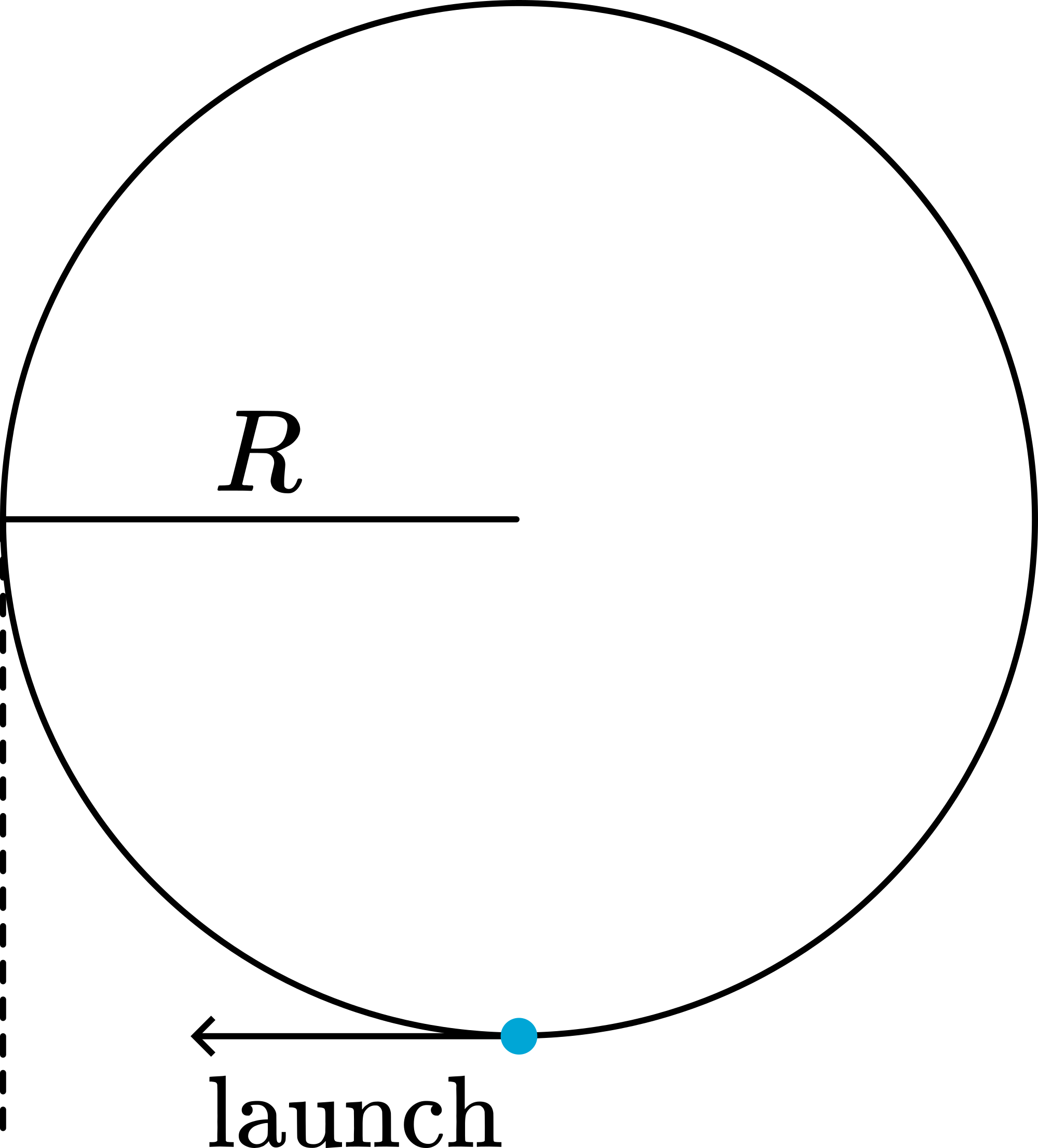
Making the pendulum swing along the circumference of the paper circle requires some practice. Launch the suspended ball tangentially and give it just enough speed to reach a maximum deflection equal to the radius, , of the paper circle. (see Figure 3).
Sources
Mansfield, M and O’Sullivan, C., Understanding physics, pag. 70
Roest, R., Inleiding Mechanica, pag. 55-56
Young, H.D. and Freedman, R.A., University Physics, pag. 141-142