Aim
To show an example of Newton’s first law
Subjects
1F20 (Inertia of Rest)
Diagram
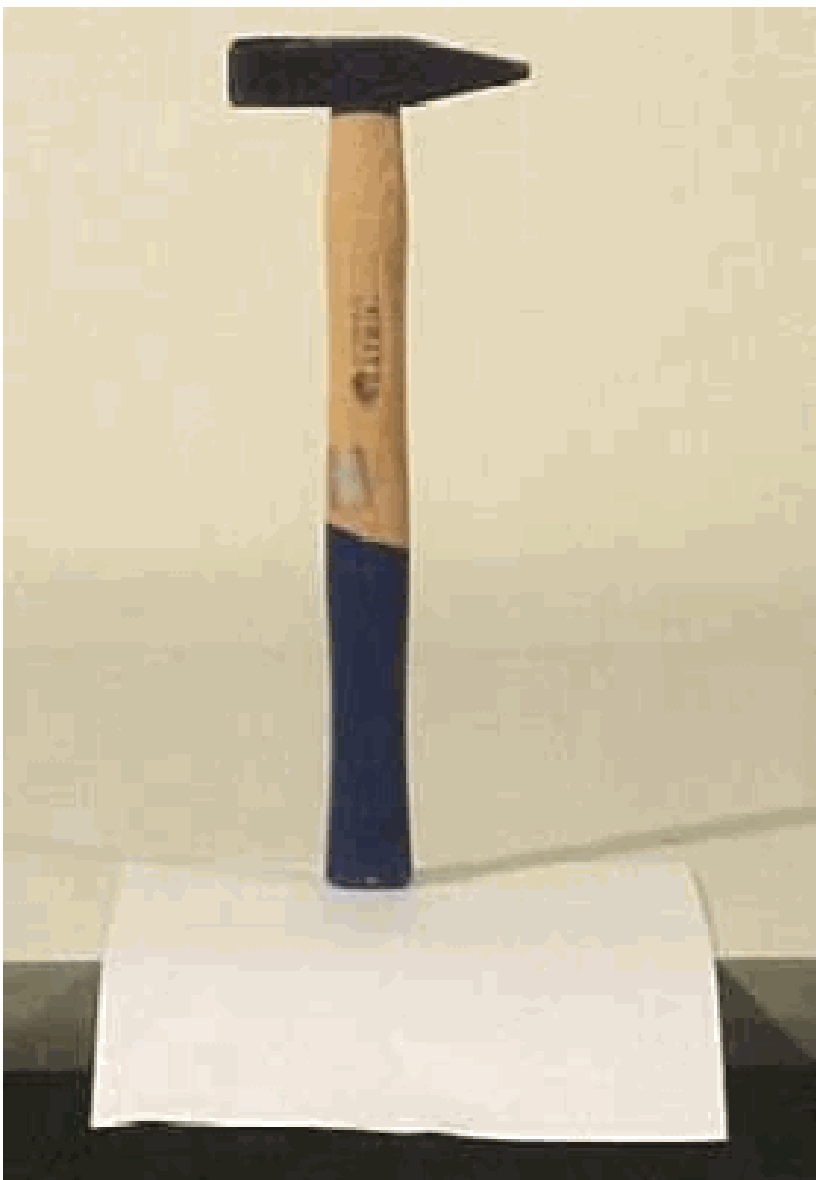
Equipment
Hammer
Sheet of paper
Presentation
This demonstration is an exciting variant to the traditional tablecloth pull; Very little is needed to topple the balanced hammer.
The sheet op paper is placed on the table and the hammer is balanced on it (see Diagram). For the audience it is observable that it takes care to balance the hammer with its head up; a slight disturbance makes it fall.
When the hammer is balanced, take hold of the sheet of paper and with a quick jerk, you pull the sheet of paper away. The hammer remains balanced!
Explanation
This is one of the many possible demonstrations to show the validity of Newton’s first law. We like this one, because a very small disturbance makes the hammer fall down, giving the demonstration more tension to the audience.
Also, Newton’s second law can be used to explain this demonstration:
The effect of a given force between the sheet of paper and the hammer depends on the impulse of that force . The impulse is small when the sheet of paper moves away quickly ( is small). The resulting horizontal displacement will then be very small.
Analysis shows that the horizontal displacement of the mass on the sheet equals:
, where is the coefficient of friction between sheet and hammer and is the coefficient of friction between hammer and table and the time to pull the sheet from beneath the hammer. So is very sensitive to !
Remarks
After the lecture students like to try the demonstration by themselves.
A successful demonstration needs trying it before you show it!
Sources
Ehrlich, Robert, Turning the World Inside Out and 174 Other Simple Physics Demonstrations, pag. 21
Sutton, Richard Manliffe, Demonstration experiments in Physics, pag. 46-49
Jones, Evan, The Physics Teacher, Vol. 15, pag. 389