Aim
A demonstration of Newton’s first law.
Subjects
1F20 (Inertia of Rest)
Diagram
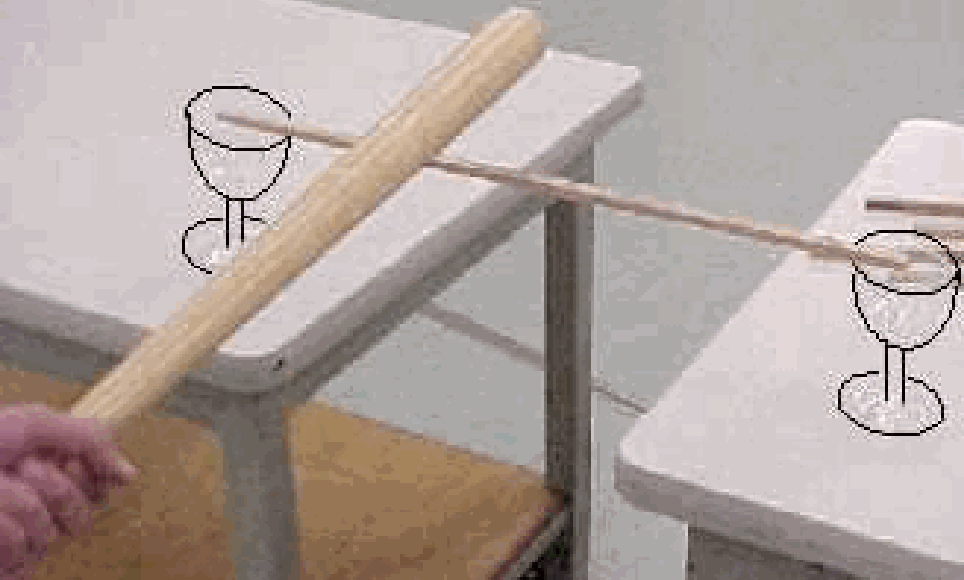
Equipment
2 wine glasses
3 wooden sticks (we use meranti multi-ply, .)
a heavy club (we use a baseball bat).
Presentation
Place a wine glass on the edge of each of the two tables. Take a stick and demonstrate to the audience that it takes considerable force to break it. Let the ends of the stick with its broad side up rest on the two glasses. Now hit the middle of the thin stick with the heavy club. Giving it enough speed to break the stick but leaving the wine glasses unmoved.
Repeat this performance with and then . The shorter the stick, the more surprising the experiment.
Explanation
When the club comes down, it touches the horizontal stick and acts on it with a force . The effect of this force depends on the impulse . The impulse is smallest when the club hits quickly, causing the least disturbance of the stick ( is small). For this reason, the club should be given a relatively high speed.
As soon as the horizontal stick is broken into two halves, these halves not only drop but also rotate around their center of mass. The centers of mass stay where they were just before hitting (inertia of rest). Due to this rotation, a stick-half moves away from the wineglass in an upward direction, provided the club has given it sufficient rotational speed.
When the horizontal stick between the wine glasses is chosen shorter, the effect is small only when the contact-time between club and stick is still shorter than it was before, because the mass of the stick is smaller now. So, in this case, the club should have an even higher speed.
Remarks
This demonstration is a variation of the demonstration in which a penny is shot out from under a stack of pennies. The stick on the wine glasses is a horizontal version of the vertical stack of pennies.