Aim
To show the ferromagnetic behaviour of a cubic lattice.
Subjects
5G20 (Magnet Domains and Magnetization) 5G40 (Hysteresis)
Diagram
Equipment
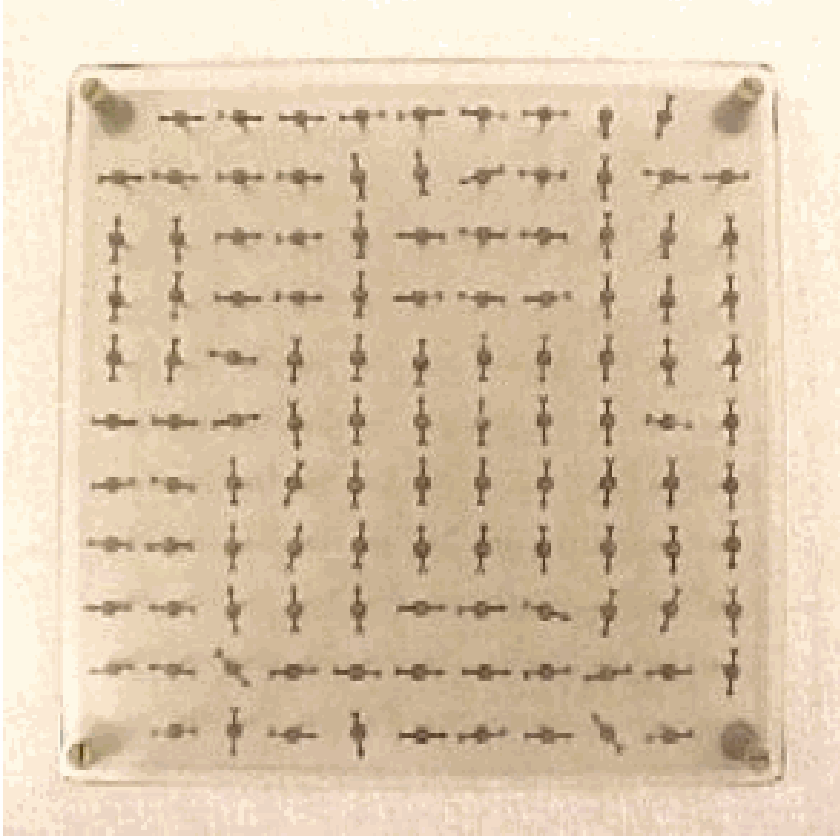
Cubic lattice with compass-needles (see Diagram).
Bar magnet.
Overhead projector.
Presentation
The model is placed on the overhead projector and projected. The individual compass-needles are aligned in groups, but in total there is no net direction. Slowly the bar magnet approaches the model. Every now and then a group of needles suddenly change their orientation and align themselves with the external magnetic field. When the bar magnet is close near the model, all needles are aligned in the same direction.
Slowly the bar magnet is moved away. Some of the needles change their direction with a step of 90 , but most of the needles keep their orientation. Only when you approach the model with the other pole of the bar magnet, then they redirect themselves.
Observing the number of needles aligned with the external field gives a good impression of the hysteresis loop. (Counting the number of individual compass needles enables you to draw a hysteresis loop.)
Explanation
The model behaves like ferromagnetic material. It has a cubic (better: flat square) structure with magnetic domains.
When the material (model) is magnetized to saturation and the external magnetic field is reduced to zero, a substantial magnetization remains. This behavior is characteristic of permanent magnets. Reducing the magnetization to zero requires the application of a magnetic field in the opposite direction.
Remarks
You can have random orientation again by shaking the model.
Sources
Biezeveld, H. and Mathot, L., Scoop, Natuurkunde voor de bovenbouw, part 4/5 vwo, pag. 222
Friedrich, Artur, Handbuch der experimentellen Schulphysik, part 6, Elektrizitätslehre I, pag. 178
Sutton, Richard Manliffe, Demonstration experiments in Physics, pag. 285
Griffith, D. J., Introduction to Electrodynamics, pag. 278-281.