Aim
The concept of impulse explains this very peculiar behavior of a bouncing ball.
Subjects
1K10 (Dynamic Torque)
1N10 (Impulse and Thrust)
Diagram
Equipment
Superball.
Table.
Safety
A superball can jump into many unexpected directions, so mind vulnerable objects in the neighborhood.
Presentation
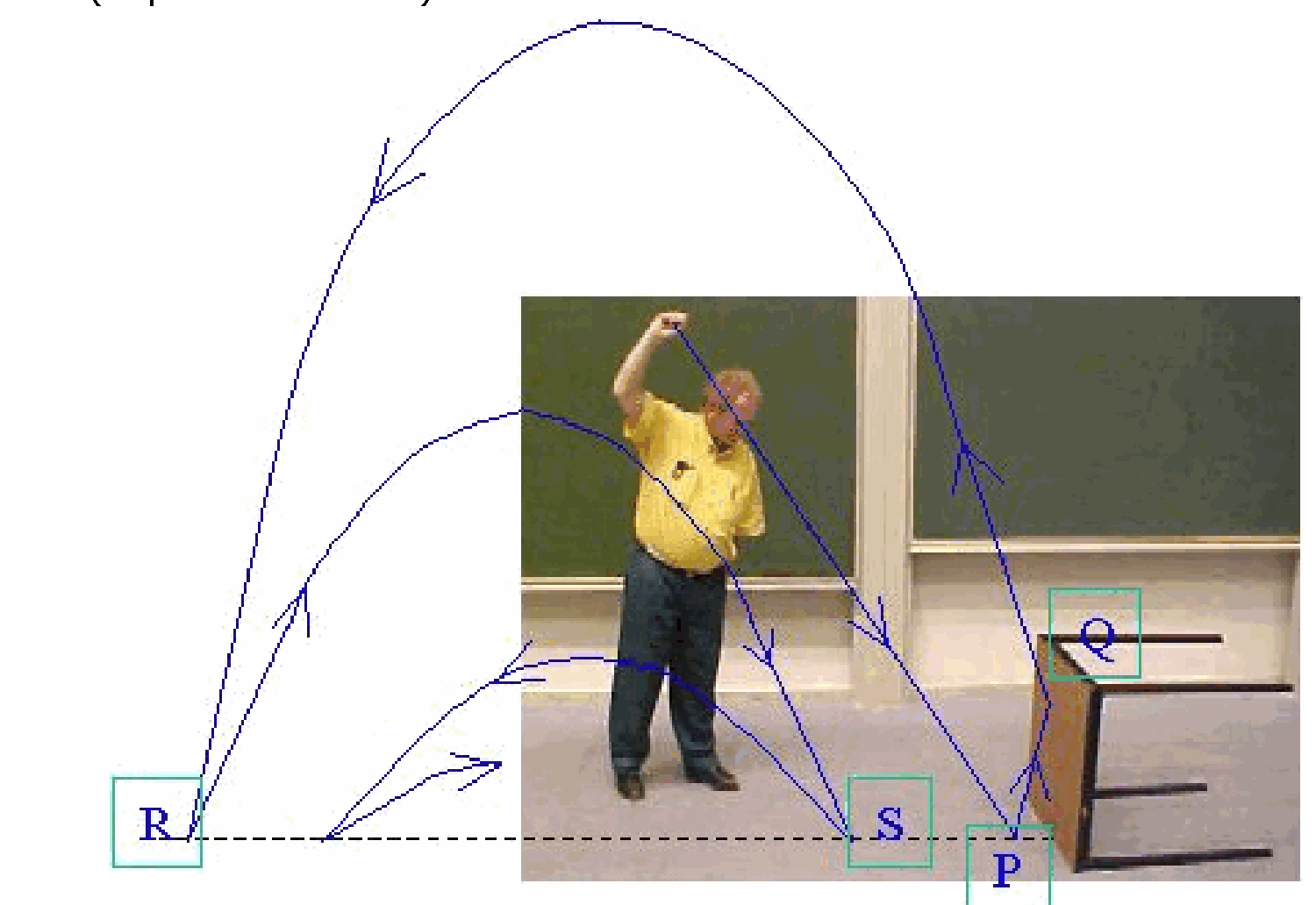
The table is positioned as shown in Diagram. The ball is thrown as shown. The ball bounces to a fro.
Explanation
As a basis to explanation see the demonstration Boomerang ball. Using a large basketball thrown against the floor and then bouncing against a vertical wall, shows that after hitting the vertical wall the basketball still rotates clockwise. Figure 2 A shows this.
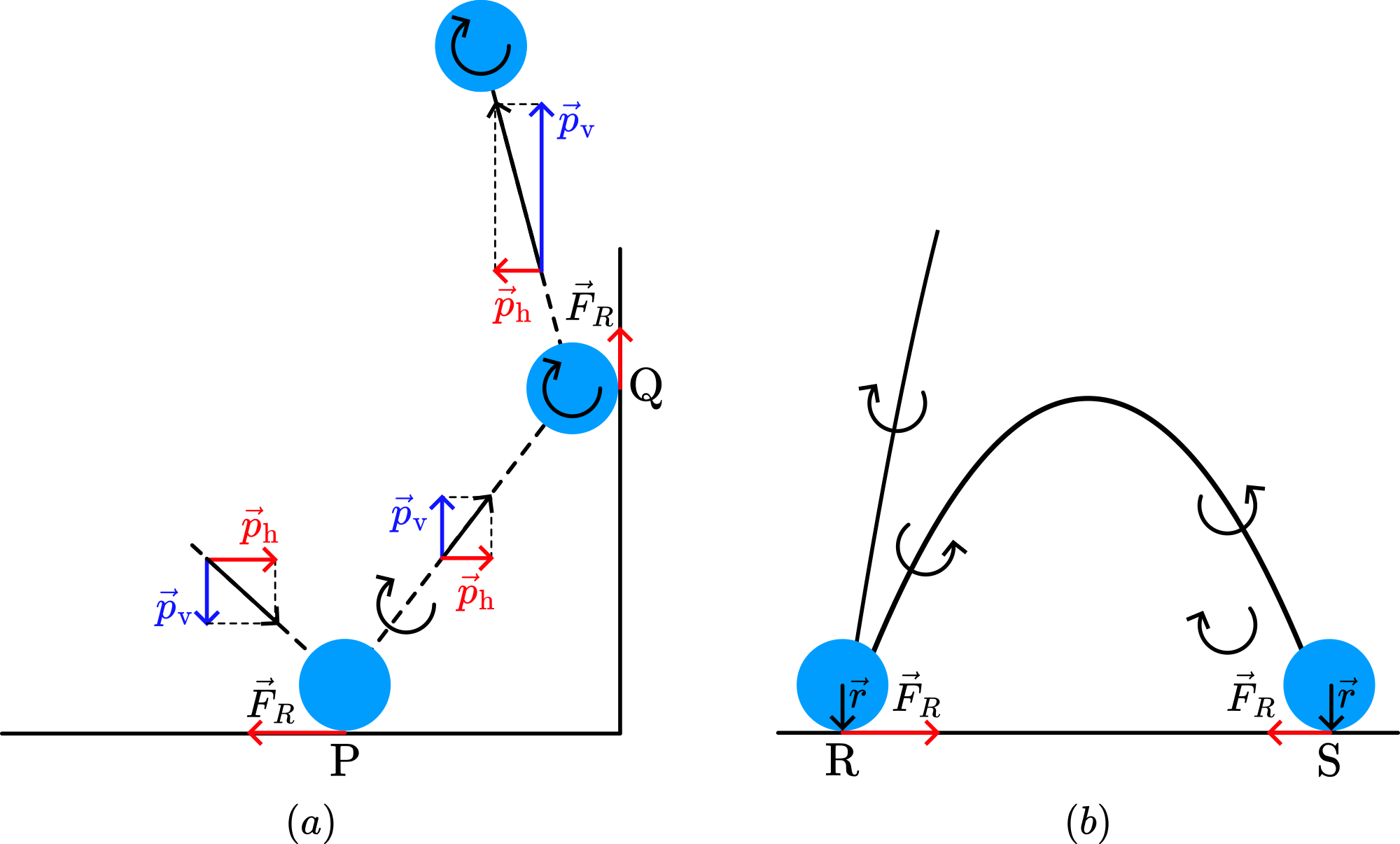
(The effect of the friction force in is not that large as that of in , since the ball approaches the vertical wall with and this momentum is smaller than
in P.)
Having hit the vertical wall the ball climbs steep (see Figure 2 A). A parabolic trajectory follows. On hitting the floor in , the friction force is directed to the right (Figure 2 B). The impulse is large enough to make the component
change direction and is inducing a counter clockwise rotation. It bounces towards and again is directed to the inner side of the parabola, making the component reverse direction and inducing clockwise rotation. And so on.
Remarks
Practicing this demonstration against a real wall will learn that this part of the demonstration can also be appreciated on its own. Having the right speed and right angle, a very high climbing ball will be the result of your practicing. Figure 2 A shows the explanation of this phenomenon: After bouncing at , has a very high value.
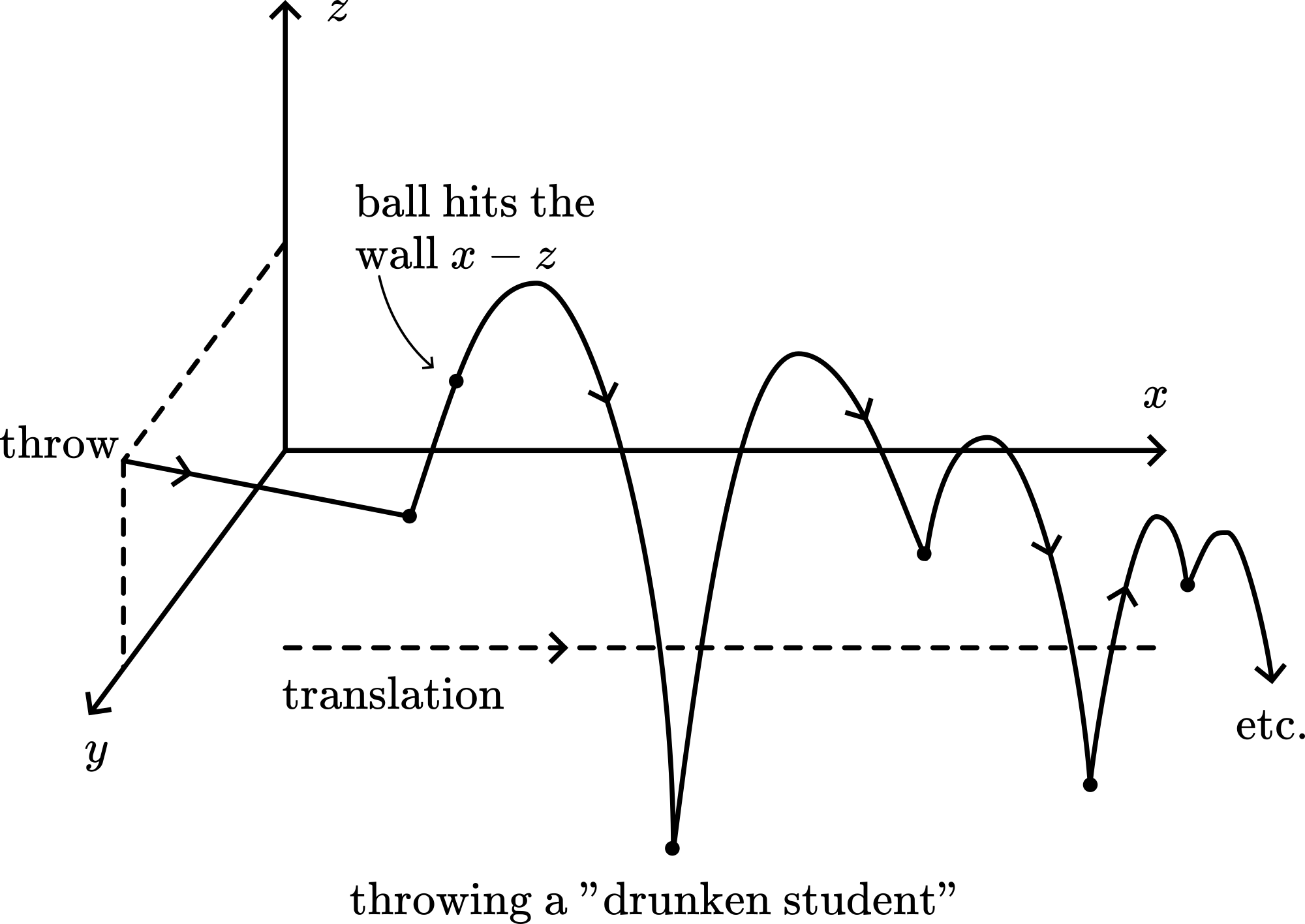
A nice variation to this demonstration is the “drunken student” (sorry, “drunken sailor”). To throw a ball that follows such a staggering trajectory, see Figure 3.
Sources
Walker, J., Roundabout, the Physics of Rotation in the Everyday World, pag. 8-12.
American Journal of Physics, pag. 875-883 (Vol. 72-7; 2004).