Aim
To show how impulse changes the movement of a thrown basketball.
Subjects
1K10 (Dynamic Torque)
1K20 (Friction)
1N10 (Impulse and Thrust)
Diagram
Equipment
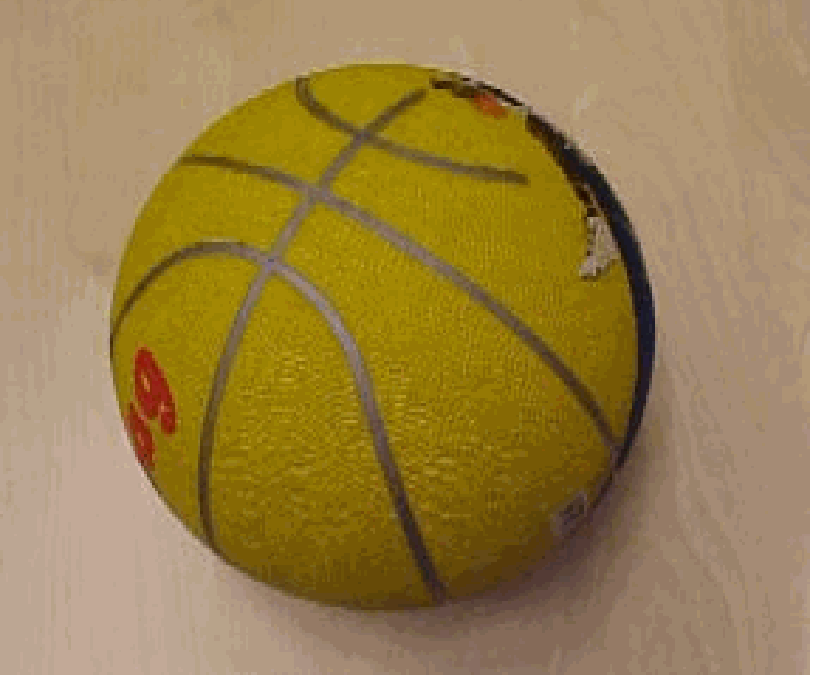
Basketball.
Presentation
The lines on the basketball make it easy to see if the ball rotates yes or no.
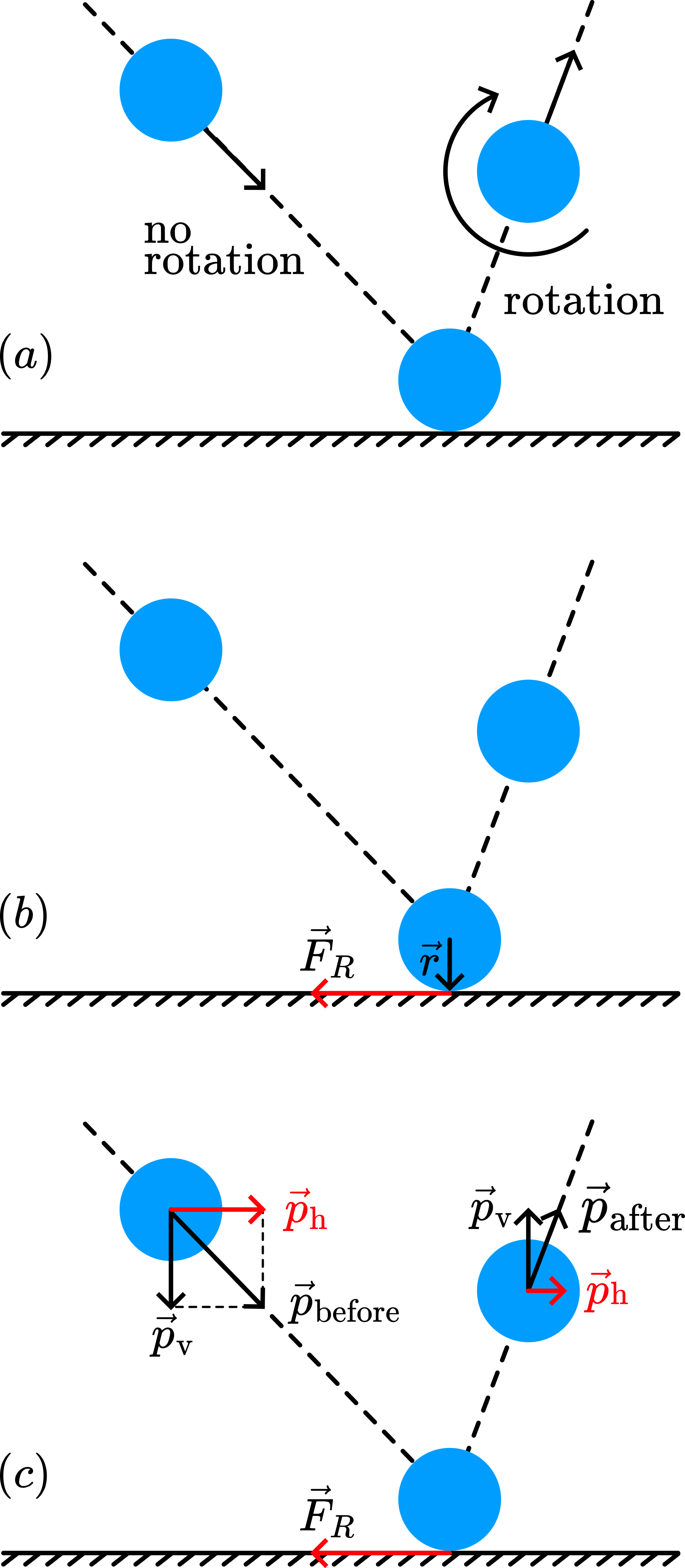
Throw the basketball and observe that before hitting the ground it does not rotate, but that after rebound it rotates (see Figure 2 A).
Also can be observed that after rebound the ball moves steeper than when it was in the throw (again: see Figure 2 A).
Explanation
The ball has an impulse , which can be looked at as consisting of a vertical component and a horizontal component . When the ball hits the ground, is reversed (supposing complete elasticity). But changes because the friction force , that acts during a short time ( ), reduces the horizontal impulse by an amount of . The combination of unchanged and changed makes that the ball mounts steeper (Figure Figure 2 C).
That it rotates as well is due to the torque during contact with the ground, changing its angular momentum by an amount of: .
Sources
American Journal of Physics, 72-7(2004), pag. 875-883
Nederlands Tijdschrift voor Natuurkunde, 70-10(2004), pag. 347
Walker, J., Roundabout, the Physics of Rotation in the Everyday World, pag. 8-12