Aim
To show the difference between braking on the rear wheels and braking on the front wheels. (To show an application of the difference between static- and kinetic friction.)
Subjects
1K20 (Friction)
Diagram
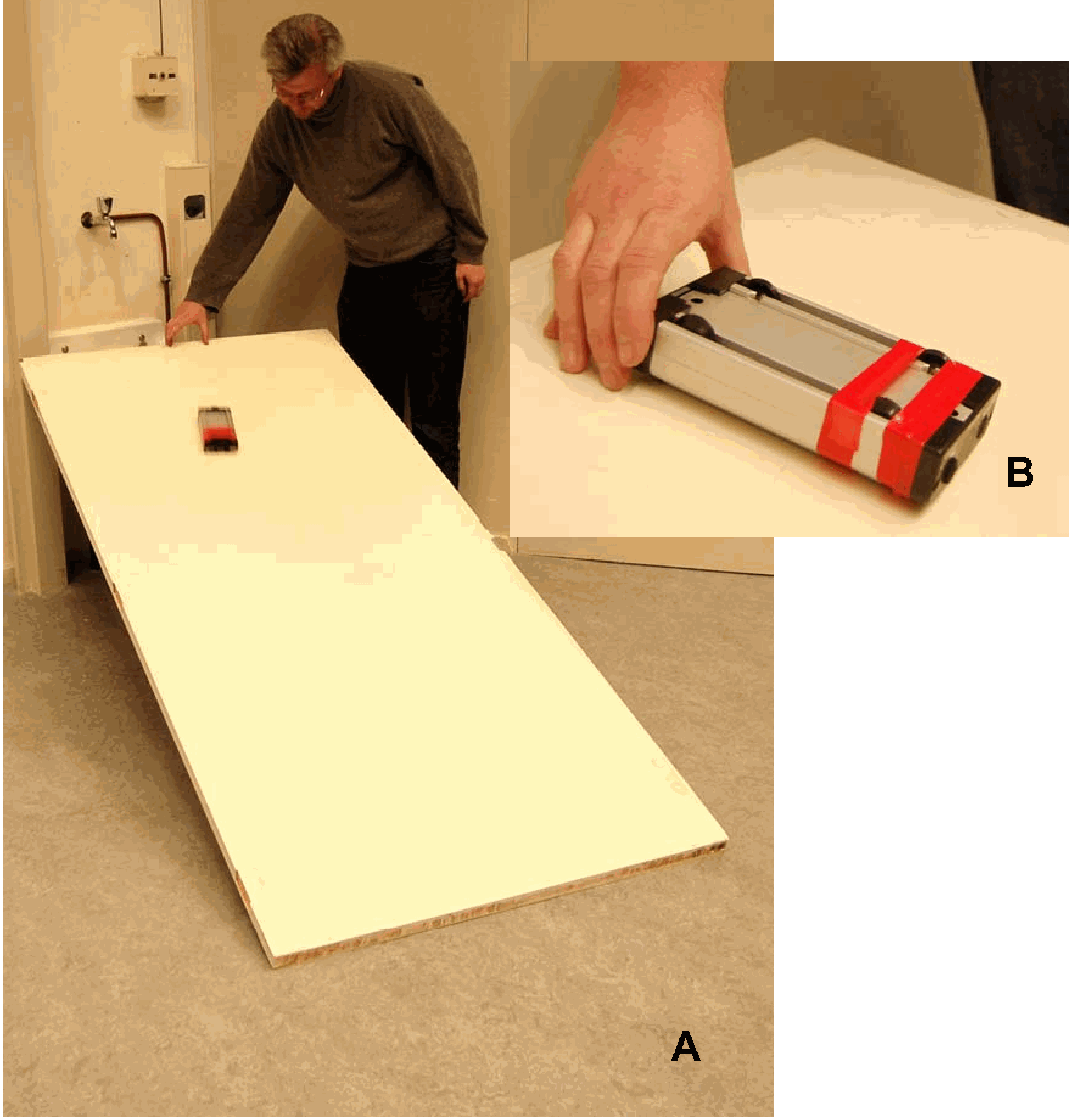
Equipment
Collision cart 1.
Collision cart 2, (the wheels of one axle are blocked using elastic tape, see B in Diagram).
An inclined board (we use an old door).
Presentation
Roll cart 1 down the incline (all wheels free) and ask the audience: “In case of rolling down an incline is it advisable to have braking (or better: “blocking”), on the rear wheels or on the front wheels, in order to have a controlled descent?” Most people guess: “rear wheels” or “doesn’t it matter which wheels you block”. Then place cart 2 with the blocked wheels at the rear, on the inclined board and permit it to go down. During this run the car reverses itself and slides down rear end first (skidding). See Figure 2.
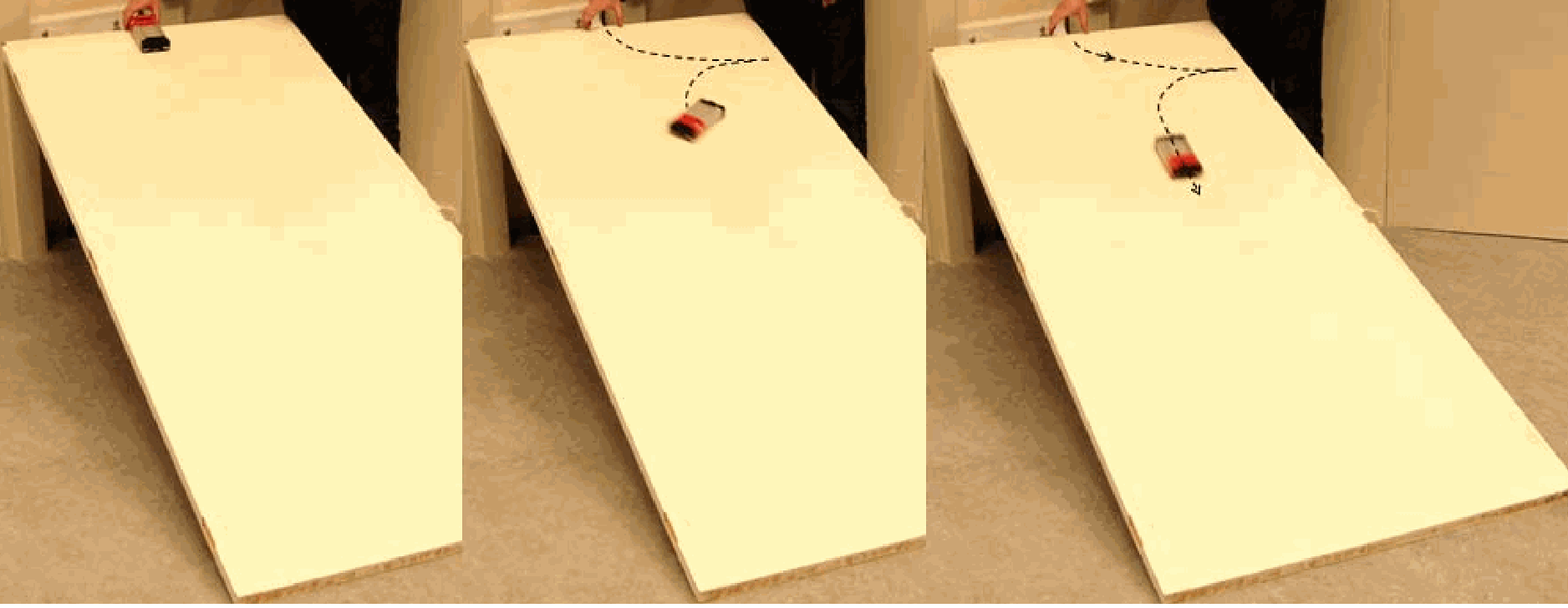
If the blocked wheels are at the front, the car slides down without skidding. It stays inline on the inclined plane. See Figure A in Diagram: The cart had its blocked wheels in front and is launched under a small angle with the direction of the inclined plane. During its run it lines up into the direction of the inclined plane.
Explanation
When a wheel is rolling, it is governed by static friction. When a wheel is sliding, it is governed by kinetic friction. The coefficient of static friction is higher than the coefficient of kinetic friction (see, for instance, the demonstration “Sliding towel” in this database). Figure 3 shows the effect of this on the cart in case of blocked wheels at the rear: The frictional force at the rear wheels is lower than that on the front wheels (supposing equal normal forces on the wheels), and so the resultant force into the downward direction along the plane is highest on the rear wheels. This means a higher acceleration along the plane and in due time the rear wheels will overtake the front wheels.
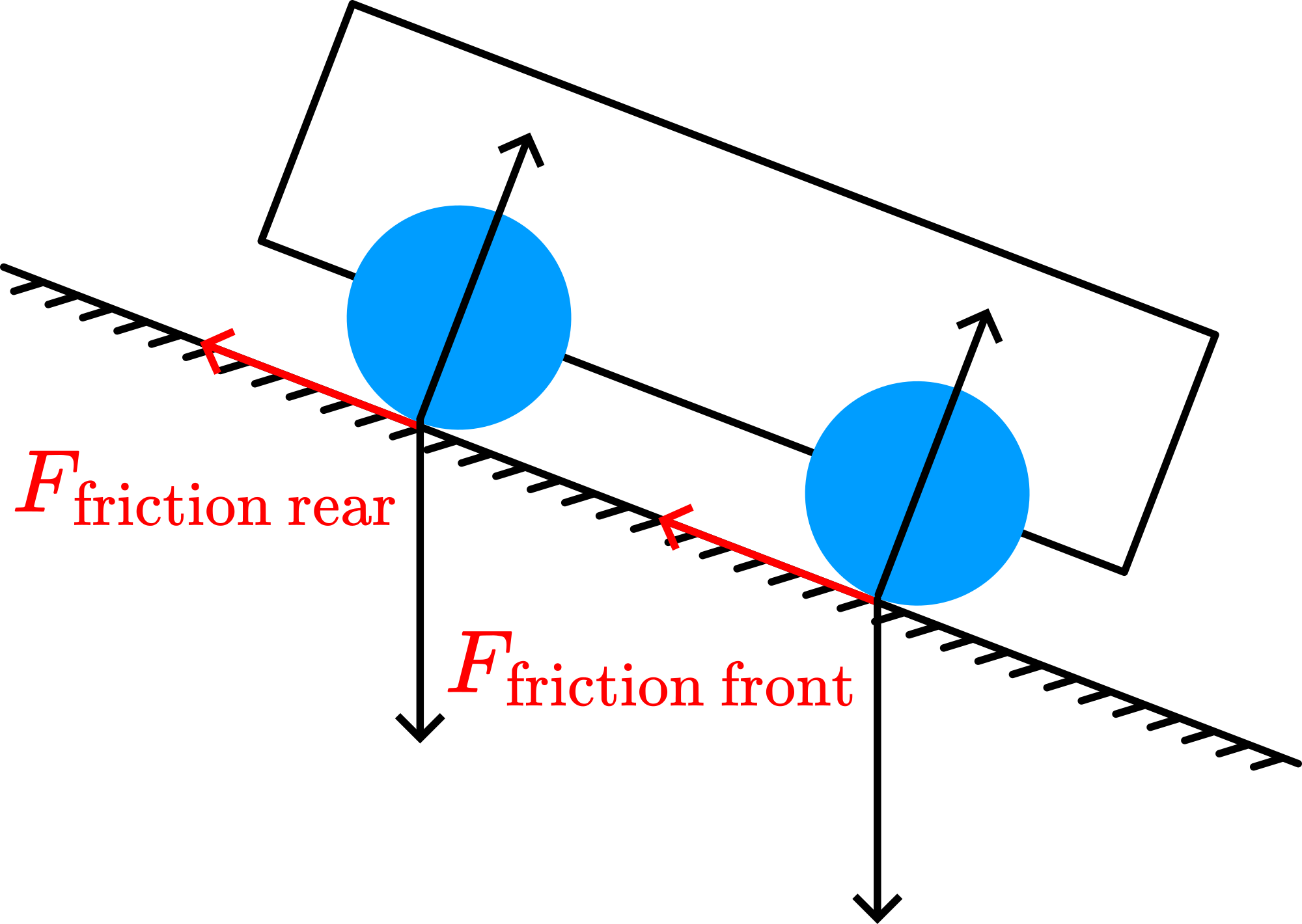
Now it will be easy to explain also the situation of blocked front wheels. In that situation the front wheels will have the highest acceleration, resulting in lining the car into the direction of the inclined plane
Remarks
Students experience the most difficulty with the fact that a rolling wheel means static friction. So stress in your explanation that the local velocity of a rolling wheel at the point of contact with the road is zero. (see Sources: The Physics Teacher)
The demo can also be done on the ground giving the cart a push. (But then students sometimes think that you trick them in the way of pushing.)
This demonstration also leads to the answer on questions like “Should you lock your brakes when sliding?” and “Why should you steer into a skid?”.
Due to the geometry of the demonstration the normal forces on the front - and rear wheels are not equal: The normal force on the front wheels is higher than the normal force on the rear wheels. In case of locking the rear wheels the difference in the friction forces (see Figure 3) is still larger and so the skidding effect will be even stronger. But in the situation where we lock the front wheels, the difference between the normal forces is contra-productive (even a front wheel lock can then produce a skid). The longer the car, the smaller the difference between the normal forces: so use a relatively long car to have a successful demonstration. (Having done the demonstration with a long car it can be stimulating to do it also with a short one.)
Sources
Lewett Jr., John W., Physics Begins With an M... Mysteries, Magic, and Myth, pag. 40.
Mansfield, M and O’Sullivan, C., Understanding physics, pag. 66-67.
Meiners, Harry F., Physics demonstration experiments, part I, pag. 153.
Sutton, Richard Manliffe, Demonstration experiments in Physics, pag. 32.
The Physics Teacher, Vol. 25, pag. 504.