Aim
To show the historic experiment of Arago on eddy currents.
Subjects
5K20 (Eddy Currents)
Diagram
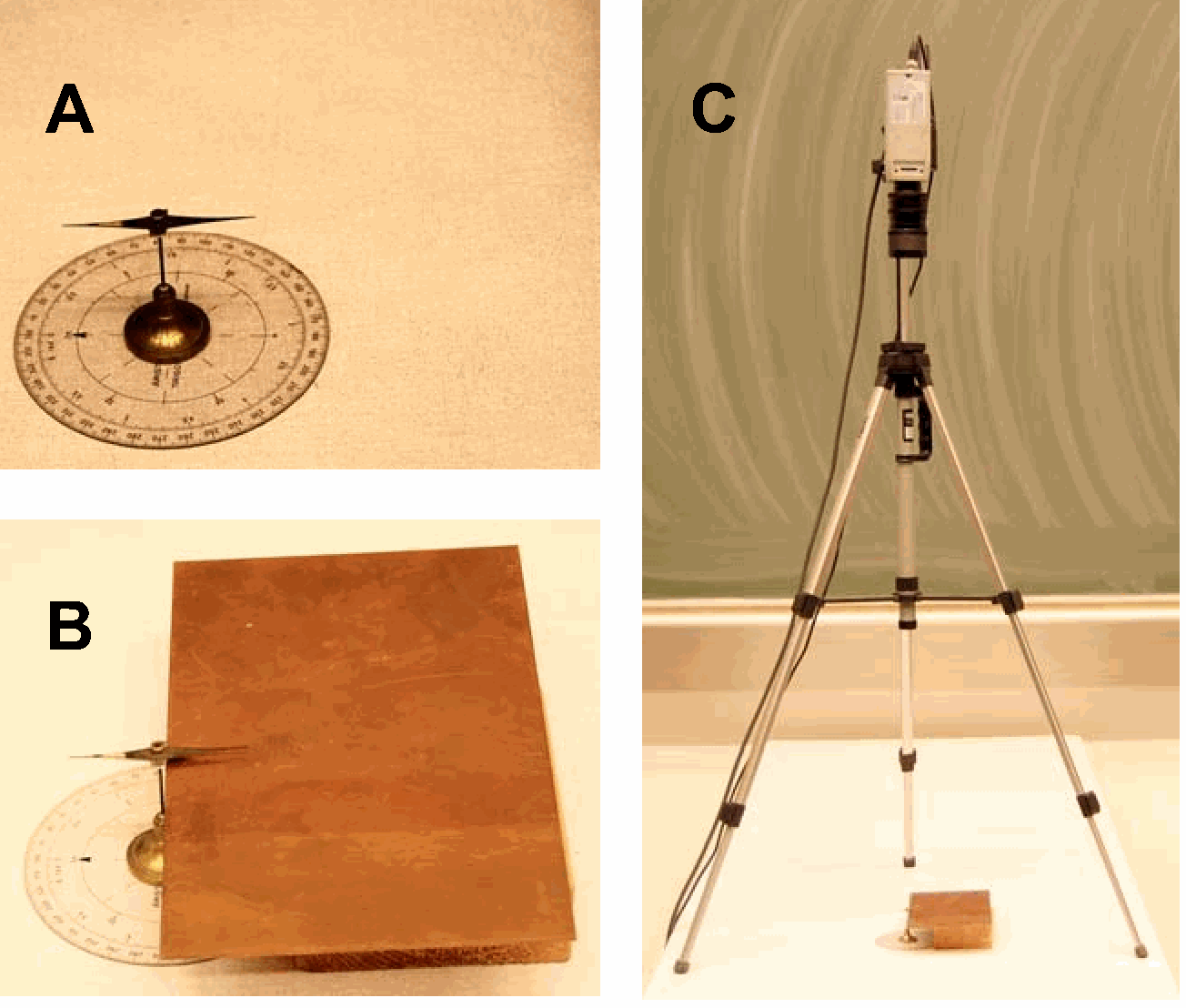
Equipment
Compass needle on needle point support.
Copper sheet , supported by a wooden block
Graduated arc (optional).
Camera on tripod.
Presentation
A top-view image of the compass-needle is presented to the audience (see Figure 2).
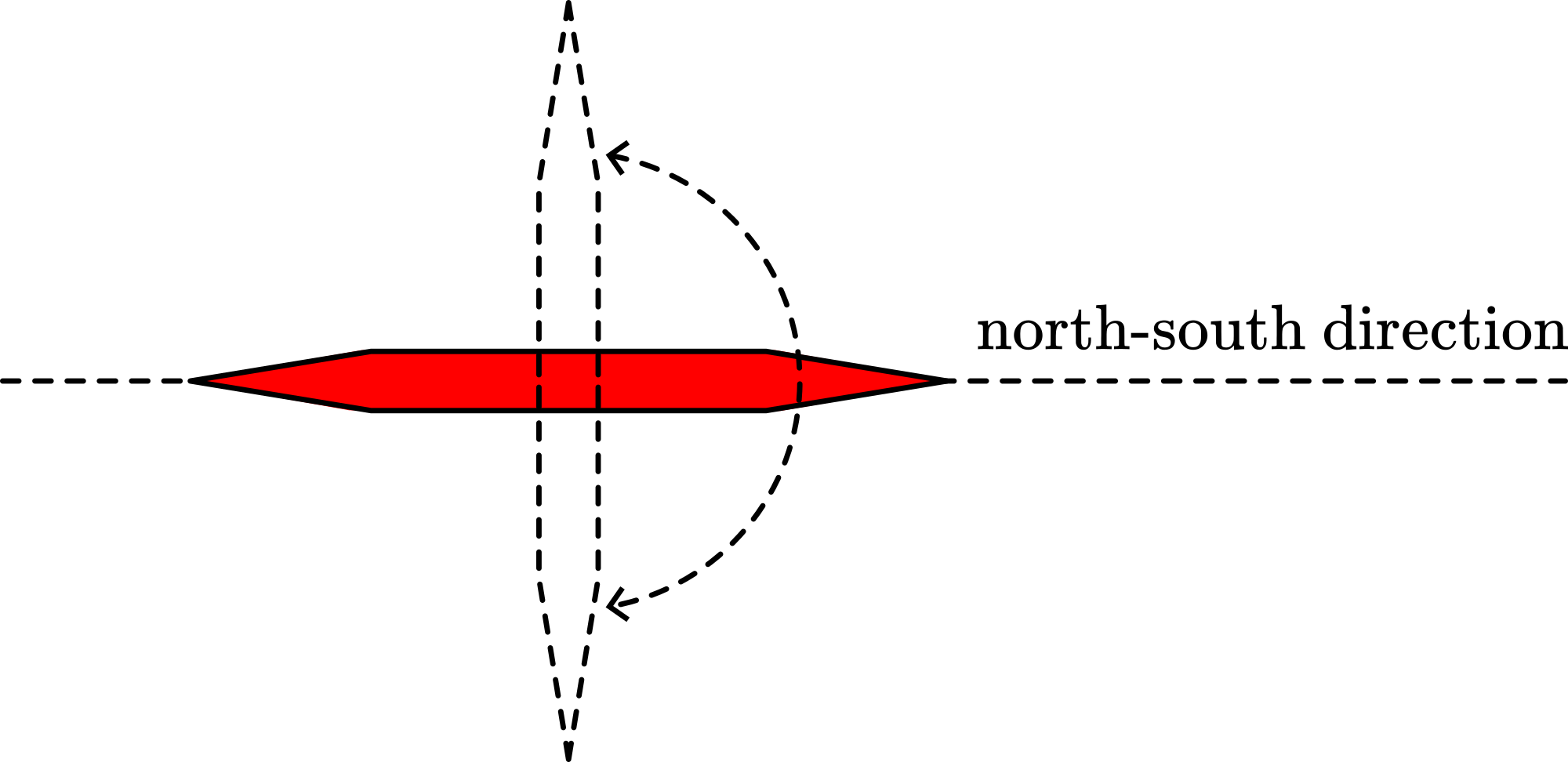
It is standing still, pointing in the magnetic North-South direction. By hand we deflect the needle . Then let it go. The needle swings quite some time before it comes to a rest again. We count around 30 complete swings in total.
Then the copper sheet is shifted close under the magnetic needle (see Diagram B and Figure 3).
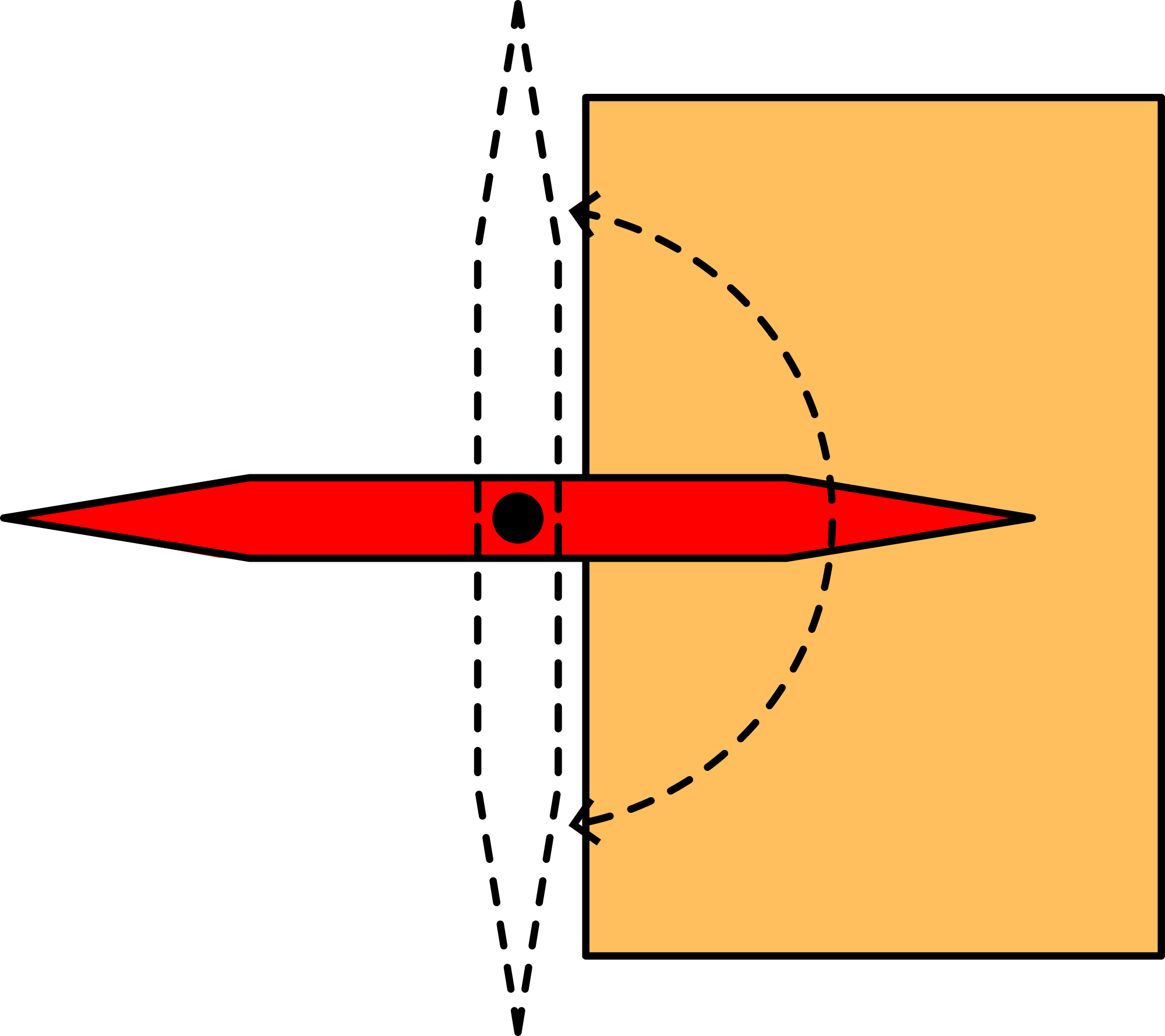
Again the needle is deflected 90º by hand. Then let it go and count again the number of swings before it comes to a rest. Now we count only around 15 complete swings.
So, the presence of the copper sheet has tremendous influence. The presence of the copper plate slows down and dampens the oscillating movement of the swinging needle.
Historically the phenomenon was observed by Arago in 1825. He observed that a compass needle in the vicinity of a piece of copper “reduces the effect of the earth’s magnetic field on the needle”. He could not explain it.
Explanation
Faraday’s law explains the slowing down.
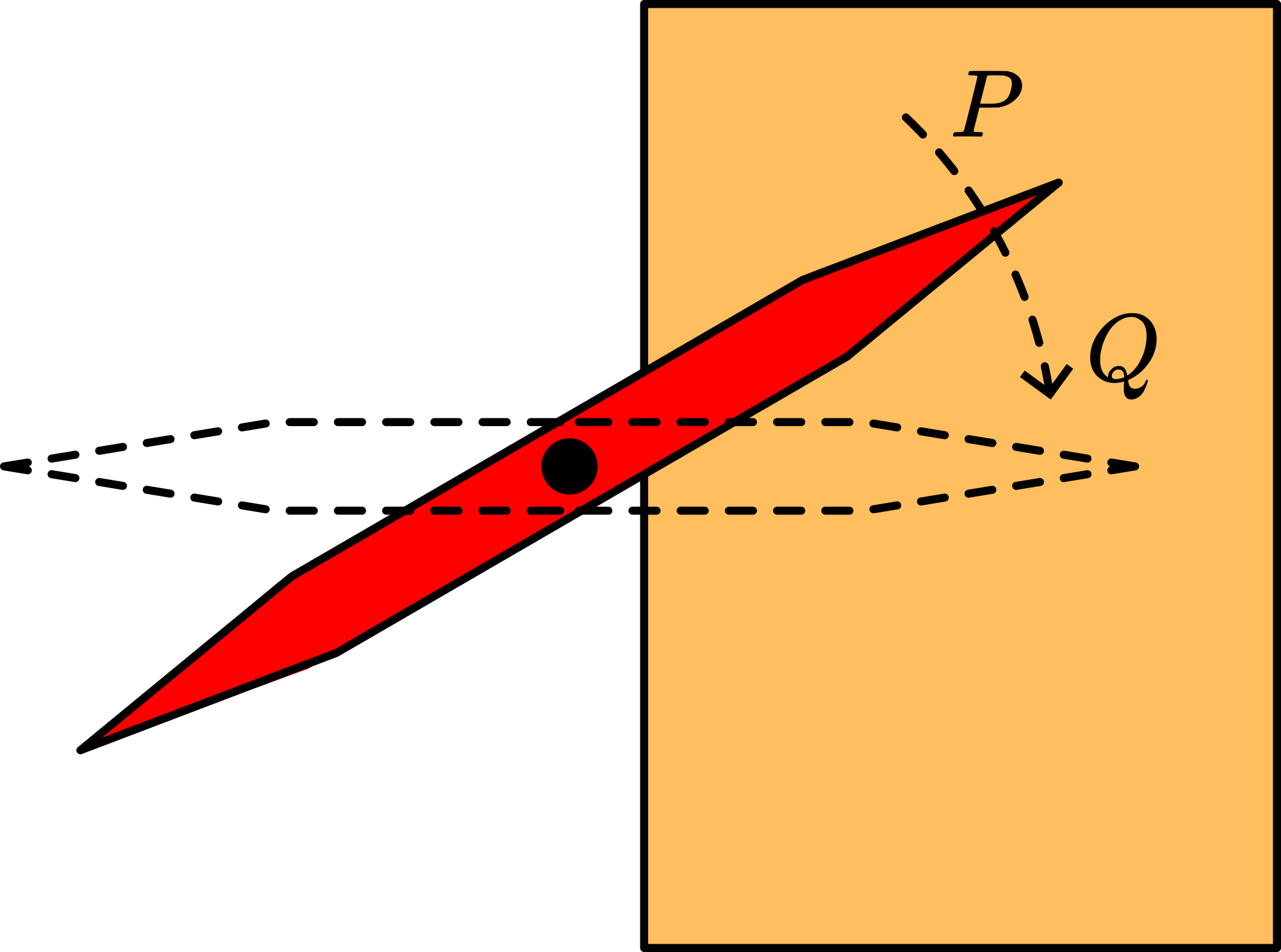
An emf is induced in the copper plate when there is a change in magnetic field. There is a change in magnetic field at position P and Q in Figure 2: In P there is a decrease in magnetic field; in Q an increase. According to Lenz’s law, currents are induced in the copper plate such that they oppose that change in flux. Opposing change in flux means that the needle has to move slower (when the needle stands still there is no change in flux at all). So, at P an eddy-current will flow as to produce a S-pole in the copper plate, that slows down the moving away N-pole of the needle. In the same way an eddy-current will flow at Q in such a way as to produce a N-pole in the copper plate, that slows down the approaching N-pole of the needle.
Remarks
Counting the number of oscillations of the needle takes some time. Yet, the students, only seeing the needle swinging to and fro, show no signs of impatience. Our experience is that they even become very focussed on the experiment!
After this demonstration we show [Aragos disc](../5K2002 Aragos Disk/5K2002.md).
Sources
Biezeveld, H. and Mathot, L., Scoop, Natuurkunde voor de bovenbouw, part 5/6 vwo, pag. 138.
Giancoli, D.G., Physics for scientists and engineers with modern physics, pag. 744. N S