Aim
To show a phenomenon that can be explained using “conservation of energy”.
Subjects
1M40 (Conservation of Energy)
Diagram
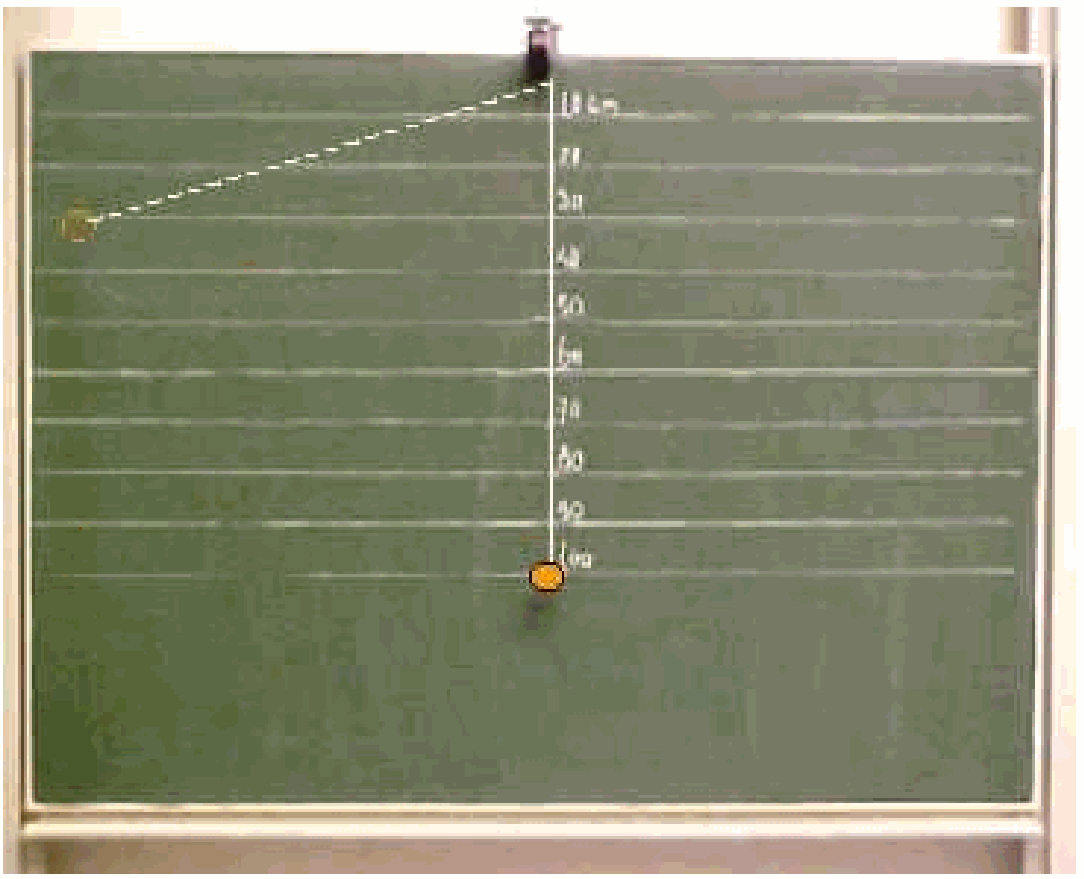
Equipment
Simple pendulum, a ball connected to a string, .
Clamping material.
A peg.
Air level.
Presentation
The pendulum is connected to the blackboard, hanging a couple of cm’s in front of it. On the blackboard, using the air-level, at every downwards horizontal lines are drawn (see Diagram).
The pendulum is pulled aside upwards to the line. Before releasing the pendulum, students are asked how far the pendulum will go upward on the other side.
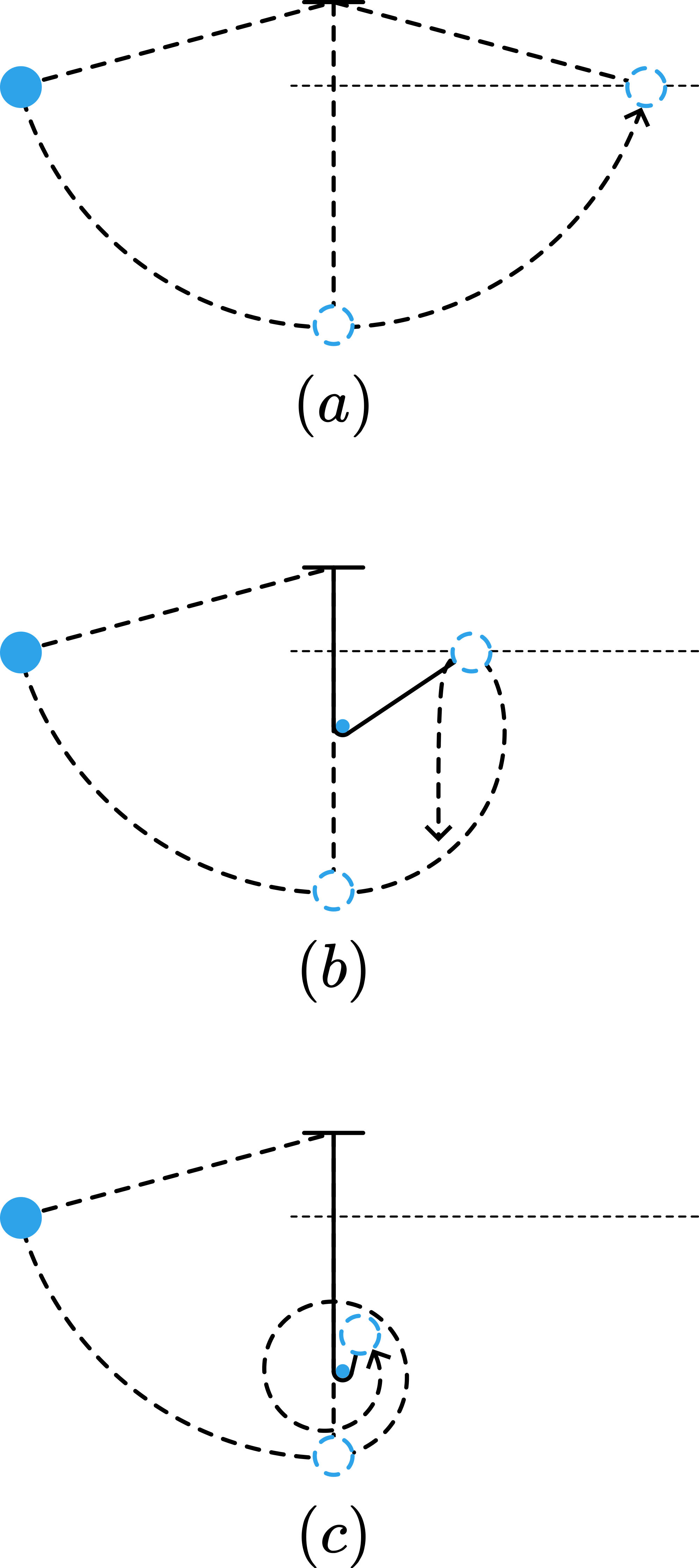
Then it is released and almost reaches the line on the other side (see Figure 2 A). A peg is placed at below the point of suspension, blocking the pendulum’s thread when the pendulum is released (we use a piece of chalk holding it there by hand). Again the pendulum is pulled aside upwards to the line. Students are asked how high the pendulum will climb now on the other side when the pendulum is released. After their answers the pendulum is released and climbs almost to the line again (see Figure 2 B).
Then the peg is placed at (or lower). It is clear now that the pendulum released at the line can never reach the same line on the other side, the thread is too short. So, ask the students to predict what will happen to the pendulum now. After their answers the pendulum is released and winds itself around the peg! (see Figure 2 C).
Explanation
In this situation (conservative field), total mechanical energy is constant:
Before releasing the pendulum, there is only potential energy, (zero reference at the line). When the pendulumbob reaches the -line on the other side there is again only potential energy. In between these two extremes the bob moves and has kinetic energy . (When the pendulum is at its lowest point, there is no potential energy anymore, and the pendulum moves at it highest possible speed.)
When a peg is placed at the -point below the suspension point, there is no restriction for the bob to raise again to the -line on the other side. It can also be observed that when it reaches that line, the speed of the bob wil be zero and the ball drops down vertically (giving a strong jerk to the thread).
When the peg is placed at below the suspension point, the released ball can only go upwards to the -line. At that point the ball still has an amount of kinetic energy, its velocity will be in the horizontal direction and the ball winds around the peg. This continues since at every turn the winding thread becomes shorter and the pendulum bob will reach a lower highest point: the pendulum will wind itself faster and faster around the peg.
Remarks
We use an air-level to draw the horizontal lines because our blackboard is not level.
Make your peg not too thin, because otherwise the thread will not wind itself completely around it. (On every turn the height-loss has to be that large as to compensate at least the “normal” energy-loss of the pendulum.)
Sources
Mansfield, M and O’Sullivan, C., Understanding physics, pag. 90-92
McComb,W.D., Dynamics and Relativity, pag. 32-34
Sutton, Richard Manliffe, Demonstration experiments in Physics, pag. 59