Aim
To show that when two balls, having equal momentums, collide with a block, the one that recoils with greater momentum imparts more momentum to the block.
Subjects
1N20 (Conservation of Linear Momentum)
1N30 (Collisions in One Dimension)
Diagram
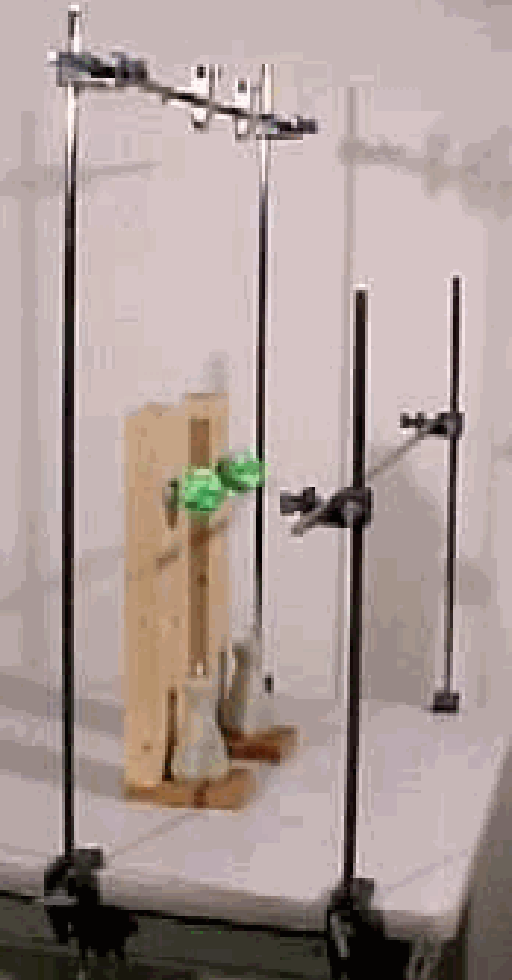
Equipment
2 Superballs on strings ($l=45\mathrm{~cm}).
2 Wooden blocks ($4\times9\times45\mathrm{~cm}), hinged on base.
Masses or clamps to fix the bases.
Modelling-clay.
Support-rods and table-clamps.
Presentation
Preparation:
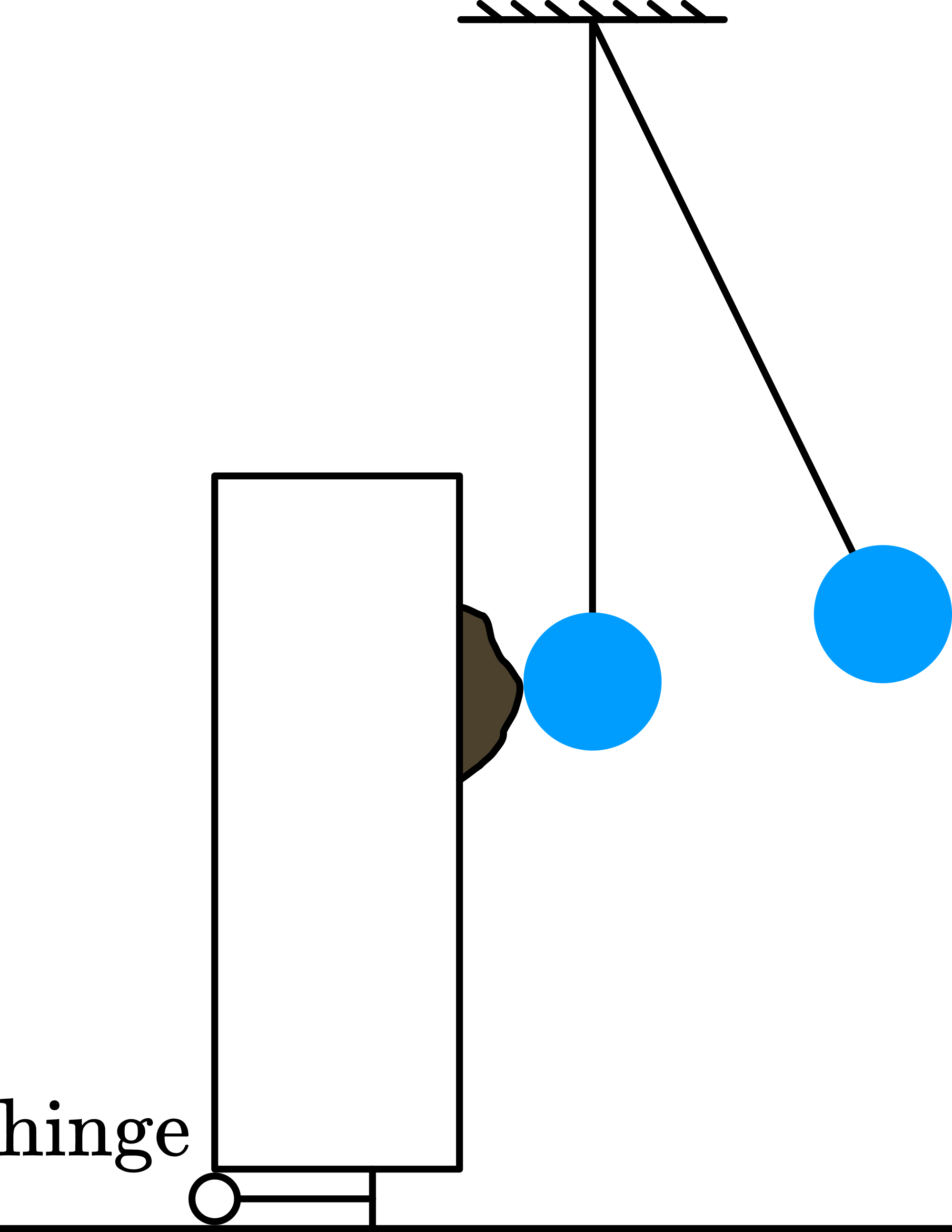
One of the wooden blocks has a piece of modelling-clay stuck to it on the place where the ball hits the block. A ball can be given a deflection by holding it against a support-rod. By means of this support-rod, both balls can be given the same starting position. By trial and error the support-rod is placed in such a position that after launching the balls the block without the clay is just knocked down.
Presentation:
One ball is given a deflection by pressing it to the support-rod. With your other hand you hold the wooden block fixed in position. Letting the ball go, it hits the wooden block. Doing this with one block after the other it is clearly observed that the collision with the clayed block is less elastic than the collision with the other block (the ball bounces less far). Now the students are asked which block will be knocked down when both balls are released. After their prediction both balls are launched simultaneously and only the block without the clay is knocked down. The presentation can be discussed now, focussing on the idea that the concept of change in impulse is relevant.
Explanation
When the ball hits the wooden block, the block experiences a force depending on the momentum . The elastic collision imparts more momentum to the block because the ball changes its momentum from to (a change of ), while the ball hitting the clayed block changes its momentum from to 0 (a change of ). So is twice as high in the first situation.
Remarks
Sticking the piece of clay to the wooden block, we model it in a sharp way (see Figure 2).
Flattening the clay-surface makes it more elastic.
Sources
Ehrlich, Robert, Turning the World Inside Out and 174 Other Simple Physics Demonstrations, pag. 27-28