Aim
To show, qualitatively, the influence of the moment of inertia in rolling downhill.
Subjects
1Q10 (Momentum of Inertia)
1Q20 (Rotational Energy)
Diagram
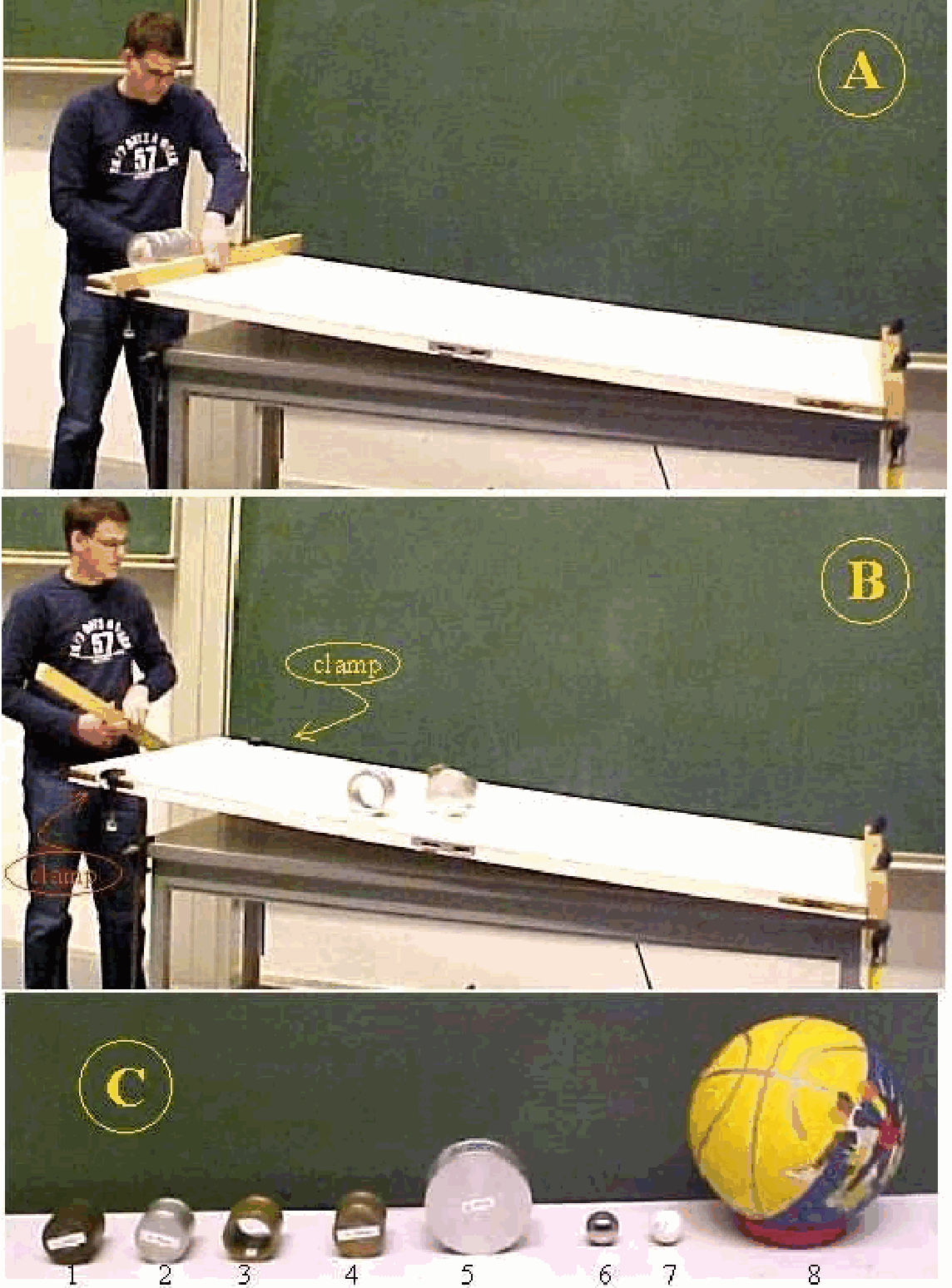
Equipment
Inclined ramp ( ; we use a flat door).
Rolling objects
cilinder of wood with lead in the center ( );
solid aluminum cilinder ( )
hollow brass cilinder ( );
solid brass cilinder ( );
solid aluminum cilinder ( );
steel ball
ping pong ball ( );
basketball;
Overhead sheet with list of moments of inertia of rolling objects.
Balance with large display.
Presentation
Preparation
The ramp has to be adjusted horizontally in its cross direction, using an air-level. The two clamps (see Diagram B) are placed in such a way that in starting, the shelf, while pressed against these clamps, is nicely perpendicular to the long side of the ramp. A heavy wooden beam keeps the ramp at the end of the table. This beam also stops the rolling objects.
Presentation.
Different races are presented to the students. Before each race, the mass of the racing objects is determined by placing each object on the balance. Then students are asked to predict the result of that race: Is there a winner/loser? When the answer is yes, which object will be the winner/loser?
Race 1:
and race down the ramp together, starting at the same time. is the winner, the loser. (Most students predict the right answer. Evidently the distribution of mass is important.)
Race 2:
and race down the ramp together. There is no winner. (Most students predict the wrong answer. Evidently mass is not important in this demonstration. It makes me remember Galileo dropping objects from the tower of Pisa, in which experiment mass has also no influence on the downward acceleration.)
Race 3:
, and race down the ramp together. They arrive together; there is no winner. (Many students don’t dare to predict. Evidently radius is of no importance in this experiment.)
Now an overhead sheet is presented to the students that shows a table of the expressions of moments of inertia of the various rolling objects. When mass and radius are of no importance in these downhill races then the difference will be found in the factor ahead of in the expressions of the moment of inertia. After this observation the next races will be predicted right by (almost) all students.
Race 4:
and is the winner, the loser.
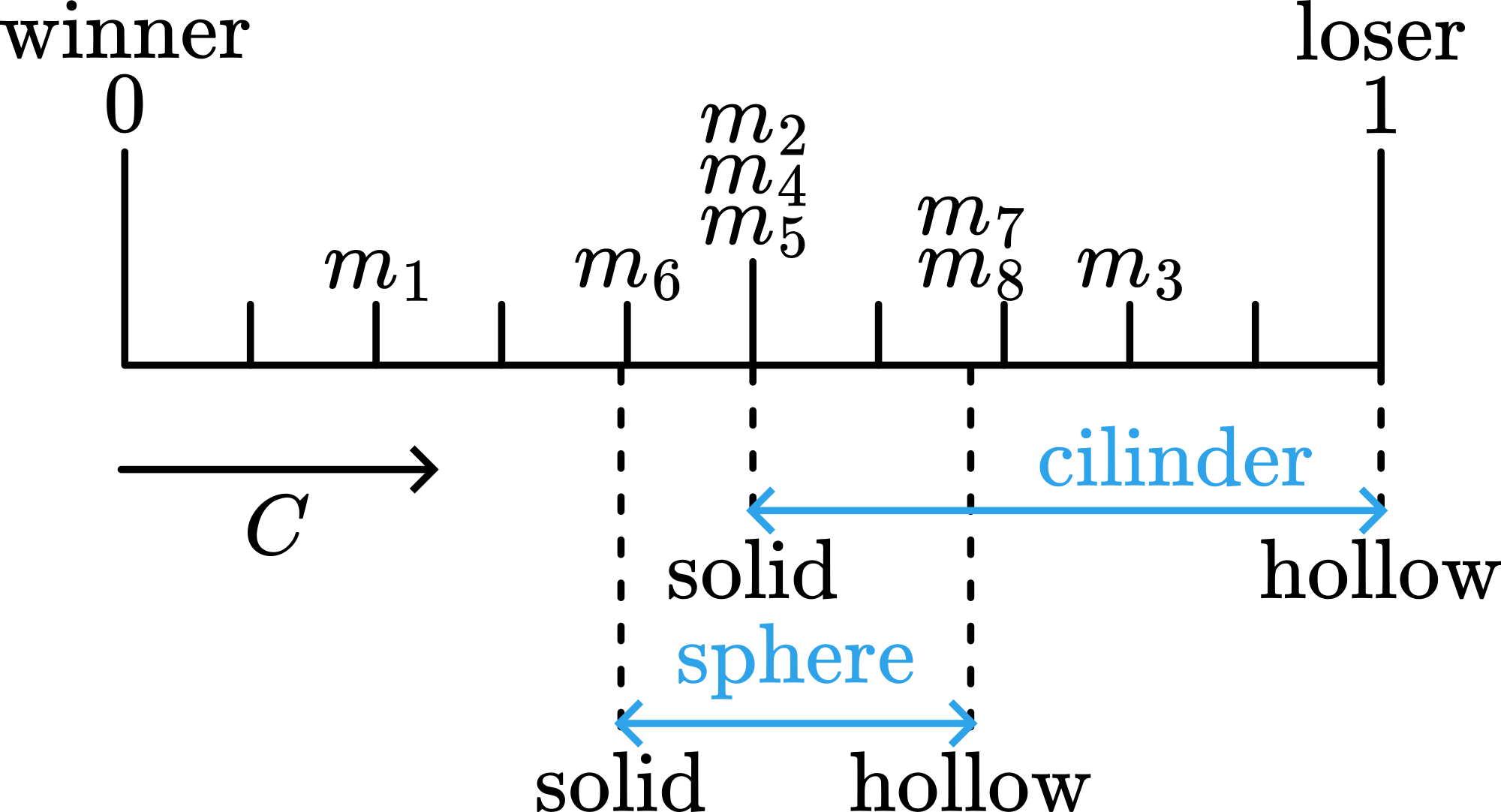
Figure 2 shows a summary. ’
Explanation
Rolling down means translational acceleration plus rotational acceleration. The more energy is needed for rotational acceleration, the less energy is left for translational acceleration.
Conservation of energy tells us: constant.
By and differentiating, we find
The moment of inertia of objects with circular symmetry can be written as: , where is a constant. From tables we know (see Figure 2):
solid sphere,
solid cilinder,
hollow sphere,
hollow cilinder,
cilinder with thickness
Using in the expression above, we find:
The larger , the smaller . Also note that does not depend on or !
Remarks
To have a fair race you need to have a good starting procedure. We get the best start by using a shelf, blocking the objects in the starting position. Starting is done by very quickly moving the shelf away into the direction of the descending ramp.
When racing the basketball and ping pong ball (Race 5) there is no winner. Makes sure that in starting, the basketball is not ahead of the ping pong ball.
Sources
Jewett Jr., John W., Physics Begins With Another M... : Mysteries, Magic, Myth, and Modern Physics, pag. 113-114
Young, H.D. and Freeman, R.A., University Physics, pag. 304
Giancoli, D.G., Physics for scientists and engineers with modern physics, pag. 263