Aim
To show precession (and to show the validity of vector-addition)
Subjects
1Q50 (Gyros)
Diagram
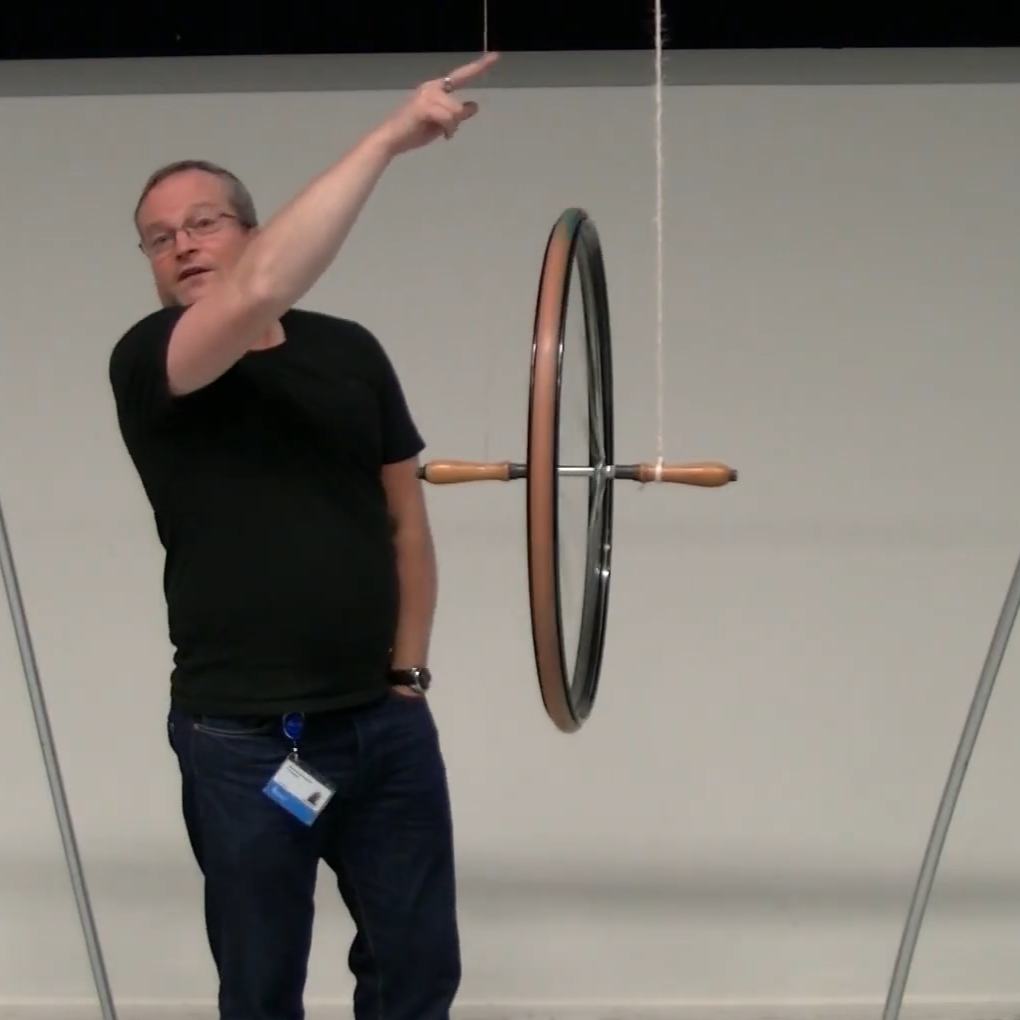
Equipment
Bicycle-wheel with handles.
2 pieces of rope.
Pair of scissors.
Presentation
The wheel is supported by strings tied to both handles. The wheel is given a fast spin by hand. Now one of the supporting strings is cut. The wheel starts to precess about a vertical axis (while its own horizontal axis of spin slowly descends toward the vertical). As the spin of the wheel diminishes, the wheel precesses more rapidly.
Explanation
Because Angular momentum is a vector quantity and can be represented by a vector parallel to the axis of spin, two angular momentum vectors can be combined using the parallelogram law. Therefore, when a gyroscope experiences a torque tending to rotate it about an axis perpendicular to its spin axis, it responds by precessing about a third axis perpendicular to the other two.
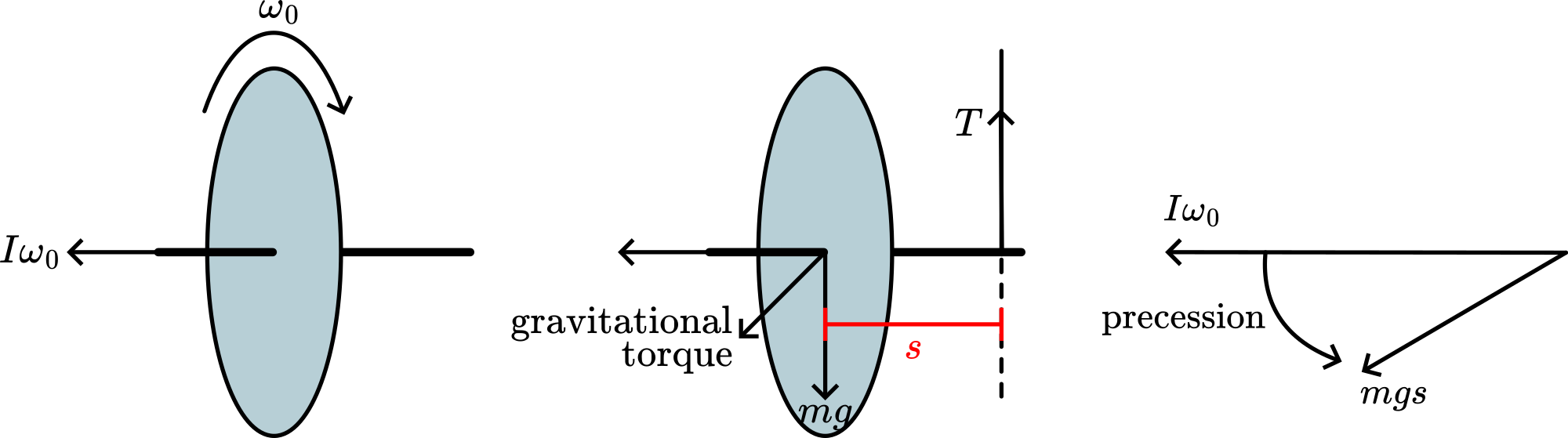
The spinning wheel has an angular momentum of . This is represented by a vector parallel to the axis of spin (see Figure 2 a). When one of the strings is cut, then gravitational torque ( ) is added to the system (see Figure 2 b ). This torque tends to change , so moves into the direction of (see Figure 2 c).
It can be shown that the speed of precession is given by , so slowing down of increases . The precession will also be more rapid by adding a weight to the unsupported handle.
Sources
Sutton, Richard Manliffe, Demonstration experiments in Physics, pag. 79