Aim
To give a geometric description of nutation
Subjects
1Q50 (Gyros)
Diagram
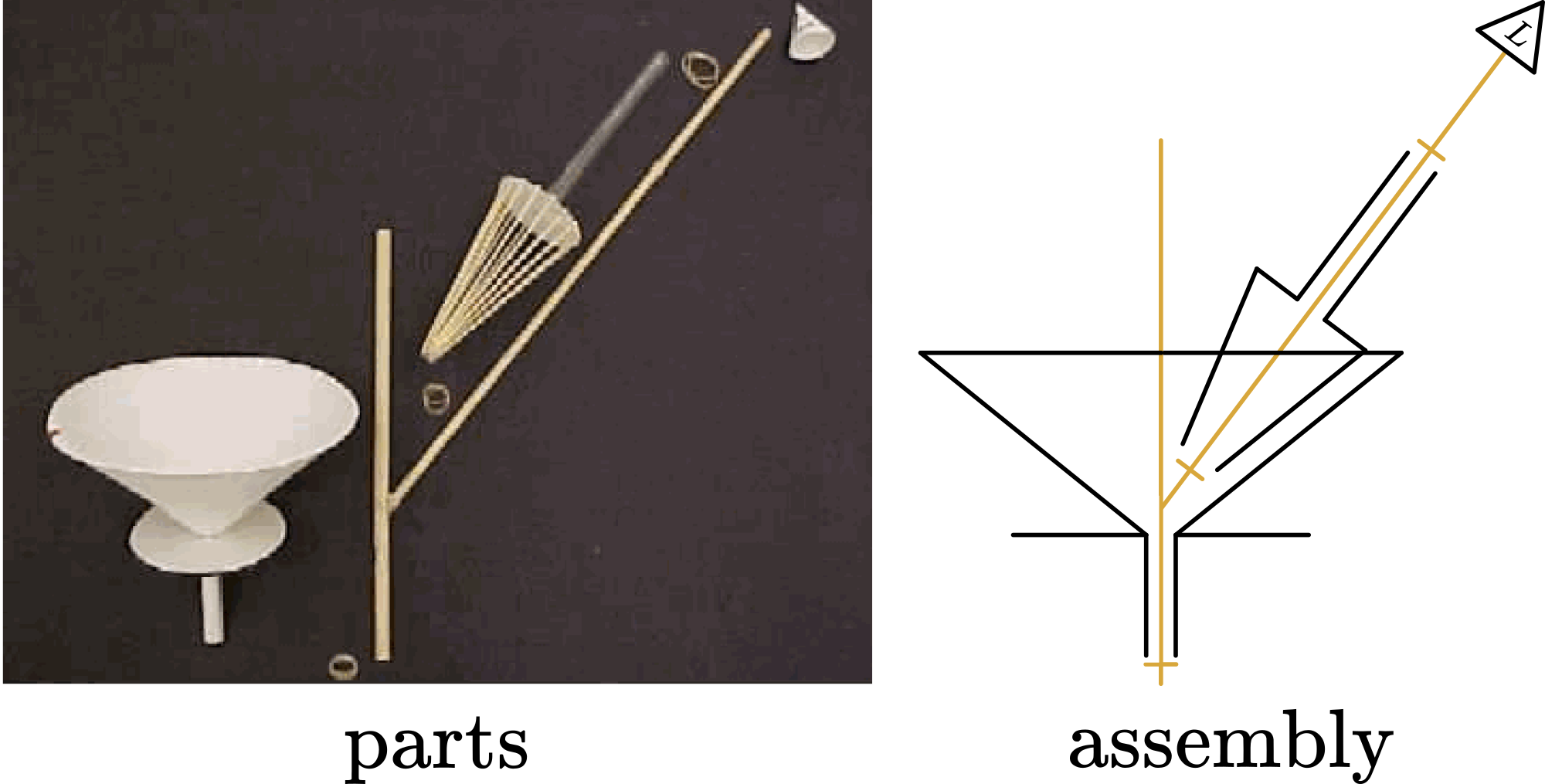
Equipment
Model (see Diagram and Figures).
Presentation
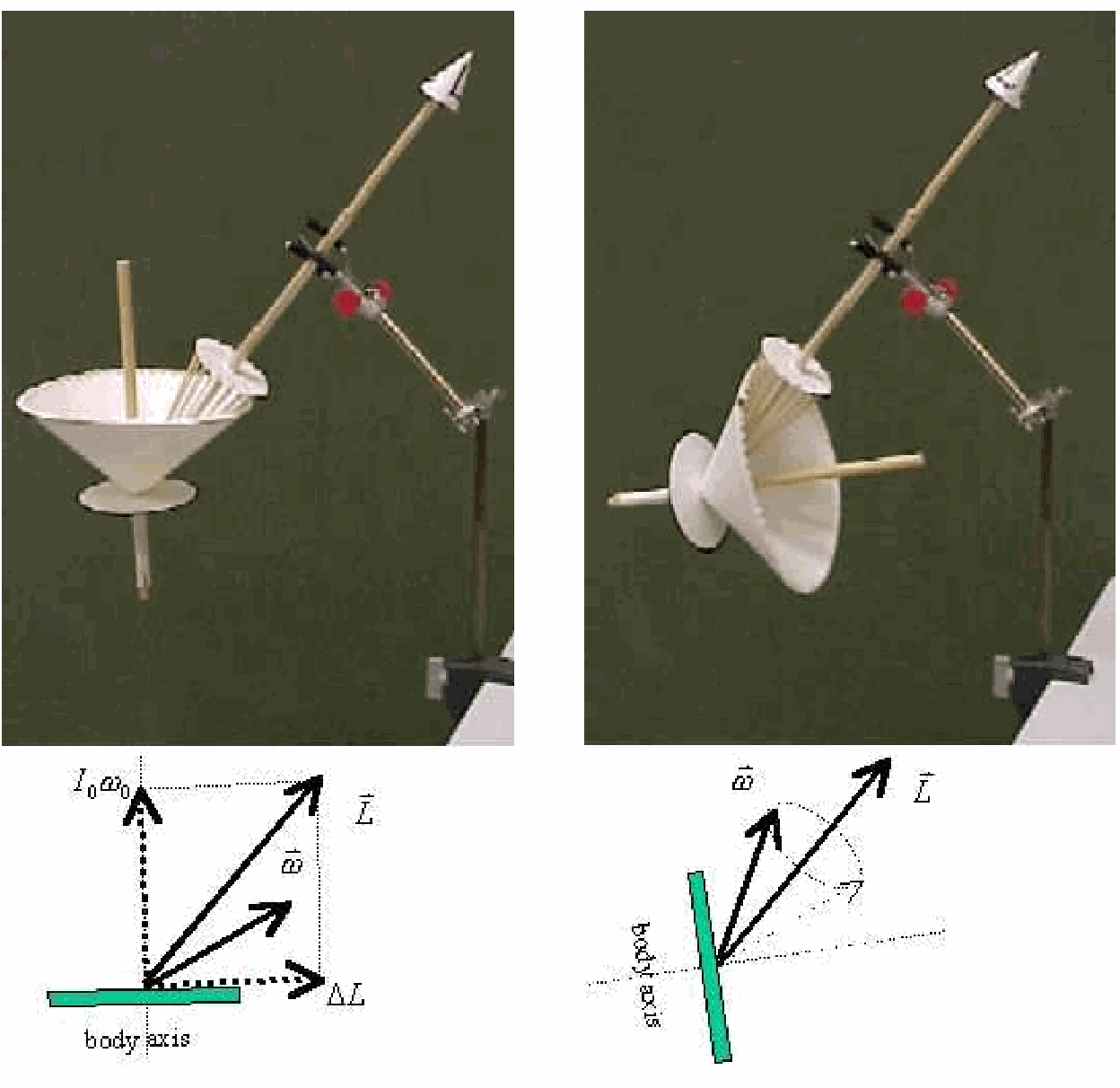
Watching a nutating object we observe that the body-axis makes a conical movement (see Nutation. This movement of the body-axis is visualized in our model by rotating the -axis by hand (see Figures).
Explanation
, wand body-axis are in one plane. While moving, remains fixed in space, so movement of that plane has to take place around .
The fixed cone (so-called “space cone”) contains wand this turns around . To show the position of with rerspect to the body axis, a cone around the body-axis (so-called body-cone) is visualized. This body-cone also contains . So in our model the position of is seen where the two cones touch each other. While rotating, the movement of the body-axis around (nutation) and the movement of the momentary rotation-axis around the symmetry-axis can be observed.
Remarks
The model is made in such a way that the two cones grip each other (teeth on the inside of the rim of the body-cone grip the wooden bars of the space-cone), so that the cones are not slipping. This is needed since there is only one while in our model is in two cones.
Our model represents the movement of a disk-shaped nutating object . Visualizing of a nutating bar-shaped object needs a model having the body-cone revolving with its outside around a fixed space-cone.
Sources
Borghouts, A.N., Inleiding in de Mechanica, pag. 224-227
Roest, R., Inleiding Mechanica, pag. 222-226 Nutation (2)