Aim
To determine by measuring the period of a simple pendulum.
Subjects
3A10 (Pendula)
3A40 (Simple Harmonic Motions)
Diagram
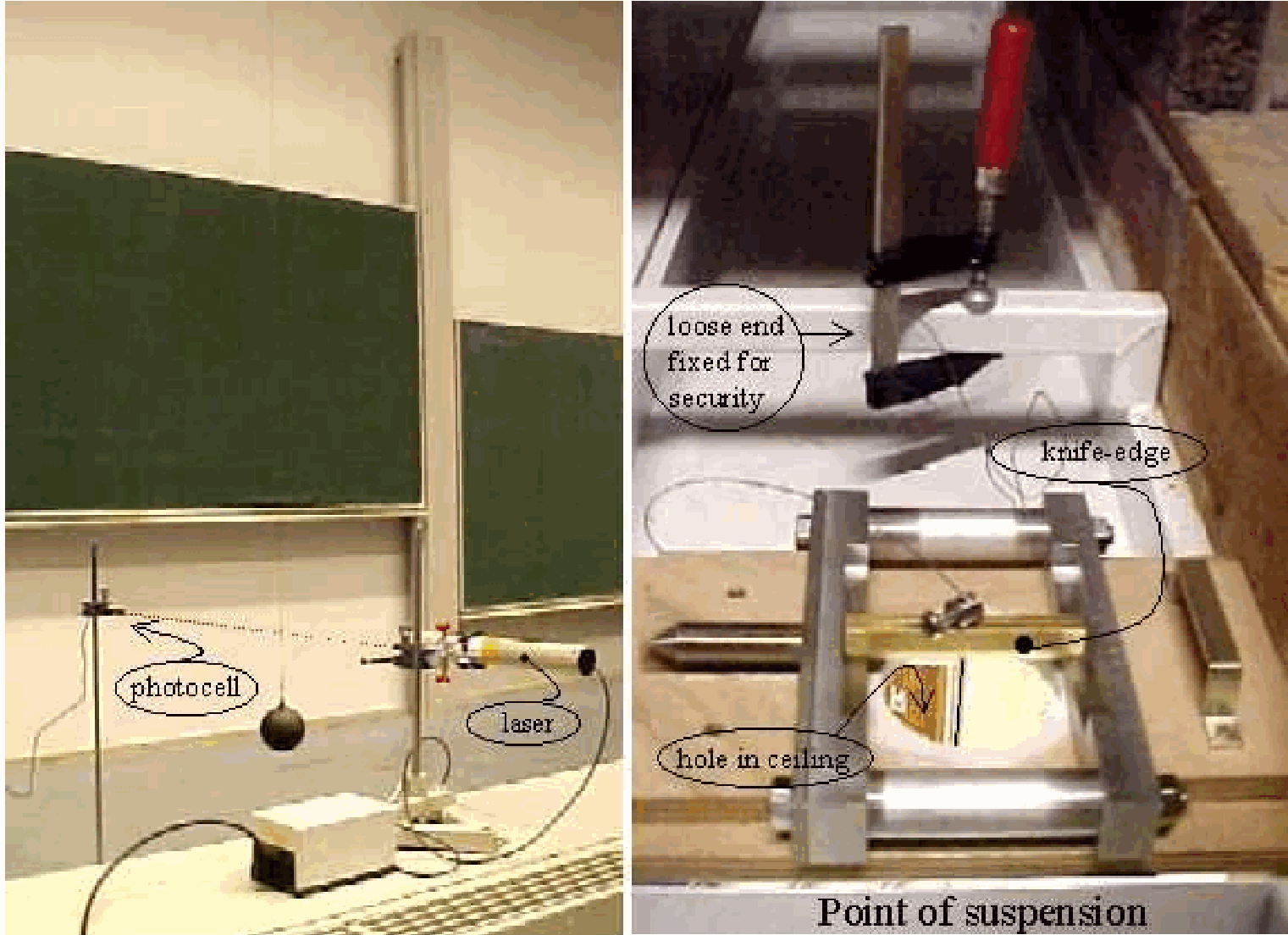
Equipment
Cast iron sphere.
Thread.
Knife-edge suspension.
Photogate (Laser and laser switch).
Tape measure.
Data-acquisition system and computer. (We use Science Workshop).
Projector to project monitor-image.
Presentation
Set up the pendulum and photogate (see Diagram). The length of the pendulum is measured. The photocell is connected to the interface and the software is made such that on the monitor a table of period-time ( ), and the calculated value of , is presented.
The pendulum is given an very small amplitude and around ten measurements are registered. When the measurement is stopped, the software also presents the mean value of and and their standard deviation.
Explanation
If the motion of the pendulum is confined to small amplitude oscillations, the period of motion is given by , and . We give our pendulum an amplitude of approx. . Having a length of around this means that the angle the thread makes with the vertical is about . This small-angle approximation is very accurate (see literature) compared to the accuracy with which we measure and .
We measured: and (std.dev.:0.0007), giving .
Remarks
The most troublesome is the measurement of : How accurate is a simple hardware store tape measure?
The measurement of is performed carefully, since in appears as and so in the error analysis this gives a weighing factor of 2 .
Also the length of the pendulum compared to the size of the sphere is important to consider. When we neglect the mass of the thread compared to that of the cast iron sphere, but not neglecting the dimensions of the sphere, we should write: . When the sphere is a point-mass, and we have again . But when the sphere is not a point-mass, we have and introduces an error compared to . In our situation and . This introduces an error of less than 0.0001 in , so small compared to the standard deviation.
Sources
Borghouts, A.N., Inleiding in de Mechanica, pag. 129-131
Mansfield, M and O’Sullivan, C., Understanding physics, pag. 72-73 and 168
Roest, R., Inleiding Mechanica, pag. 91-93
Stewart, J, Calculus, pag. 262 and 266
Young, H.D. and Freeman, R.A., University Physics, pag. 407-410