Aim
To show torques and forces on a current loop in a magnetic field.
Subjects
5H50 (Torques on Coils)
Diagram
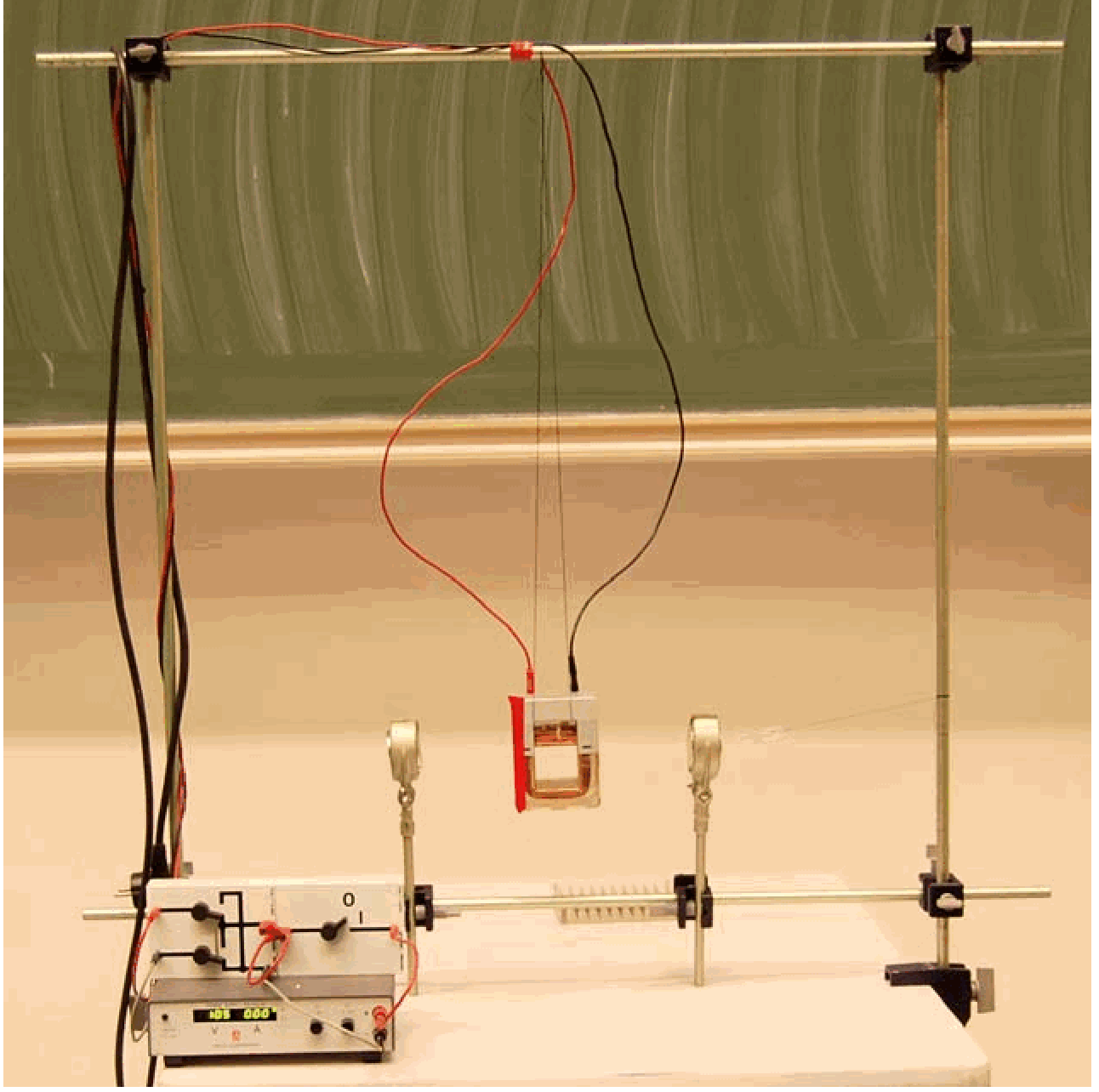
Equipment
Two Neodymium magnets fixed in clamps.
Coil with a piece of red tape at one side. The coil is suspended by thin thread, so it can rotate easily (see Diagram).
Power supply, .
Switch and Two-way switch.
Array of compass-needles.
Paperclip (to show the presence of a magnetic field).
Camera and screen to show the demo to a large audience.
Safety
The Neodymium magnets are very strong. If these magnets are not handled carefully, there is risk of serious injury. The magnets are fixed in clamps and stored with a thick piece of sheet between them.
-Carefully slide them apart when you use them, to prevent your fingers becoming trapped between them.
-Keep them several meters away from magnetic information carriers.
-Never operate the magnets in explosive environments, since they generate sparks!
Presentation
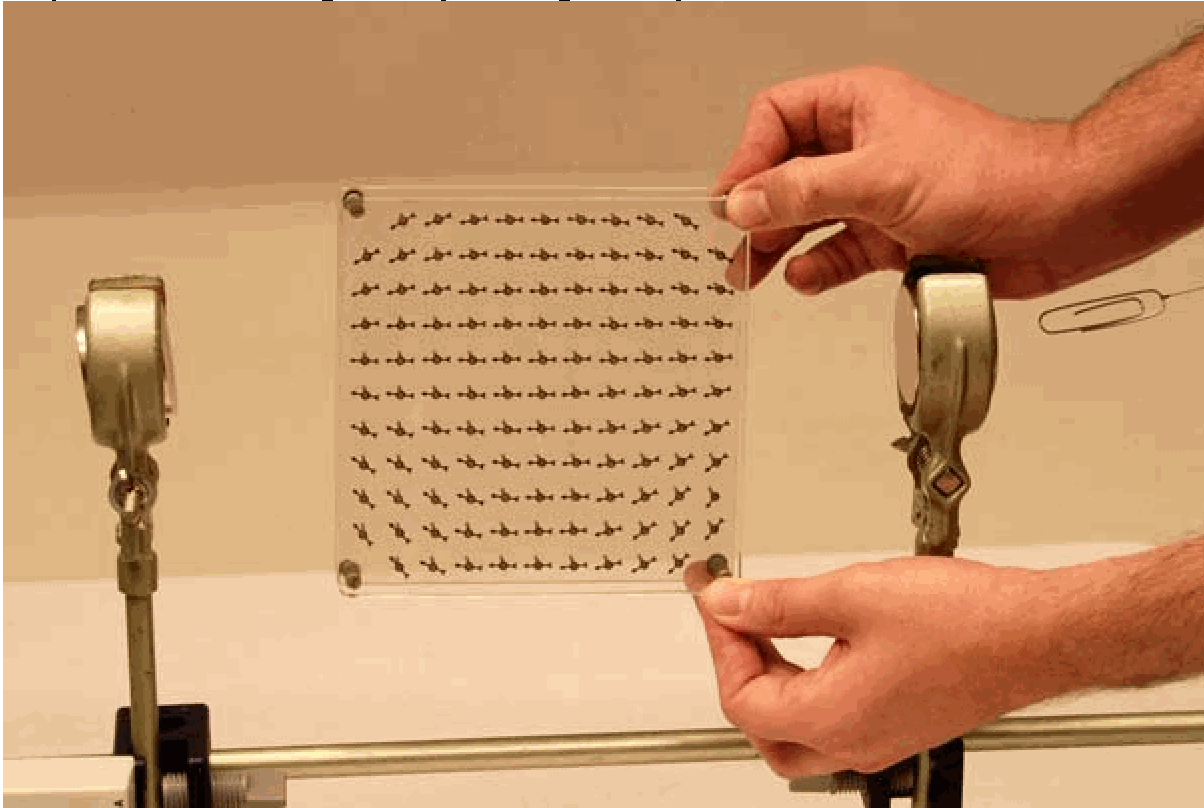
Using the array of compass needles we show that there is a uniform magnetic field between the permanent magnets (see Figure 2).
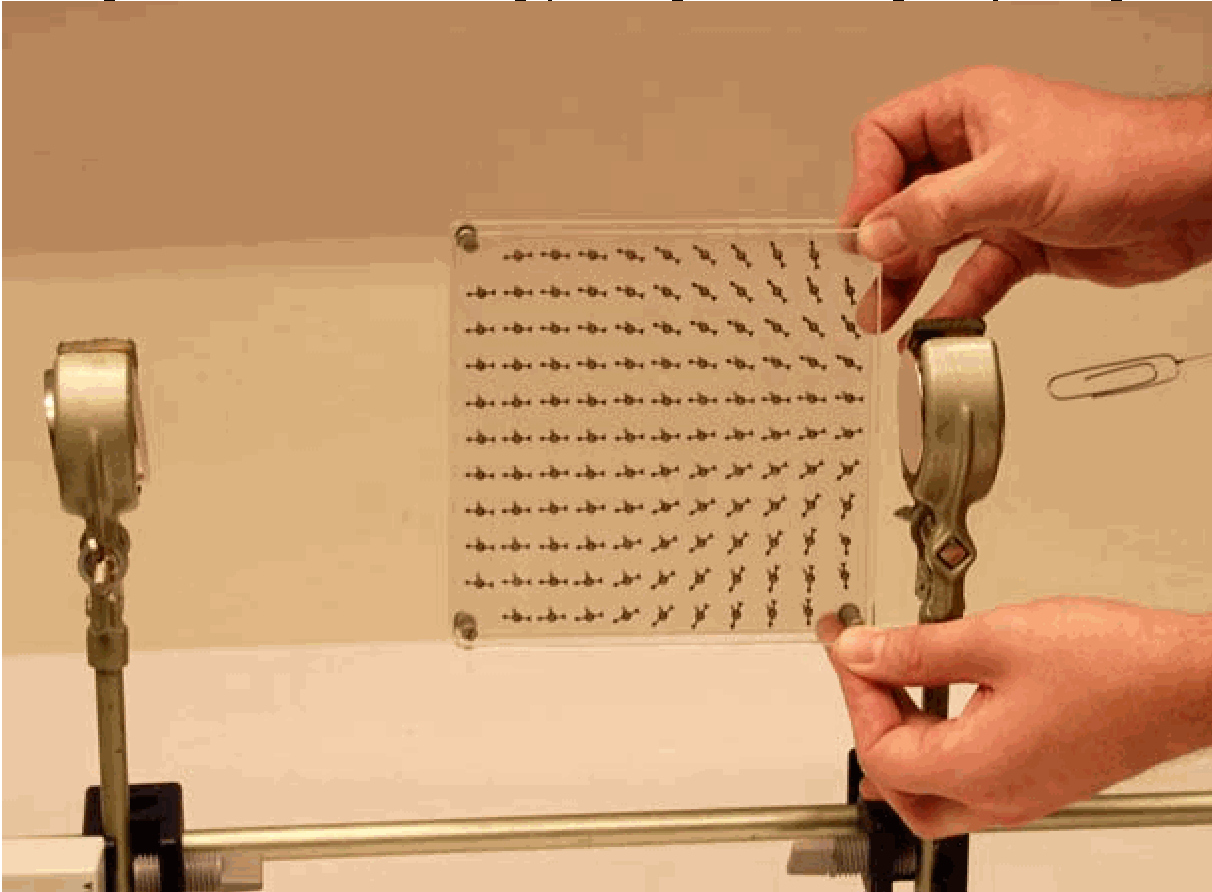
Close to the magnets the field is strongly divergent/convergent (see Figure 3).
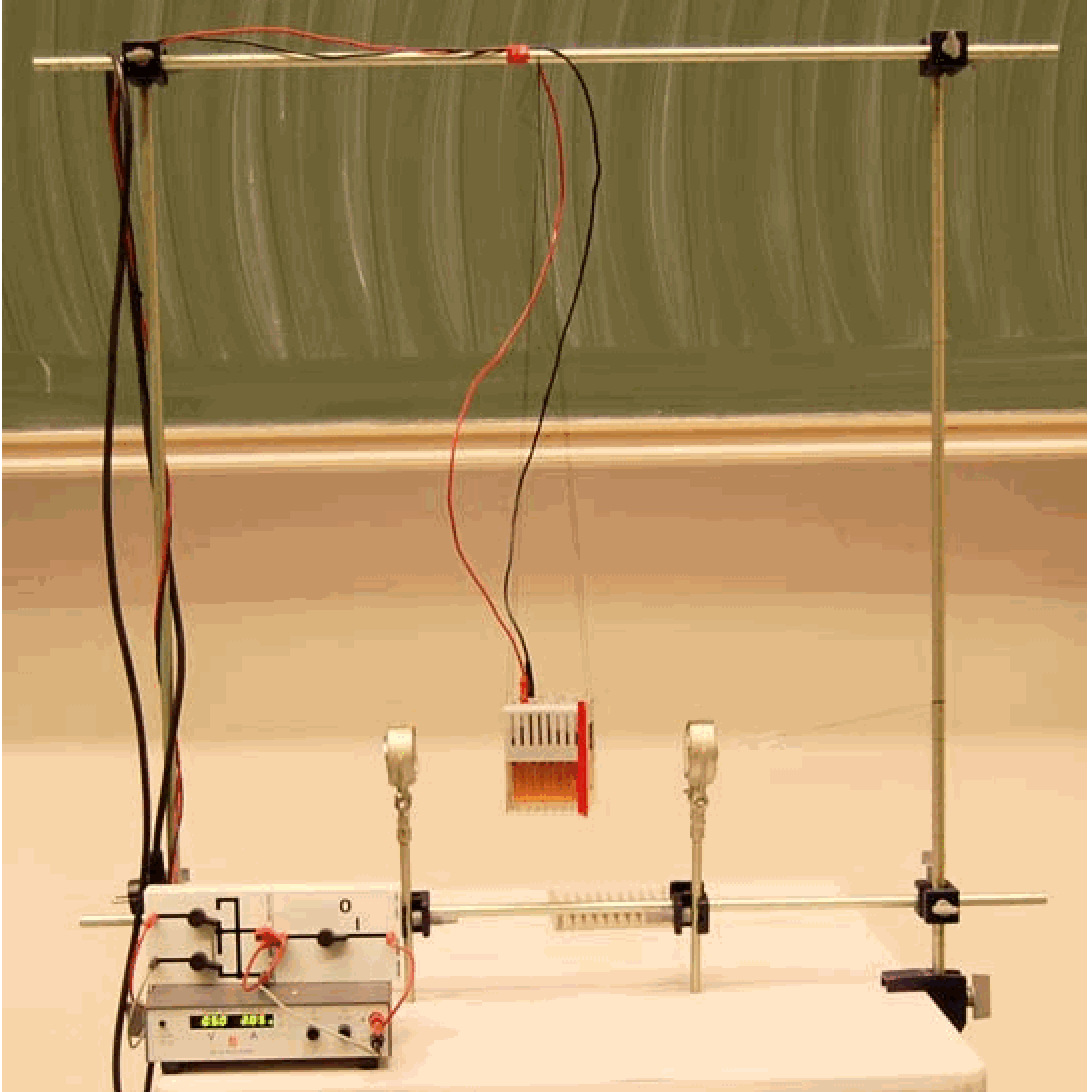
Then the coil is suspended between the two magnets (see Diagram). Connecting the power supply to the coil shows that the coil makes a rotation and lines up with the magnetic field (see Figure 4). There it remains at rest.
Conclusion is that in a homogeneous magnetic field a current carrying coil (a dipole) experiences a torque that lines up that dipole with the field. And in that uniform field there is no net force.
Then the coil is displaced a little from its central position: It attracts itself towards one of the magnets and sticks there (see Figure 5).
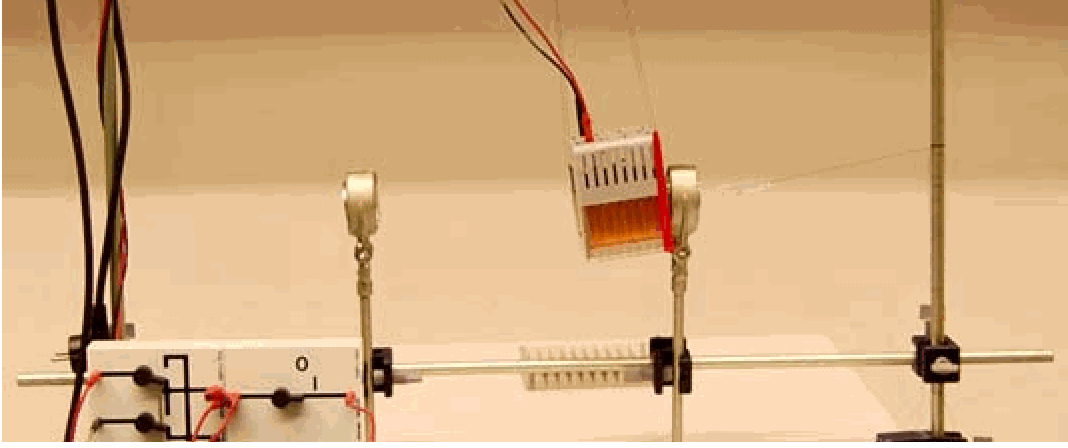
Conclusion is that in a non-uniform field there is a net force on a current loop (dipole).
Explanation
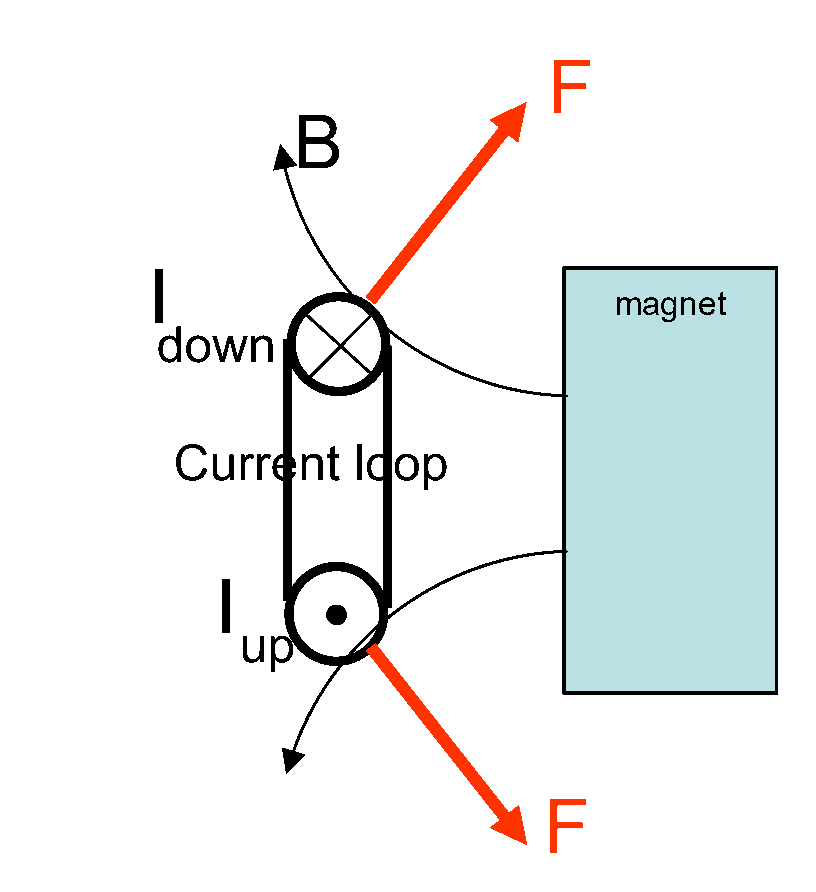
There are Lorentz-forces on all sides of the coil. The forces on the bottom- and topside of the coil cancel (they only tend to stretch the coil). The two forces on the sides are also equal and opposite but they do generate a torque ( is the magnetic field and being the area of the current loop).
When the field is non-uniform, there is a radial component of and there will be a net force towards the magnet (see Figure 6).
Remarks
The lining up of a current loop in a uniform field is an example of what dipoles do in a material. So it can be used as an example to present para-magnetism.
Sources
Griffiths, D.J., Introduction to Electrodynamics pag.255-258.