Aim
To use components of force.
Subjects
1J30 (Resolution of Forces)
Diagram
Equipment
Rope, about .
Hinged bars, with a nylon thread () between the extremities.
Two strong students.
Presentation
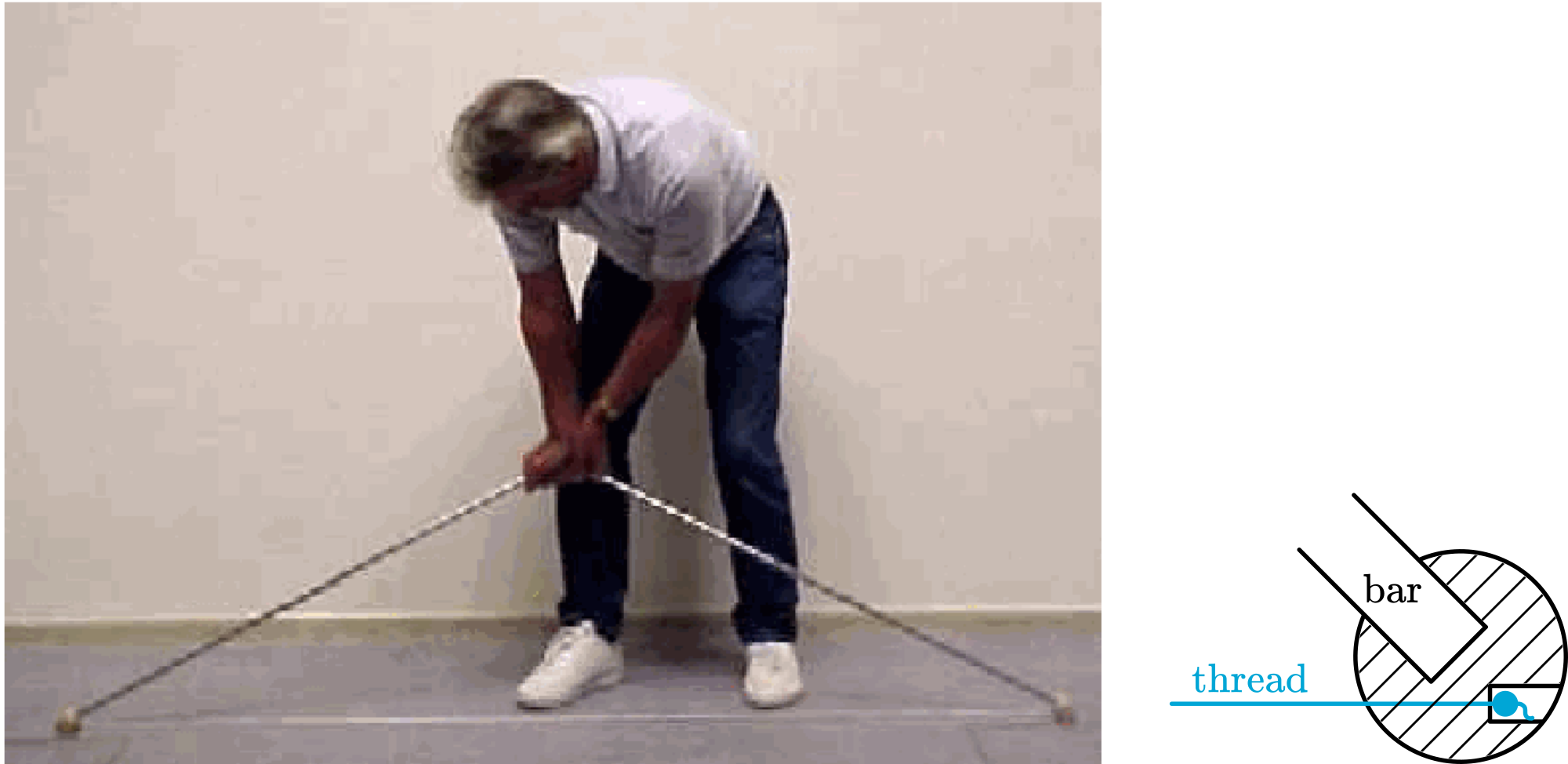
The two students pull with force on the ends of the rope, keeping it in equilibrium. From above, the professor pushes downwards,in the middle of the rope, easily touching the ground, with almost no effort, while the students work extremely hard to prevent this. Both strong students give way to the weak professor. (see Figure 2)

A thick nylon thread is shown and it is clear to all that by hand it cannot be broken. (The strong students can try it.) The thread is fitted between the extremities of the hinged bars (see Diagram). The professor pushes vertically downward on the joint between the bars and breaks the thread.
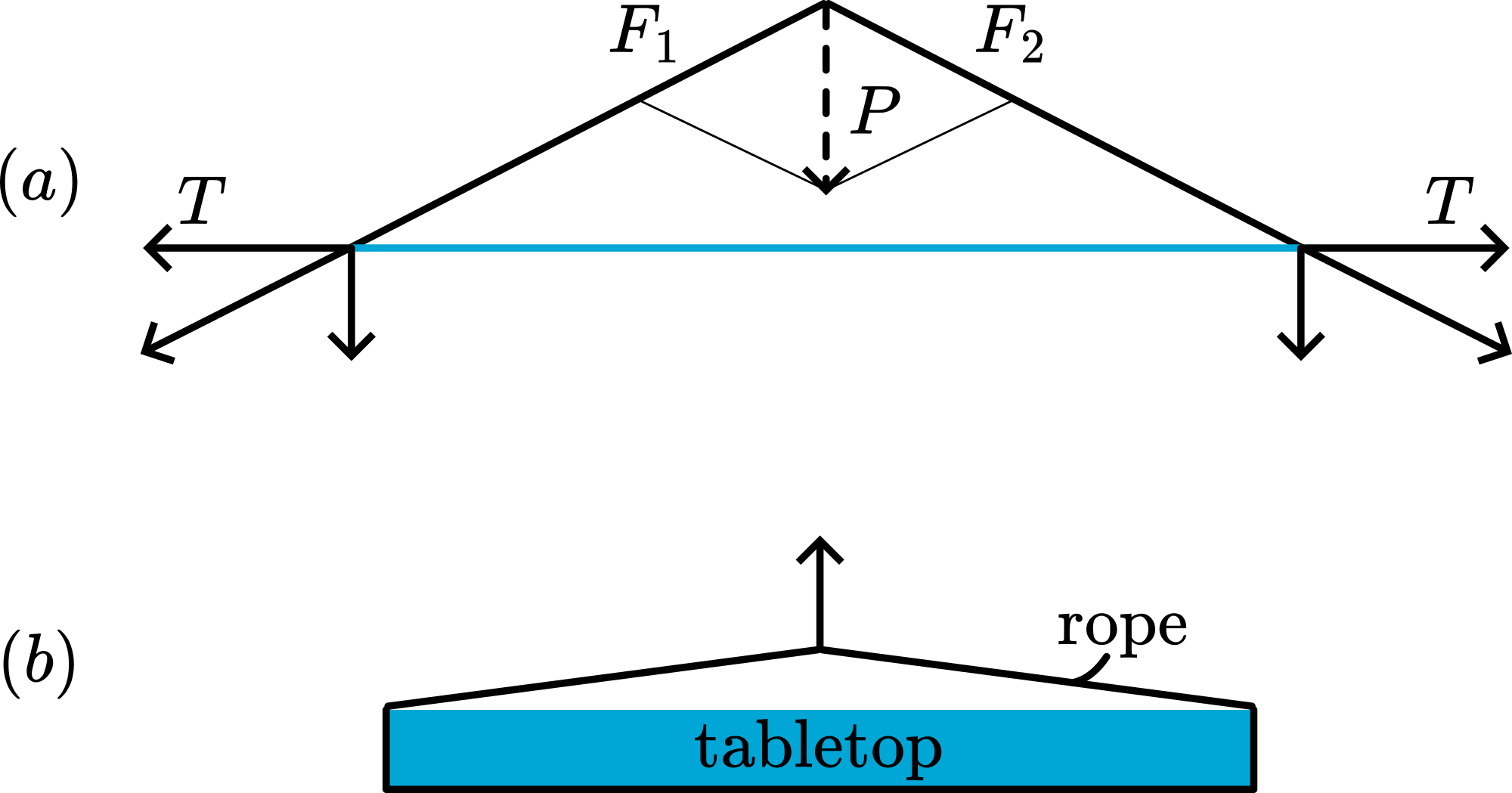
A piece of rope, that cannot be broken by hand, is tightly knotted around the top of a table (see Figure 3 B). A metal bar is stuck under it and when the bar is pulled upwards, the rope breaks easily.
Explanation
We consider the situations as being in equilibrium.
Equilibrium requires that there is resolution of force (see Figure 2). The students need a large force to cancel the small force of the professor.
In equilibrium the force downward should be in the direction of the bars ( and in Figure 3). The horizontal components of these forces give the tension in the thread. and are the components of force along the bars of the professor’s force . The more the bars are pressed downward, the higher the components and will be and the higher the tension in the thread.
The tension in the string due to the upward force is much higher than this upward force (construct the force-balance diagram to see this).
Remarks
There should be no knots in the nylon thread, so fixing this thread between the extremities of the bars needs to be done in a special way. We have chosen the solution shown in the detail-drawing in the Diagram.
Sources
Freier, George D. and Anderson, Frances J., A demonstration handbook for physics, pag. M-27
Sutton, Richard Manliffe, Demonstration experiments in Physics, pag. 20