Aim
The relationship between the coefficients of static- and kinetic friction explains why two fingers supporting the ends of a meterstick always meet at the center of mass of the stick.
Subjects
1K20 (Friction)
Diagram
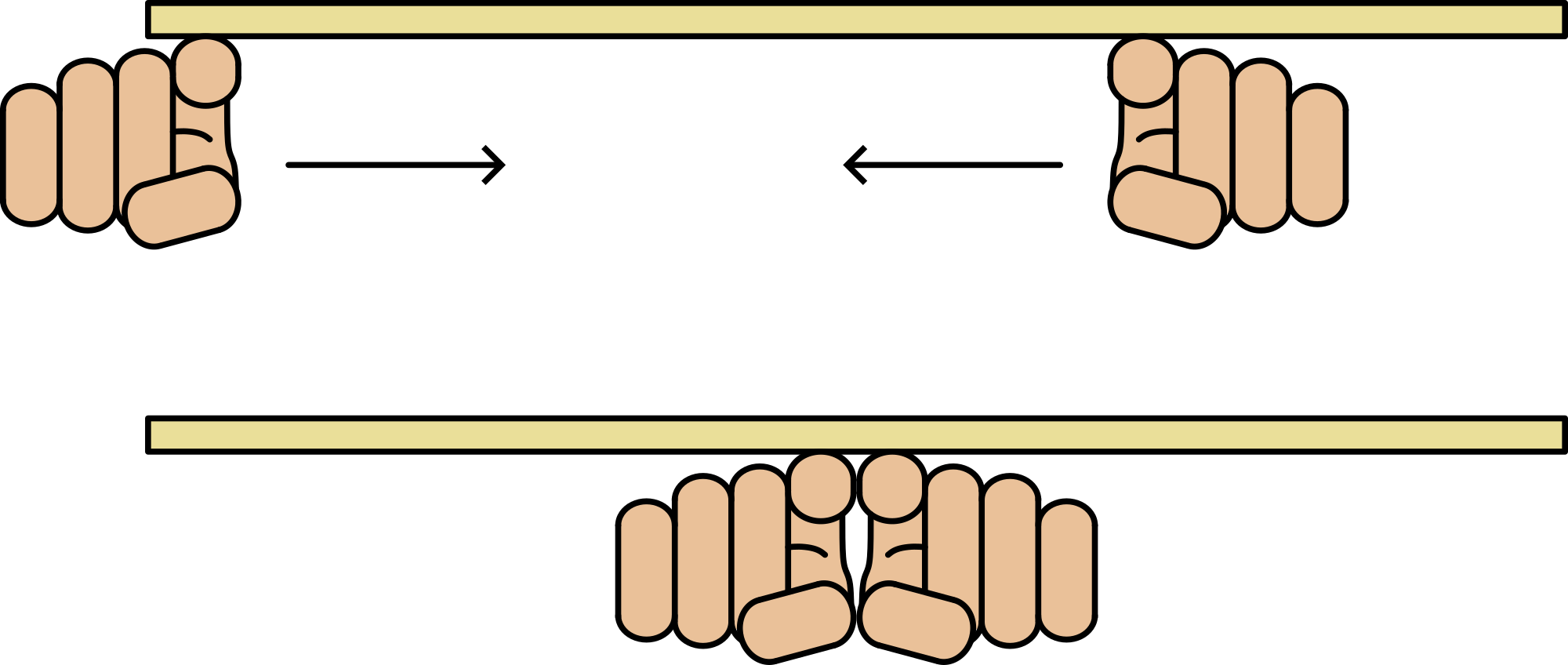
Equipment
Stick, wood, about , with hooks at the ends, a clearly marked centre and blockmarks every .
Small weight with ring.
Rubber glove or piece of rubber.
Presentation
Let the stick rest on your index fingers, so that these are symmetrically near the stick’ ends. Ask what will happen when the fingers are slowly brought together.
Show that the stick will not fall. The point where the fingers meet is the point that divides the stick into two equal parts (halves).
Now, lay the stick asymmetrically on the fingers and repeat the above. A similar result is obtained: the stick will not fall and the fingers will meet in the middle of the stick. The explanation (see below) using the term ‘friction’ is given.
Next, let us consider friction. Use one bare finger and one finger in a glove (or a piece of rubber as a finger). Repeat above procedure. The result remains the same, even under these circumstances.
As a last experiment the stick is made linearly inhomogeneous by hanging a weight on one end of the stick. Ask the same questions and perform the same experiment. The result is that the stick still won’t fall of the fingers but the place where the fingers meet is different this time. This part of the demonstration can also be done using a (large) broom.
Explanation
Initially, the stick exerts the same force on both fingers. Once the fingers start moving, the force on one finger becomes greater than on the other. The finger closest to the center of the stick experiences the larger force and therefore the greater friction.
As a result, the other finger is able to slide toward the center of the stick until the force on that finger becomes greater. At that point, the friction on the first finger becomes smaller, allowing it to move toward the center as well. This alternating process continues until both fingers meet beneath the center of the stick.
This behavior is independent of the initial positions of the fingers and also independent of the type of friction.
According to the second condition for equilibrium, the fractions of the meterstick’s weight resting on your two fingers, and , depend on the distances and to the centre, according to the relation . At the point where one finger stops moving and the other starts moving, the static-friction force of the fixed finger equals the kinetic-friction force of the moving finger: (see Figure 2).
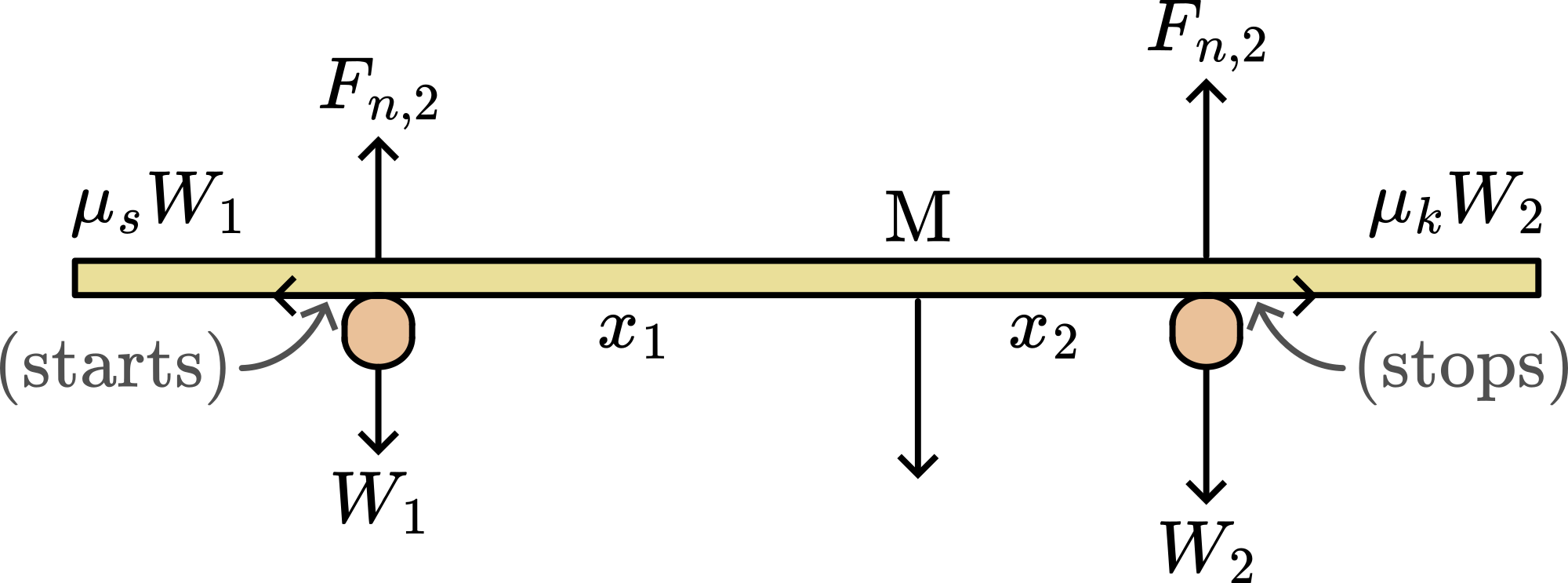
Combining these equations yields the condition . You can measure the values of and by observing where one finger stops sliding and the other starts. Hence, you can determine the ratio of the two friction coefficients using .
Remarks
You can extend the demonstration by suddenly accelerating one of your fingers. In that specific case the friction force each finger exerts on the stick need not be the same: using Newton’s second law we see that accelerations imply unbalanced forces.
Video Rhett Allain
Video embedded from https://
Sources
Ehrlich, Robert, Turning the World Inside Out and 174 Other Simple Physics Demonstrations, pag. 49
Taylor, Charles, Art and Science of Lecture Demonstration, pag. 47
Friedrich, Artur, Handbuch der experimentellen Schulphysik, part 2, Mechanik der festen Körper, pag. 130
Vlaanderen, C.L., Physics Fair
Borghouts, A.N., Inleiding in de Mechanica, pag. 61