Aim
To show the basic principle of an electric motor
Subjects
5K40 (Motors and Generators)
Diagram
Equipment
Bicycle with ac dynamo.
Transformer, ac output.
Disassembled dynamo.
Presentation
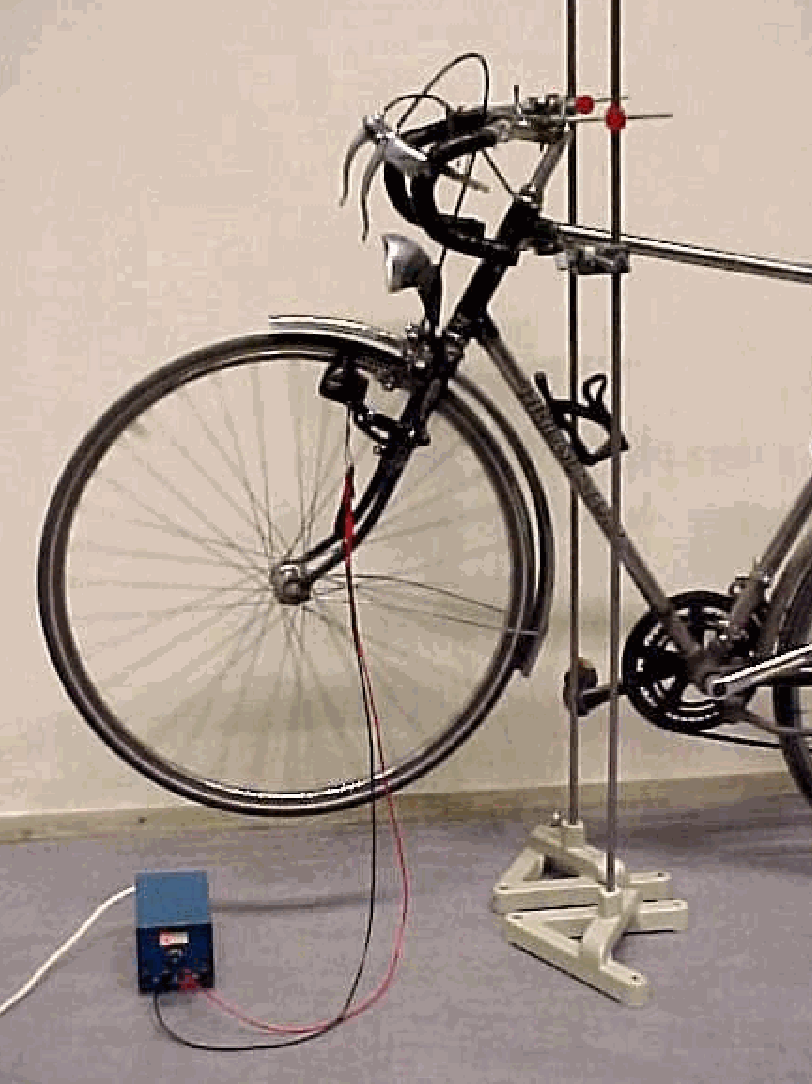
The bicycle has his front wheel lifted from the ground (see Diagram). The dynamo is pressed against the rim of the front wheel-tire. The ac output of the transformer is connected to the dynamo and switched on. Now the dynamo is shaking and makes a humming sound.
When the front wheel is given a turn by hand, the wheel will continue turning, driven by the dynamo. The dynamo is working as an electric motor now. When the wheel is loaded (braking it lightly by means of your hand on the tire) then the wheel stops abruptly and the dynamo shakes and hums again.
When you give the wheel a push into the other direction the dynamo will also drive the wheel into that direction.
Explanation
Inside the dynamo we find a static coil and a rotating permanent ceramic magnet. The ceramic magnet has 8 poles and turns inside the coil (see Figure 2 and a disassembled dynamo).
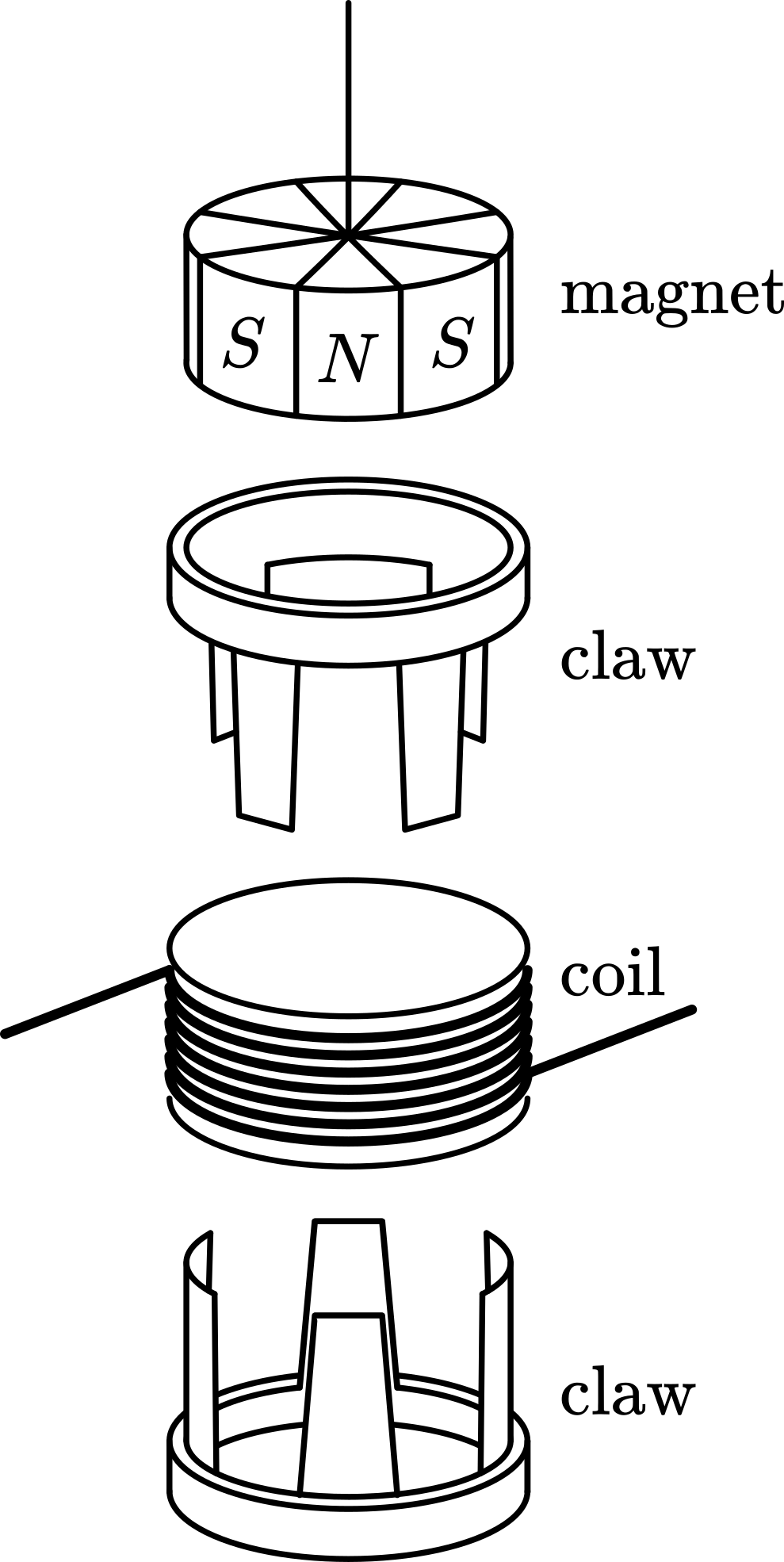
Using two claw rings, whose claws fit inside the coil, magnetic north and south poles are effectively created perpendicular to the coil. Rotating the magnet causes the positions of the north and south poles to switch. This rotation also induces an electromotive force (emf) in the coil.
When an alternating current from a power supply flows through the coil, the claws continuously reverse their north–south polarity, alternately attracting and repelling the poles of the ceramic magnet. If the magnet reaches the appropriate rotational speed, its motion in one direction will continue (see Figure 3 A).
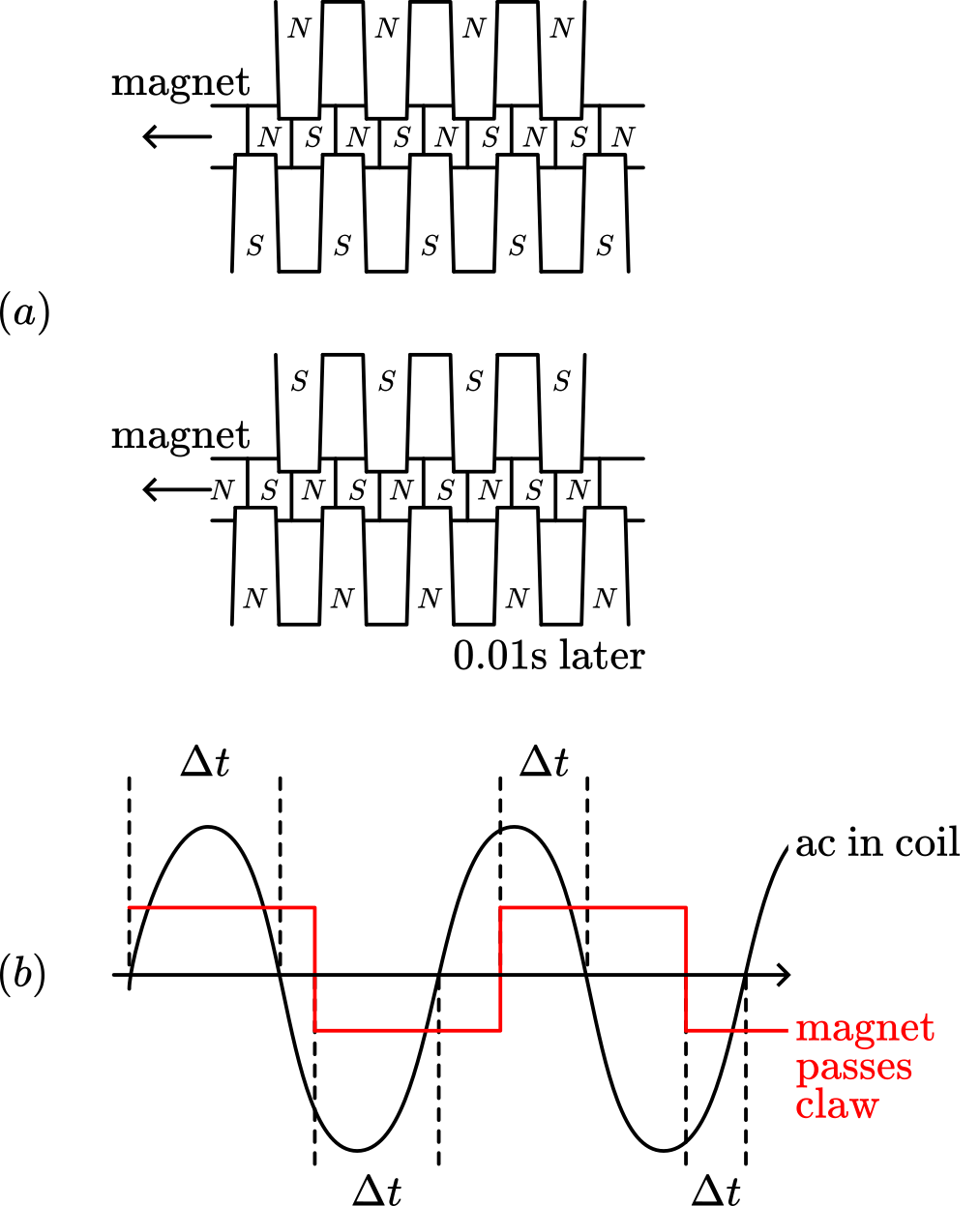
When the magnet is too slow just a little bit the driving momentum, on the magnet becomes smaller and smaller, because becomes smaller and smaller and the magnet will stop (see Figure 3 B).
The magnet cannot start turning by itself because its rotational inertia is too high to pick up the right speed within . When standing still the magnet is repelled and then attracted and so on, so it will make a vibrating movement.
The rotational speed of the magnet is directly related to the ac frequency of the power supply. (This is why this type of motor is called a synchronous motor.) We have , so every . the claws switch polarity. With 8 poles in the magnet, the magnet will make a full turn in . This is in 4 cycles of the ac-current. So the magnet will turn round with a frequency of . The diameter of the dynamo’s wheel will determine how fast the frontwheel of the bicycle will go round.
Video Rhett Allain
See 9:59 minutes
Video embedded from https://
Sources
Mansfield, M and O’Sullivan, C., Understanding physics, pag. 495-496
Sutton, Richard Manliffe, Demonstration experiments in Physics, pag. 348