Aim
To show how a rotating rugby ball lifts itself
Subjects
1Q60 (Rotational Stability)
Diagram
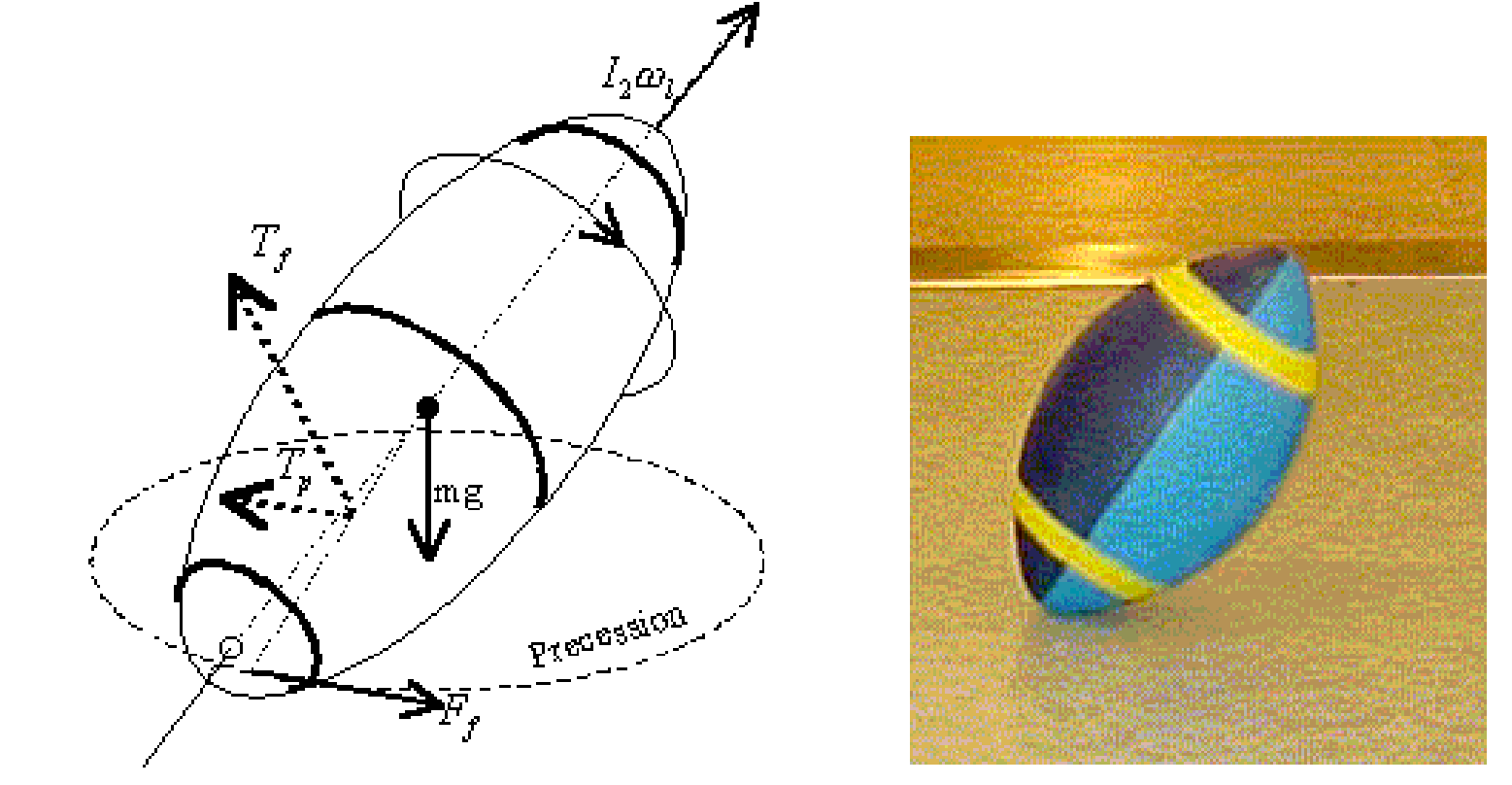
Equipment
Rugby ball
Presentation
The rugby ball lies on the floor. By hand it is given a fast spin around its short axis (see Figure 2).
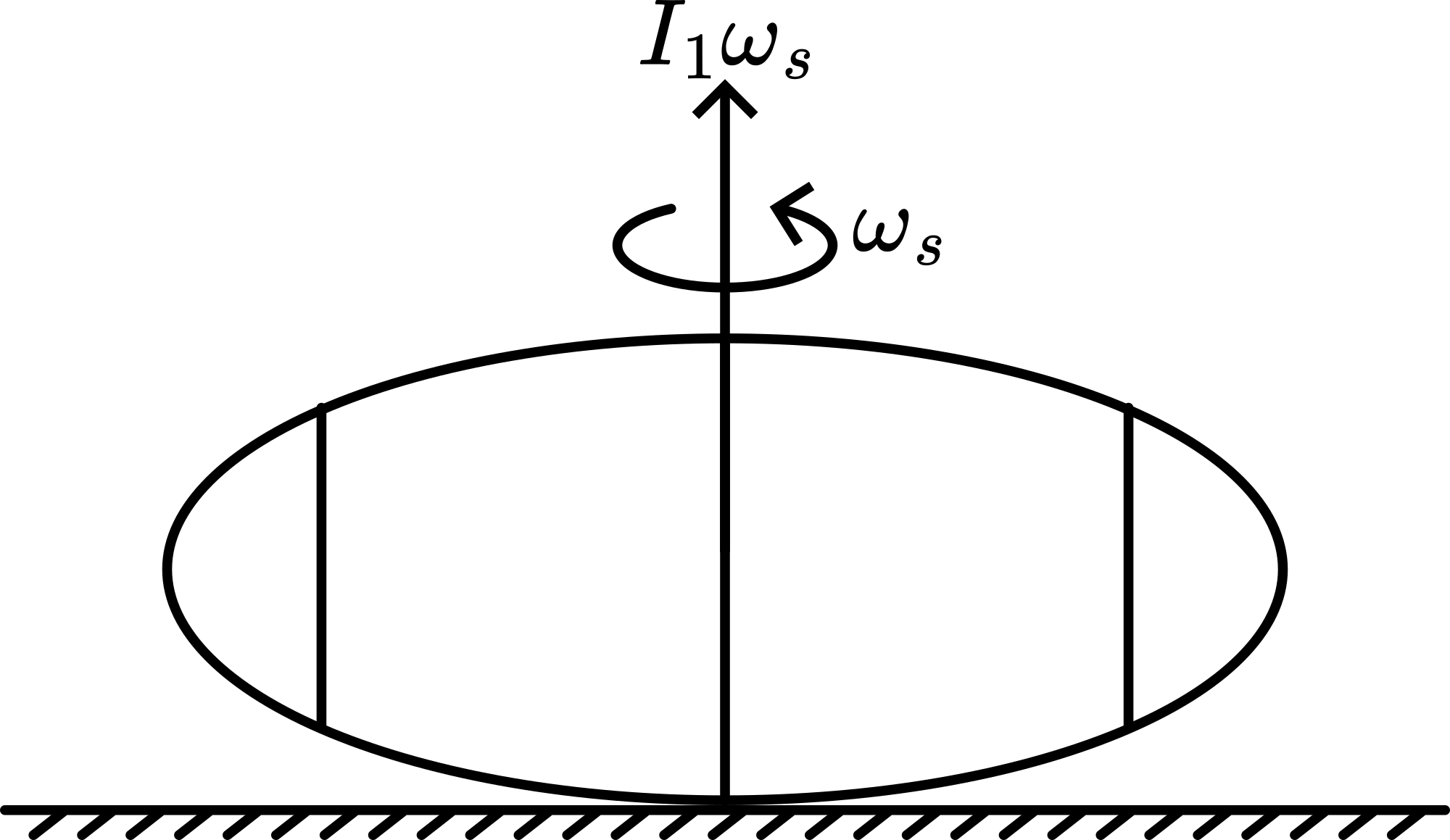
When the ball has made some turns it lifts itself, finally standing on its nose (tail) and rotating around its long axis.
Explanation
When the ball turns around its short axis ( ) it will tilt its long axis a little due to unbalanced mass distribution. Then spinning around its long axis will start (see Figure 3) and at the same time, the long axis starts a precession ( moves into the direction of ).
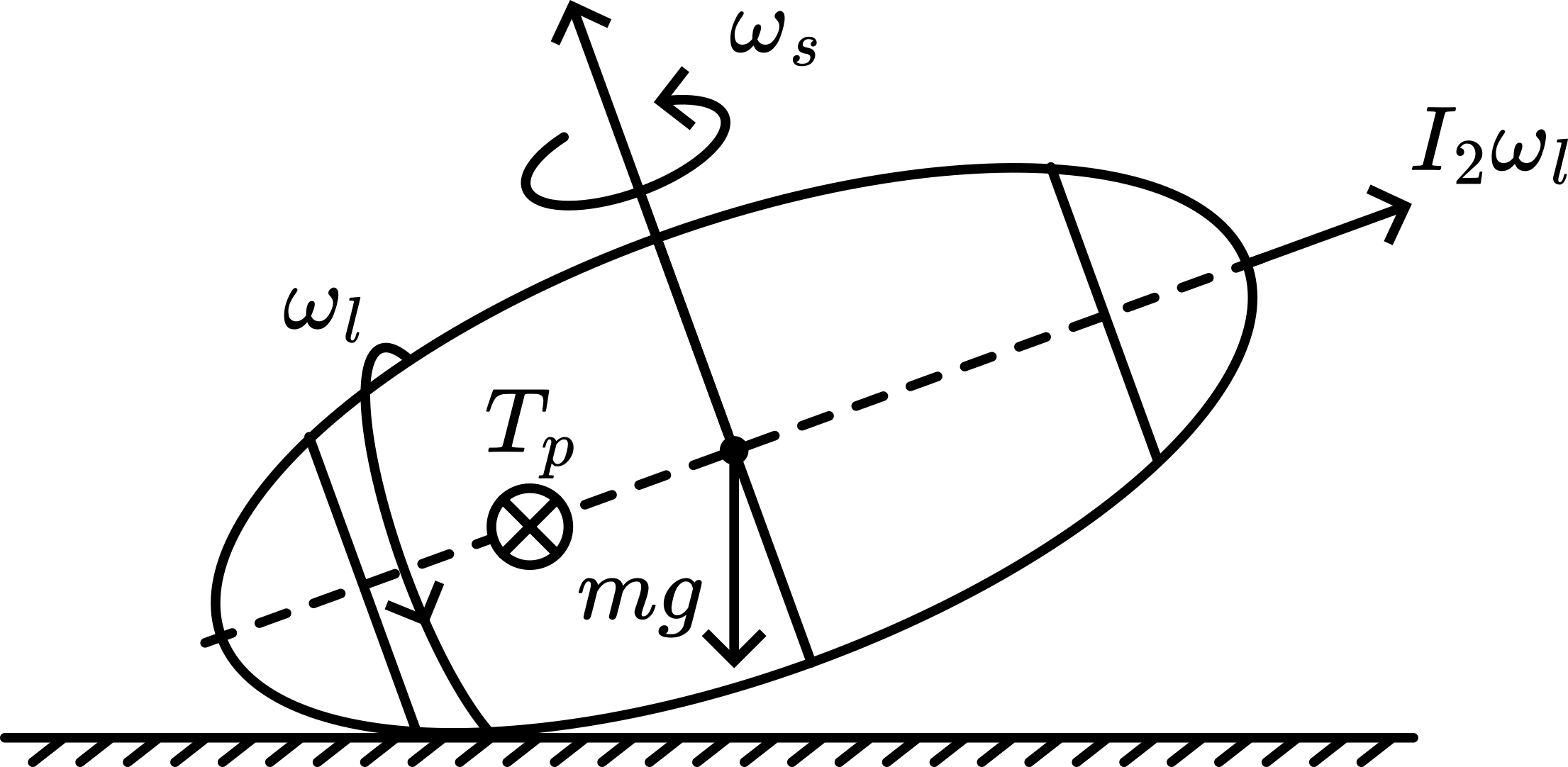
The point of contact slips on the floor (see Diagram). The friction force on the ball is pointing in the same direction as its direction of precession. The torque ( ) of this friction force is pointing upward (see Diagram), almost perpendicular to . So the friction force gives a torque that erects the ball ( moves into the direction of ).
See also the demonstrations Precession 3a and Precession 3b in this database where it is shown how a precessing object reacts to an applied torque.
Remarks
Friction between ball and floor must be high enough to make this demonstration successful.
This demonstration can also be done with a hardboiled egg. Doing it on my kitchen table, the angular speed of the egg must be quite high to reach the lifting effect.
Sources
Borghouts, A.N., Inleiding in de Mechanica, pag. 230-231
Friedrich, Artur, Handbuch der experimentellen Schulphysik, part 2, Mechanik der festen Körper, pag. 233-235
Roest, R., Inleiding Mechanica, pag. 230-231